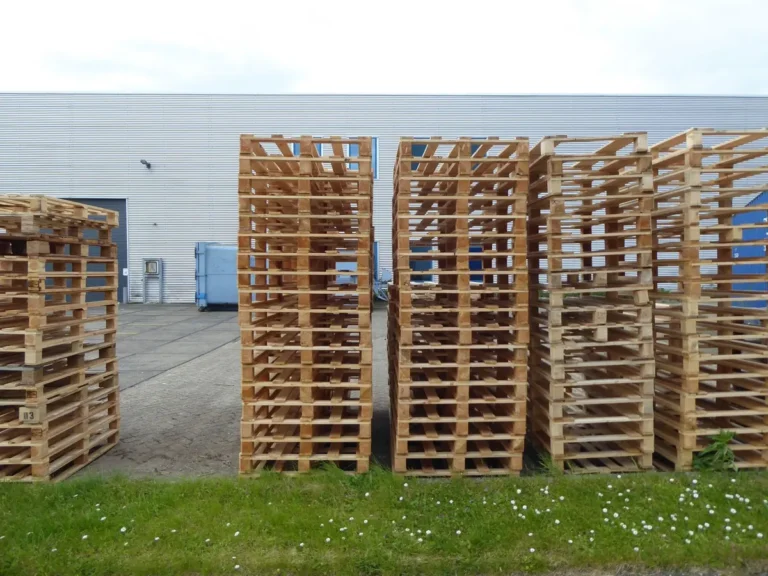
Most furniture and building material shipments from China travel on wooden pallets, in crates or with wooden dunnage. ISPM 15, the International Standard for Phytosanitary Measures on wood packaging material in international trade, sets one internationally recognised measure for that wood: it must be made from debarked wood, treated by an approved treatment and carry a mark. The standard applies to the wood packaging, not to the furniture or building product packed in it.
This article reads the ISPM 15 text (FAO 2018 edition published by the IPPC Secretariat) and the United States rule that applies it, 7 CFR 319.40-3 (eCFR), both read on 11 October 2026. We have not read the wood packaging rules of Australia, Canada or the EU in their own original texts, so check the importing authority for any destination other than the United States. This is a reading of the published texts for procurement planning, not legal advice. For related topics, see our guides to timber legality documents for China wood products and the container loading report.
What the standard covers and what it exempts
The scope clause says the standard describes phytosanitary measures that reduce the risk of introduction and spread of quarantine pests associated with international trade in wood packaging material made from raw wood. It says the covered material includes dunnage but excludes wood packaging made from wood processed in such a way that it is free from pests, with plywood as the example.
Section 2 lists the forms covered: crates, boxes, packing cases, dunnage, pallets, cable drums and spools or reels. Section 2.1 lists the articles exempted as of sufficiently low risk:
- wood packaging material made entirely from thin wood (6 mm or less in thickness);
- wood packaging made wholly of processed wood material, such as plywood, particle board, oriented strand board or veneer created using glue, heat or pressure, or a combination of them;
- barrels for wine and spirit that have been heated during manufacture;
- gift boxes for wine, cigars and other commodities made from wood processed in a way that renders it free of pests;
- sawdust, wood shavings and wood wool;
- wood components permanently attached to freight vehicles and containers.
The text adds that not all types of gift boxes or barrels are constructed in a way that makes them pest free, so certain types may be within scope. A pallet made partly of solid wood and partly of processed board is a composite; Annex 2 says a composite unit is considered a single unit for marking purposes.
Treatment, debarking and the mark
The approved measures consist of the use of debarked wood and an approved treatment from Annex 1, with the mark from Annex 2. Section 3.1 says the application of the mark renders the use of a phytosanitary certificate unnecessary, because it indicates that the internationally accepted measures have been applied.
- Debarking (Annex 1): wood packaging material must be made of debarked wood. Small separate pieces of bark may remain if they are less than 3 cm in width, or, if wider than 3 cm, have an individual surface area of less than 50 square cm.
- Heat treatment, code HT (Annex 1): the fundamental requirement with a conventional heat chamber is a minimum temperature of 56 °C for a minimum of 30 continuous minutes throughout the entire profile of the wood, including its core.
- Treatment codes (Annex 2): HT heat treatment, DH dielectric heating, MB methyl bromide and SF sulphuryl fluoride.
- Authority (section 4.1): treatment and application of the mark must always be under the authority of the national plant protection organisation, and treatment should be carried out before the mark is applied.
The mark has four required components (Annex 2): the symbol, an ISO two-letter country code, a producer or treatment provider code assigned by the national plant protection organisation, and the treatment code. The same annex sets the following about how it is applied:
- the mark must be legible, durable and not transferable;
- it must be placed in a location visible when the wood packaging is in use, preferably on at least two opposite sides of the unit;
- it must not be hand drawn;
- red or orange should be avoided because those colours are used for dangerous goods labelling;
- no other information may be contained within the border of the mark;
- for dunnage, shippers should ensure that all dunnage used to secure or support commodities is treated and displays the mark, and small pieces that do not include all required elements should not be used.
Sourcing this for a commercial project?
FBM Sourcing manages the entire China procurement package for overseas construction projects. We work with Developers · General Contractors · Builders · Commercial Project Owners · Interior Design & Construction Companies · FF&E Solution Providers. Send your BOQ, drawings or product schedule for review.
Reuse, repair and remanufacture
Section 4.3 matters when a factory or a packer uses second-hand pallets. A unit that has been treated and marked and has not been repaired, remanufactured or otherwise altered does not require re-treatment or re-application of the mark throughout its service life. A unit that has had up to approximately one third of its components removed and replaced is repaired wood packaging, and only treated wood or processed wood material may be used for the repair, with each added treated component individually marked. A unit that has had more than approximately one third of its components replaced is remanufactured, and it must have previous marks permanently obliterated, be re-treated and be marked anew.
What the United States rule says
7 CFR 319.40-3(b) allows regulated wood packaging material, whether in use as packing for regulated or non-regulated articles or imported as cargo, to be imported under a general permit if the conditions are met. The two that concern a shipper are these.
- Treatment (paragraph (b)(1)): the wood packaging material must have been treated in accordance with part 305 of the chapter.
- Marking (paragraph (b)(2)): the material must be marked in a visible location on each article, preferably on at least two opposite sides, with a legible and permanent mark approved by the International Plant Protection Convention, including a unique graphic symbol, the ISO two-letter country code, a unique number assigned by the national plant protection agency to the producer, and an abbreviation of the treatment type, such as HT or MB.
Paragraph (b)(3) provides that an inspector at the port of first arrival may order the immediate reexport of regulated wood packaging material imported without the required mark. When we retrieved the section from the eCFR on 11 October 2026, its version list showed 2 November 2020 as the most recent amendment date, so check the eCFR for a later version before you rely on this reading.
What to put in a China purchase brief
The standard puts duties on national plant protection organisations and on producers and treatment providers. The following are questions a buyer can write into the brief so the packing is right before the container is loaded. Put each answer in writing and keep it with the order.
- Packing materials list: which pallets, crates, cases and dunnage are used for each product line, and which are solid wood and which are processed board.
- Mark on every solid wood unit: that every solid wood pallet, crate and dunnage piece will carry the mark, with the treatment code shown.
- Photographs: a photograph of the mark on a sample pallet and crate before loading, and photographs of the dunnage used to brace the load.
- Second-hand pallets: whether any reused or repaired pallets will be used and, if so, that they carry a single legible mark.
- Processed board alternatives: whether the packer offers pallets or crates made wholly from processed wood material, which the standard exempts, and whether the destination accepts them.
- Packing list: whether the packing list records the type of wood packaging used for each container.
Questions buyers ask about ISPM 15 wood packaging
Does ISPM 15 apply to the furniture itself?
No. The scope clause covers wood packaging material made from raw wood, such as pallets, crates, boxes and dunnage. Timber furniture and timber building products are not wood packaging material under the standard.
Are plywood pallets covered?
Section 2.1 exempts wood packaging made wholly of processed wood material, such as plywood, particle board, oriented strand board or veneer created using glue, heat or pressure. A pallet partly of solid wood is not wholly processed board.
What does the mark show?
Annex 2 requires a symbol, an ISO two-letter country code, a producer or treatment provider code assigned by the national plant protection organisation, and a treatment code such as HT, DH, MB or SF.
Is a phytosanitary certificate needed as well?
Section 3.1 says the application of the mark renders the use of a phytosanitary certificate unnecessary for the wood packaging material, because the mark indicates that the approved measures have been applied.
Where can I find the rules for Australia or the EU?
This article did not read them. Ask the importing authority or the customs broker for the current requirement, and put the answer in the brief.
How does FBM Sourcing support this kind of project?
We review the brief, collect comparable quotations and manage the package for the project. For suppliers you nominate, we charge a 5% commission; for products we source for you, we quote a direct price. Our own team performs one inspection after bulk production is complete and before shipment, and the client’s project team is welcome to attend.
FBM Sourcing manages the entire China procurement package for overseas construction projects. We work with Developers · General Contractors · Builders · Commercial Project Owners · Interior Design & Construction Companies · FF&E Solution Providers.