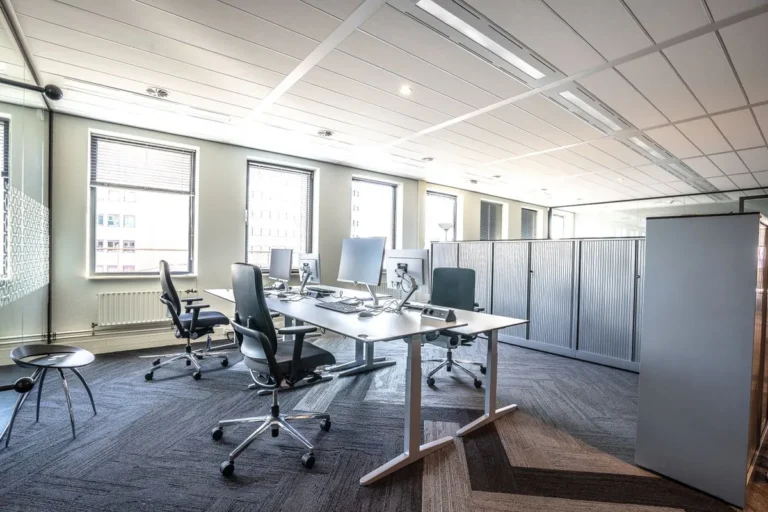
An office furniture brief that gets you an accurate China quote needs five things: a workstation schedule with quantities by floor, dimensional and modular constraints, a performance grade per seat and desk type, fabric and finish direction, and the delivery sequence the site can actually accept. Without those, a factory prices a generic assumption and the quotation you receive cannot be compared against any other — which is why two quotes for “150 workstations” routinely differ by a factor that has nothing to do with either factory’s efficiency.
This article sets out what belongs in an office furniture brief before you send it to China for pricing, what each field changes on the factory side, and which items are worth resolving before the RFQ rather than during production. It is the office-furniture companion to the same exercise for door hardware schedules, commercial lighting and hotel sanitaryware.
What Does a Factory Actually Need to Price Office Furniture?
- A schedule, not a total. “150 workstations” is not a quantity — a factory needs how many are 1200mm single-run benches, how many are 1400mm, how many carry a return, and how many sit at the ends of a bench where end panels and cable spines change. A schedule with 6–10 typed positions prices in one pass; a single total gets priced against the cheapest interpretation.
- Floor-by-floor quantities. The same 150 desks split across five floors is a different delivery, packing and labelling job than 150 on one floor. Floor breakdown drives carton labelling and the loading sequence, and it is the single field most often missing from a first-round brief.
- Fixed dimensional constraints. Lift car internal dimensions, stair widths, door leaf clear opening and slab-to-slab height decide whether a 2400mm meeting table ships assembled or as a knock-down top with separate legs. A factory cannot infer these and will assume the easier case.
- Performance grade per type. Task chairs, visitor chairs, executive chairs and collaboration stools sit at genuinely different price points because of gas lift cycle rating, base material and mechanism class — not because of appearance. Specify the grade, not the look.
- Whether the design is fixed or open. If you are working to an approved design package, say so and issue it. If the layout is still moving, say that too — a factory quoting an open brief will price conservatively, and you will read that as expensive.
What Should the Workstation Section Contain?
Workstations are usually the largest single line in an office furniture budget by value, so this section carries the most pricing risk. Six fields resolve most of it:
- Module and run length: the individual work surface width (1200 / 1400 / 1600mm are the common export modules) and how many positions per bench run. Non-standard widths are producible but change panel yield and therefore price.
- Worktop construction: board thickness, core type (particleboard, MDF, plywood), edge treatment (2mm PVC edge banding is the volume standard) and formaldehyde class. If your destination requires CARB Phase 2 / TSCA Title VI or E0/E1 board, state it in the brief rather than at sample stage — board is bought before production starts.
- Height adjustment: fixed height, crank, single-motor or dual-motor electric. Motor count, column stage count and the control unit are the cost drivers, and the power specification for the destination market has to be stated (motors are not universally rated).
- Leg and frame: steel gauge, powder coat versus anodised, and whether the frame is a proprietary factory profile or built to your drawing. A proprietary profile is cheaper and faster; a drawn profile needs tooling.
- Cable management: spine, tray, flip-top grommet, and whether power modules are supplied by the factory, by you, or by the electrical contractor on site. This is the most common scope gap in office furniture packages.
- Storage attached to the workstation: mobile pedestal (2-drawer, 3-drawer, filing), lockable or not, and lock keying — keyed alike, keyed different, or master keyed. Keying is a schedule field, not a detail.
How Should Seating Be Specified So Quotes Are Comparable?
Seating is where identical-looking quotations diverge most, because the visible shell tells you almost nothing about what has been costed underneath it. A comparable brief states, per chair type:
- Mechanism class — simple tilt, synchro-tilt, or multi-function with independent seat slide and back angle lock.
- Gas lift rating — cycle-tested class and stroke. Gas lift cylinders are a bought-in component with wide quality bands; specifying a test standard rather than a brand keeps the comparison fair and the shortlist open.
- Base and castor — nylon versus aluminium base, castor type for carpet or hard floor, and whether braked castors are needed.
- Foam — moulded versus cut foam, density, and the fire performance standard your destination requires. Fire performance for contract seating is a destination-specific requirement; see fire safety and compliance certificates for FF&E for how BS 7176, CAL 117 and AS/NZS 3744 differ.
- Upholstery — mesh, fabric or leather, with the abrasion resistance (Martindale or Wyzenbeek) and rub-count expectation for a contract environment rather than a domestic one. If you intend to supply your own fabric, say so in the brief — it changes both the price basis and the schedule.
- Warranty basis and spare parts — which components are covered, and whether replacement gas lifts, castors and mechanisms are quoted as a spares allowance with the order. Spares are far cheaper shipped with the main consignment than sourced individually two years later.
Sourcing office furniture for a commercial fit-out?
FBM Sourcing works with project owners, developers, main contractors and FF&E contractors on commercial building projects. Send us your layout and whatever schedule exists — our team will review it and get back to you.
What Belongs in the Storage, Meeting and Reception Sections?
- Storage: height in tiers rather than millimetres alone (a “3-tier” cabinet is understood across factories), door type (hinged, sliding, tambour), back panel thickness, adjustable shelf pitch, and whether units are floor-standing, under-bench or wall-hung. Under-bench units must be checked against the workstation frame — the two are often drawn by different people.
- Meeting tables: shape, seating capacity, top construction, base type, and critically whether power and data modules are cut into the top by the factory. If they are, the module make and cut-out dimensions must be in the brief; if they are not, say the top ships solid.
- Reception and bespoke joinery: reception desks, feature walls and bespoke counters are millwork, not furniture, and are priced from drawings rather than a schedule. Keep them in a separate section of the brief — mixing bespoke joinery into a furniture schedule is the most common reason a quotation comes back with an unexplained lump sum. See vetting custom millwork factories for what changes when an item moves into that category.
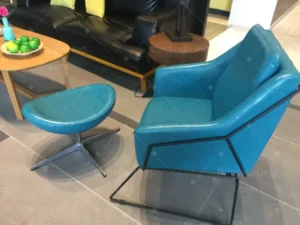
- Soft seating and breakout: sofa and lounge items carry frame, foam and fabric variables closer to hotel FF&E than to office furniture, and are usually made by different factories. Listing them separately makes it easier to consolidate them properly rather than forcing one supplier to subcontract.
Which Commercial and Logistics Fields Change the Quotation?
- Destination port and Incoterm. A quote to FOB and a quote to CIF are different numbers for the same furniture; state which you want so the comparison is like-for-like.
- Target programme, not a required date. Give the site handover window and the fit-out sequence. A factory can plan production against a window; it cannot commit to a fixed calendar date before order confirmation, and a brief that demands one gets padded lead times in response.
- Delivery split. Whether the whole package ships in one consignment or in phases by floor. Phased delivery is normal on multi-floor fit-outs and needs to be in the brief because it changes packing, marking and container planning.
- Packing standard. Export carton with corner protection is standard; if you need palletised delivery, labelled per floor or per room, or additional protection for a long inland leg after the port, specify it.
- Sample requirement. Whether you want a pre-production sample of the chair and a workstation mock-up, and who bears sample and freight cost. See who pays for samples, moulds and tooling for how this is normally handled.
- Order structure. Office furniture packages are shipped as full containers, consolidated across factories where the package spans seating, storage and millwork. Knowing this at brief stage lets quantities be planned to fill containers efficiently rather than discovering a part-filled container after pricing.
What Can You Leave Out of the First Round?
A brief that tries to answer everything delays the quotation. Four things can safely wait:
- Final fabric colourway — the grade and abrasion class affect price; the colour usually does not, provided it sits within the same fabric book.
- Exact laminate decor codes — state the finish family (melamine, HPL, veneer) and resolve the decor at sample approval. See melamine vs PVC vs lacquer for how the families differ in cost and durability.
- Branding and logo application — useful to flag as a requirement, but the artwork itself is not needed to price.
- Installation scope — whether local installation is by your contractor is a commercial matter that does not change the factory price, though it does change how you want the goods packed and labelled.
Workstations are the part of an office brief that most often has to be re-quoted, because a benching run is priced as a system rather than as loose desks. For the verified listed makers, the manufacturer types behind the rest of the package and the standards a specification should name, see our list of office workstation and cubicle manufacturers in China.
A Brief Checklist You Can Send As-Is
- Project type, location, destination port, and whether the design package is approved or still developing
- Workstation schedule: type, module width, quantity, floor
- Worktop: thickness, core, edge, formaldehyde class
- Height adjustment: fixed / crank / single or dual motor, destination power specification
- Seating schedule by type with mechanism, gas lift rating, base, foam and upholstery grade
- Storage schedule with tiers, door type, keying instruction
- Meeting tables with capacity and power module treatment
- Bespoke joinery listed separately with drawings
- Fire and emissions standards required at destination
- Programme window, phasing by floor, packing and labelling requirement
- Incoterm, sample expectation, and any warranty or spares requirement
Anything in that list you cannot answer is worth marking “to be confirmed” rather than omitting — a factory reading an explicit TBC prices a range and flags it, while a factory reading silence prices an assumption you never see. If you want the brief structured for you, send whatever you already have — a layout plan, an FF&E schedule, or even a furniture list from a previous project — and our team will review it and get back to you.
About FBM Sourcing
FBM Sourcing manages the entire China procurement package for overseas construction projects. We act as a China-based sourcing partner to project owners, developers, main contractors and FF&E contractors — your eyes and your representative in China — covering sourcing, factory selection, pre-shipment quality control, consolidation and shipping documentation. For suppliers you nominate, we charge a 5% commission; for products we source for you, we quote a direct price. We ship by full container, consolidating across factories — never less-than-container-load. You can see how the wider service is structured on our China building materials and FF&E procurement page.
If you have an office fit-out coming up, send us the layout and whatever schedule exists — use the quote button above or WhatsApp +86 135 6007 5057.
FBM Furniture
If your package is mainly office furniture, see office furniture on fbmfurniture.com, the site of FBM Furniture, the furniture sourcing line of FBM Sourcing Limited.