
When you order modern Chinese furniture for a hotel or office project, your specification package needs to cover three things: a dimensioned drawing set with material and finish call-outs, documented compliance with the formaldehyde-emission and fire-safety standards that apply in your destination market (CARB Phase 2 / TSCA Title VI for engineered wood, CAL 117 for upholstery foam sold into the US, the REACH formaldehyde limit for EU projects), and a signed pre-production sample before the factory cuts a full run. Chinese contract manufacturers can reproduce almost any contemporary, Western-facing design in engineered wood, veneer, metal-frame or upholstered form — how cleanly that happens depends on how completely your spec sheet removes guesswork before tooling starts.
What Does “Modern Chinese Furniture” Actually Mean in Commercial Manufacturing?
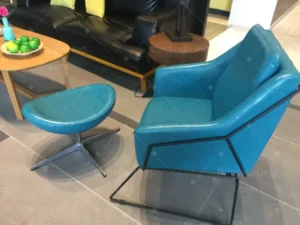
In the contract furniture trade, “modern Chinese furniture” and “Chinese contemporary furniture” usually describe the same thing: pieces manufactured in China’s furniture clusters — Foshan and Dongguan chief among them — to an international contract-grade design language, not to a regional or traditional Chinese aesthetic. Design cues that recur across hotel and office ranges include clean rectilinear silhouettes, low, grounded case-good profiles, mixed-material construction, and restrained ornamentation, with any reference to traditional joinery lines kept simplified rather than literal. It is a manufacturing capability, not a single fixed look — the same factories that run these programs can also produce Scandinavian-influenced, mid-century or fully custom hotel-brand-standard designs from the same equipment and material base.
Foshan and Dongguan tend to specialize differently within the same broad capability: Foshan clusters run heavier on case-good and casegoods-adjacent metal production, while Dongguan and the wider Pearl River Delta carry more of the upholstered seating and soft-furniture capacity. A single hotel or office project usually draws on more than one cluster once desks, wardrobes, lounge seating and dining chairs are all in scope, which is one reason a spec package that reads consistently across categories matters more than which single factory produces it.
Materially, three families cover most of what shows up in a modern Chinese furniture program. Case goods (desks, credenzas, wardrobes, headboards, reception units) are typically built on an engineered wood core — MDF, particleboard or plywood — faced in either real wood veneer or a decorative laminate, a decision covered in more depth in our solid wood vs. engineered wood comparison. Frame and leg components on lounge and dining pieces are commonly powder-coated or electroplated metal, chosen for dimensional consistency across large order quantities. Seating and soft-furniture elements are built up from a foam core — specified by density and firmness — wrapped in commercial-grade fabric, vinyl or a leather-look material; we go into fabric versus vinyl trade-offs in our contract-grade upholstery fabric guide.
What Should Go Into Your Spec Sheet and Drawing Package So a Factory Can Quote and Produce Accurately?
A Chinese factory can only price and build to the tolerance you need if the drawing package removes ambiguity before the first cutting list is issued. For a modern Chinese furniture program, that package typically needs to include:
- Dimensioned technical drawings — plan, elevation and section views with overall and component tolerances, not a rendering alone.
- A finish schedule — veneer species or laminate/paint reference code, sheen level, and edge-profile detail for every visible surface.
- Substrate and core specification — which components are solid wood, engineered wood core, or metal, and to what grade.
- A hardware and fixings schedule — hinge, glide, connector and lock specifications, since these drive both cost and long-term durability.
- An upholstery specification — fabric or vinyl grade, foam density, and the fire-retardant standard that applies in the destination market, plus any customer’s-own-material (COM) allowance.
Whether a factory builds strictly to your drawings (OEM) or adapts one of its own platforms to your finish and dimension requirements (ODM) changes both lead time and minimum order quantity — we cover that distinction in our OEM vs. ODM custom furniture guide. Either way, the more complete the package on day one, the fewer revision rounds happen after tooling is already committed.
Which Material and Finish Standards Actually Matter for Commercial Buyers?
For engineered wood components, US-bound projects should ask for compliance with CARB Phase 2 and TSCA Title VI formaldehyde-emission limits, which apply to composite wood cores in case goods and cabinetry. For EU projects, REACH Annex XVII entry 77 (Regulation (EU) 2023/1464) bars placing on the market, after 6 August 2026, furniture and wood-based articles that release more than 0.062 mg/m³ of formaldehyde under the test conditions set in that regulation; EN 717-1 remains a current European chamber method for wood-based panels, but the regulation does not name it as the legal test. Where a project face is real wood veneer rather than laminate, the choice affects both cost and maintenance profile over the life of the asset — our HPL laminate vs. wood veneer comparison walks through when each makes sense for hotel case goods.
On the upholstery side, foam and cover-fabric fire performance is governed by whichever market the furniture ships into. For US projects, California’s TB 117-2013 (commonly shortened to CAL 117) sets smolder-resistance requirements for cover fabric and fill material in commercial seating, and 16 CFR Part 1640 has made it the US federal flammability standard for upholstered furniture since 25 June 2021. Commercial seating durability — cycle testing on frames, arms and mechanisms — is typically benchmarked against the ANSI/BIFMA X5 series, the standard framework US contract furniture buyers use to compare load and fatigue performance across manufacturers. None of these standards are optional add-ons; they are what a factory tests to when it already runs export programs, and asking for the test report up front is a normal part of vetting a supplier, not an unusual request.
Sourcing this for a commercial project?
FBM Sourcing works with project owners, developers, main contractors and FF&E contractors on hotel, apartment, school, office and other commercial building projects. Send us your BOQ, drawings or product list — our team will review it and get back to you.
How Does FBM Sourcing Handle Sample Approval Before Full Production?
Full production on a custom or semi-custom modern Chinese furniture range only starts after a pre-production sample has been reviewed and signed off. In practice this means the factory builds one representative unit of each SKU (or each finish variant on a shared platform) to the exact drawing package, and that sample is checked against dimensions, finish match, hardware function and, where relevant, upholstery fire-rating documentation before cutting lists for the full order are released. This step is what catches a veneer grain mismatch, an undersized drawer glide or a foam density that reads softer than specified — problems that are cheap to fix on one sample and expensive to fix across a container of finished pieces. We walk through the full sequence, including QC touchpoints and how it feeds into shipping, in our guide to the furniture sourcing agent sample, QC and shipping process.
A first-round sample is produced once materials and finishes are confirmed, with timing confirmed by the factory, and any revision round adds further time on top of that. Once the sample is approved, it is common practice to request a small allowance of spare parts and touch-up materials — hardware, matching finish or fabric offcuts, in a quantity agreed at order stage — packed alongside the shipment, so minor transit damage or an on-site adjustment does not require reordering from China months later.
FBM Sourcing manages the entire China procurement package for overseas construction projects. On a modern Chinese furniture program that means coordinating the drawing package, the factory quote, the sample round and the production schedule as one process rather than a set of separate hand-offs between buyer, factory and freight forwarder. All quotations, invoices and shipping documents are issued by FBM Sourcing — you deal with us, and we carry the responsibility. For suppliers you nominate, we charge a 5% commission; for products we source for you, we quote a direct price.
Container Loading and MOQ for a Modern Furniture Program
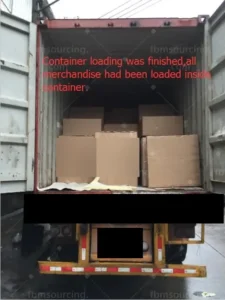
Modern Chinese furniture for hotel and office projects is ordered by the full container, and how those containers get filled depends on the scale of the order relative to a single SKU run. Sometimes, on a large project, the modern Chinese furniture pieces alone fill full containers; sometimes the modern Chinese furniture pieces share containers with the other product categories of the same project; and sometimes, in one batch, we combine a dozen or more product categories from several projects of the same client into a few containers — always full containers, and for us this is routine, well-practised work. How much of a mid-size hotel guest-room or corporate office floor package fits in one 40HQ container depends on how the pieces knock down for transit and is set in the load plan once packing and dunnage are accounted for.
Do You Need a Furniture Sourcing Agent, or Can You Order Direct From a Factory?
A developer or contractor with an in-house procurement team and an existing factory relationship can order modern Chinese furniture direct, provided someone on their side is prepared to manage drawing revisions, sample rounds, QC and container logistics across what is usually more than one factory once case goods, seating and metal components are all in scope. Where that capacity does not exist in-house, a furniture sourcing agent — or sourcing partner, to use the broader term — sits between the buyer and the factory floor to carry that coordination load: consolidating the spec package, running sample approval, and combining shipments across product categories into full containers. For a hotel or office project ordering across multiple furniture categories at once, that coordination is usually where the time gets spent, more than in any single factory’s production schedule.
FBM Furniture
If your package is mainly office furniture, see office furniture on fbmfurniture.com, the site of FBM Furniture, the furniture sourcing line of FBM Sourcing Limited.
Frequently Asked Questions
Is modern Chinese furniture the same as traditional Chinese furniture?
No. Modern Chinese furniture and Chinese contemporary furniture describe pieces manufactured in China to an international contract-grade design language — clean lines, mixed materials, restrained ornamentation — rather than to a regional or classical Chinese aesthetic. The same factories can typically also produce traditional-style ranges; it comes down to the drawing package, not a fixed factory specialty.
Does Chinese-made contract furniture meet CARB Phase 2 and TSCA Title VI requirements?
Factories that regularly export engineered wood furniture to the US generally test and certify their composite wood components against CARB Phase 2 and TSCA Title VI formaldehyde-emission limits, but this should always be confirmed with a test report for the specific substrate used on your order rather than assumed from the factory’s general export history.
How long does sample approval usually take before full production starts?
Timing varies with how many finish variants and SKUs are involved, but a pre-production sample round is a distinct step that has to close out — with sign-off on dimensions, finish and hardware — before the factory releases cutting lists for the full order.
Can a Chinese factory match an existing hotel brand’s design standard?
Yes, provided the brand standard is translated into a full drawing and finish package rather than reference photos alone; this is typically handled as an OEM build against your exact drawings, or an ODM adaptation of a factory’s existing platform to your finish and dimension callouts.
What certification should I ask for on upholstered seating going to a US hotel project?
Ask for test documentation showing the cover fabric and fill material meet CAL 117 smolder-resistance requirements, and where the seating is structural or high-cycle (lobby, dining, reception), ask whether the frame and mechanism have been tested against the relevant ANSI/BIFMA X5 category for commercial use.