A manufacturing sourcing agent is a China sourcing partner that buys building products directly from the factories that actually run the production line for each product — not from trading companies, wholesale markets or catalog resellers. The agent works on the buyer’s side of the table: it matches every item on a project’s product list to the right type of factory, verifies that the factory genuinely manufactures that product, and then manages sampling, production, in-factory quality control and full-container shipping under one accountable contract. The result is factory-direct procurement: factory-level control, without the buyer having to build a China supply chain of their own.
FBM Sourcing manages the entire China procurement package for overseas construction projects. This article explains what a manufacturing sourcing agent actually does for developers, main contractors and FF&E contractors, why building products in China are organized around single-category production lines, and how the factory-direct procurement process works from drawings to loaded containers.
What Does a Manufacturing Sourcing Agent Actually Do?
The defining feature of a manufacturing sourcing agent is who it answers to. It does not own a factory or hold stock. It is engaged and paid by the buyer, which means the sourcing agent works only for you — its job is to get your project the right factory, the right specification and the right price, and to stand behind the order after it is placed.
In practice, a building material sourcing agent does five things a project team cannot easily do from overseas:
- Factory matching by production line — knowing which type of factory actually manufactures each product category, and in which industrial cluster those factories sit.
- Factory verification — confirming, on site and through China’s public corporate records, that a company genuinely runs the production line it claims, before any money moves.
- Specification control — turning drawings, BOQs and finish schedules into factory-ready specifications, and freezing them through approved samples.
- In-factory quality control — inspecting during and after production, inside the factory, before goods are packed.
- Consolidation and export — combining many product categories into full containers under one set of shipping documents.
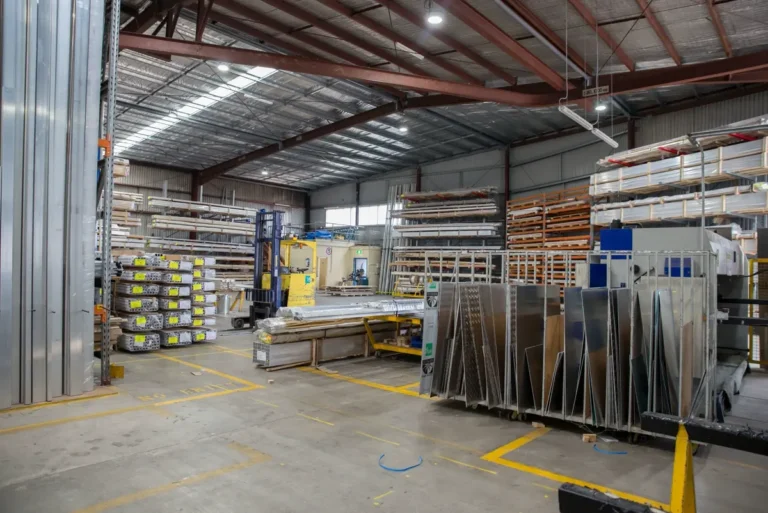
China’s building products industry makes this role necessary. Manufacturing is concentrated in single-category industrial clusters — a city or district where hundreds of factories make one product type and almost nothing else — so a commercial project sourcing fifteen product categories is, in reality, dealing with fifteen different production ecosystems. That structure is why one factory type per product category is the rule, not the exception, in Chinese building materials manufacturing.
Why Does Each Building Product Need a Different Factory?
Because the production processes have nothing in common. A factory is its production line: the machinery, the tooling, the workforce skills and the material supply chain are all built around one manufacturing process, and a genuinely different process means a genuinely different factory.
FBM Sourcing applies this as a fixed sourcing principle: for every product category, we buy only from a source factory that actually runs that production line. A bathroom package is the clearest illustration. Bathroom accessories, faucets, ceramic toilets, basins and bathtubs are normally five separate production lines run by five different types of factory: accessories are stamped, welded and polished metalwork; faucets are brass casting, machining and plating, made to standards such as EN 817 or ASME A112.18.1; toilets and basins are vitreous china fired in kilns, covered by EN 997 for WC pans and EN 14688 for wash basins; and bathtubs are thermoformed acrylic sheet with reinforcement. No single factory runs all five processes.
A company that offers all five categories from one address is therefore manufacturing at most one of them and reselling the other four — which is exactly the model behind the one-stop building material supplier: convenient, but with reseller margins and second-hand quality control on most of the catalog. A manufacturing sourcing agent gives a project the same single point of contact while buying each category factory-direct from its own source.
Sourcing this for a commercial project?
FBM Sourcing works with project owners, developers, main contractors and FF&E contractors on hotel, apartment, school, office and other commercial building projects. Send us your BOQ, drawings or product list — our team will review it and get back to you.
How Factory-Direct Procurement Works, Step by Step
Factory-direct procurement through a manufacturing sourcing agent follows a fixed sequence:
- 1. Requirements and drawings — BOQ, drawings and finish schedules become factory-ready specifications.
- 2. Factory matching and verification — each category is matched to a source factory running that production line, verified on site and against public records.
- 3. Sampling and approval — physical samples freeze the specification before any bulk order.
- 4. Order, production and in-factory QC — inspection by our own team at the factory, as one inspection once bulk production is finished, before shipment.
- 5. Consolidation and full-container shipping — all categories exported together under one set of documents.
Step 1: Requirements and drawings
The process starts with whatever the project already has: a BOQ, architectural drawings, a door or sanitary schedule, or simply a product list with quantities and a destination port. The agent’s first job is translation in the engineering sense — turning project documents into specifications a factory can price and produce: dimensions in millimetres, materials and finishes, applicable standards for the destination market (for example AS 2047 for windows on Australian projects, or EN 12150 for tempered safety glass), and packing requirements for ocean freight.
Step 2: Factory matching and verification
Each product category is then matched to factories that actually run that production line, in the industrial cluster where that category is made. Before any factory enters the project, FBM Sourcing verifies it in both directions: our own team visits the factory to confirm the production line for that exact product is installed and running, and we cross-check the claimed factory site against China’s public corporate registry — the registered legal entity, its business scope, its filings and its social-insurance workforce records must all match a manufacturing operation of the claimed scale. A trading company can rent a showroom and print a brochure; it cannot fake a kiln, a plating line or a workforce of one hundred and fifty machine operators in the public record. This verification is part of the procurement package — the buyer never has to judge a Chinese factory alone.
Step 3: Sampling and approval
Once the factory is confirmed, physical samples are produced from the actual line that will run the bulk order — with timing confirmed by the factory for each category. The approved sample, together with the written specification, becomes the quality benchmark the entire order is inspected against. On commercial projects this step is where most future disputes are prevented: color, finish, weight and mechanism are agreed on a physical object, not a photograph.
Step 4: Order, production and in-factory QC
With samples approved, orders are placed and production begins. Made-to-order building products run on a production lead time confirmed by the factory in writing for each order, with complex custom categories such as curtain wall or engineered doors running longer. All quotations, invoices and shipping documents are issued by FBM Sourcing — you deal with us, and we carry the responsibility. For suppliers you nominate, we charge a 5% commission; for products we source for you, we quote a direct price.
Quality control happens inside the factory, while correction is still possible. One inspection is carried out by FBM Sourcing’s own team at the factory once bulk production is finished, with a full photo and video record before shipment. The buyer sees their order being built without leaving their office; nothing is packed until it has passed against the approved sample.
Step 5: Consolidation and full-container shipping
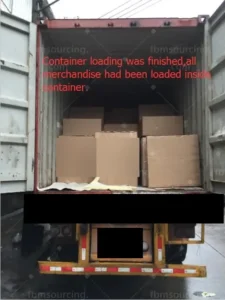
Finally, the many product categories of a project are consolidated and exported in full containers. Container capacity is worked out in the load plan, so a hotel or apartment project’s materials plan quickly into container-sized batches; fragile categories such as ceramics and glass are ordered with a small allowance of spare units in the same production batch, agreed at order stage, so site breakage never stalls installation. To continue the bathroom example: Sometimes, on a large project, the bathroom products alone fill full containers; sometimes the bathroom products share containers with the other product categories of the same project; and sometimes, in one batch, we combine a dozen or more product categories from several projects of the same client into a few containers — always full containers, and for us this is routine, well-practised work. Ocean transit time is confirmed by the carrier at booking.
How Is This Different from a Trading Company or One-Stop Supplier?
All three models give an overseas buyer a single English-speaking counterpart, which is why they are so often confused. The difference is structural. A trading company owns the transaction: it buys from factories it does not disclose, sells from its own catalog, and earns the spread — a full comparison is in our guide to the sourcing agent vs trading company question. A one-stop supplier manufactures one category and resells the rest, trading the factory that runs each production line for catalog convenience; we compare the two models for commercial projects in sourcing agent vs one-stop supplier.
A manufacturing sourcing agent is the only one of the three whose interests sit on the buyer’s side: every category is bought from the factory that actually manufactures it, one quotation covers every category, and verification and quality control are performed for the buyer, not for the seller. For a commercial project buying fifteen categories across fifteen production ecosystems, that is the difference between procurement and shopping.
Frequently Asked Questions
Is a sourcing agent the same as a trading company?
No. A trading company sells you products from its own catalog. A manufacturing sourcing agent works on your side of the table: it matches each product to a factory that actually runs that production line, and it manages verification, quality control and shipping on your behalf. The two models answer to different people. For suppliers you nominate, we charge a 5% commission; for products we source for you, we quote a direct price.
How does a sourcing agent verify that a factory actually manufactures the product?
FBM Sourcing verifies in both directions. Our own team visits the factory and confirms the production line for that exact product is installed and running, and we cross-check the claimed factory site against China’s public corporate registry — the registered legal entity, its filings and its social-insurance workforce records must match a real manufacturing operation of that scale. A company whose registered workforce could not possibly run the production line it advertises is reselling, not manufacturing. This verification is done by FBM Sourcing as part of the procurement package, before any order is placed.
Can one factory supply a complete bathroom package?
Almost never as a manufacturer. Bathroom accessories, faucets, ceramic toilets, basins and bathtubs are normally five separate production lines run by five different types of factory, because the underlying processes — metal stamping and polishing, brass casting and machining, firing vitreous china, and thermoforming acrylic — have nothing in common. A company offering all five from one address is manufacturing at most one category and reselling the rest. A manufacturing sourcing agent buys each of the five from its own source factory.
Does factory-direct procurement mean I have to order full containers?
Yes — FBM Sourcing ships full containers only. On commercial projects this is rarely a constraint: project quantities across a dozen or more product categories are consolidated into full containers, sometimes combining several projects of the same client in one batch. Full-container shipping keeps handling, damage risk and cost per unit low.
Get a China Procurement Quote for Your Project
If you are pricing a hotel, apartment, school, office or other commercial building project, the fastest way to see what factory-direct procurement changes is to put a real product list through it. Send FBM Sourcing your drawings, BOQ or product list with quantities, destination port and timeline, and our team will map each category to its source factory and come back with a structured proposal. Learn more about our China building materials and FF&E procurement service, or start the conversation today — as your sourcing partner in China, we handle the factories so you can run the project.