Commercial furniture sourcing for a project and buying furniture at retail are two different transactions that happen to involve the same category of object. A retail purchase buys an existing product from existing stock against a published price; a project purchase commissions a production run against a specification, a programme and a set of destination compliance requirements, with the buyer carrying specification risk that a retailer would otherwise absorb.
Understanding where the two diverge matters because most of the costly mistakes on a first commercial project come from applying retail assumptions — that the price is the price, that the product exists before you order it, that a photograph is a specification, and that a delay is someone else’s problem. This article sets out the seven differences that actually change how you should buy.
Difference 1: You Are Buying a Production Run, Not Stock
Retail furniture exists before you buy it. Project furniture, in almost every case, does not — it is produced after the order is confirmed, to your schedule and quantities. Three consequences follow:
- Quantity changes the unit economics. A 400-chair order and a 40-chair order are priced differently because setup, material purchasing and line scheduling are amortised across the run. At retail, quantity mostly changes only whether the item is in stock.
- The specification is yours to get right. Nobody has already decided the foam density or the board thickness on your behalf. What you write in the schedule is what gets built.
- Programme is part of the purchase. Production capacity has to be booked, and the sequence in which categories are produced matters when the package spans furniture, joinery and building materials. See building a procurement schedule around construction milestones for how this is planned backwards from site handover.
Difference 2: Contract Grade Is a Specification, Not a Marketing Word
The most expensive retail assumption is that a product which looks right will perform in a commercial setting. Contract-grade requirements are measurable, and they are the fields that separate two chairs that photograph identically:
- Abrasion resistance on upholstery, stated as a Martindale or Wyzenbeek rub count rather than “durable”. Commercial seating in a public area is specified at a materially higher rub count than domestic upholstery.
- Fire performance to the destination standard — BS 7176 in the UK, CAL 117 in California, AS/NZS 3744 in Australia. These are not interchangeable, and retail furniture is frequently certified to none of them. See fire safety and compliance certificates for hotel FF&E.
- Emissions class on board products — CARB Phase 2 / TSCA Title VI for the US, E0/E1 elsewhere. See what CARB Phase 2 compliance requires.
- Structural test class on seating and tables — cycle and load testing rather than a general assurance of sturdiness.
- Cleanability and finish for the actual environment, which is why a healthcare or foodservice project specifies differently from an office.
Difference 3: The Price Has a Structure Instead of a Number
A retail price is a single figure that already contains the retailer’s margin, warehousing, showroom cost and returns provision. A project quotation is a structure, and the parts move independently:
- Factory price, which moves with specification, quantity and raw material.
- Freight and duty, which move with volume, route and destination tariff treatment.
- Procurement cost, which on our model is a 5% commission for suppliers you nominate, or a direct price on products we source for you.
- Scope that sits outside the quotation — destination customs clearance, site delivery, installation and local permits are normally handled by your contractor or broker, and comparing a China quotation against a local supplier’s all-in figure without adding these back is the most common false-saving in project buying. See is it cheaper to buy building materials from China for the full landed cost structure.
Difference 4: You Buy by the Container, Not by the Item
Retail buying scales one unit at a time. Project buying scales in containers, and this changes planning in ways that surprise first-time project buyers:
- Orders are shipped as full containers — a 40ft high cube holds a defined volume, and quantities are worth planning to fill it rather than leaving a third of the container empty.
- Where a package spans several categories from several factories, goods are consolidated into one container rather than shipped separately. See how multiple factories are consolidated into one container.
- Packing and labelling become part of the specification, because 300 cartons arriving unlabelled at a multi-floor site costs more in site labour than the labelling would have cost at the factory.
- Volume, not weight, is usually the binding constraint on furniture. See 40ft container CBM and weight limits.
Buying furniture for a commercial project?
FBM Sourcing works with project owners, developers, main contractors and FF&E contractors on commercial building projects. Send us an existing furniture list and our team will review it and get back to you.
Difference 5: Quality Control Happens Before Shipping, Not After Delivery
Retail has returns. A project shipment does not — once a container is at sea, a defect discovered on site is a programme problem, not an exchange. The practical consequence is that inspection moves forward in the process:
- Pre-production sample approval on the items that matter, so the specification is verified in a physical object before the run starts.
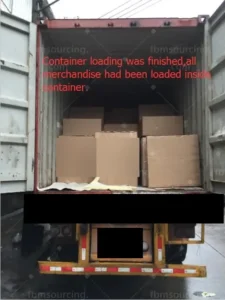
- Pre-shipment inspection against the approved sample and the packing list, before the container is loaded and sealed.
- Documented defects and rework handled while the goods are still in the factory. See what a factory audit covers before a project order for what happens earlier still, at supplier selection.
Difference 6: Lead Time Is a Framework, Not a Delivery Date
Retail quotes availability. A project quotes a lead time framework, and the honest version of that framework states what it counts from — deposit received, sample approved, or order confirmed — because those three starting points can sit weeks apart. A quotation that promises a fixed calendar delivery date before the specification is frozen is telling you something about the seller, not about the schedule. What a project buyer should expect instead is a per-category production window, a stated dependency chain, and visibility when a dependency slips.
Difference 7: You Will Probably Need to Buy It Again
Retail purchases are one-off. Project purchases are frequently repeat purchases — a second phase, a second property in the same brand, or replacement stock after a few years of use. That makes two things valuable at first order that have no retail equivalent:
- Specification archiving — keeping the approved drawings, board and fabric references, hardware makes and finish codes so a repeat order can be matched rather than re-specified from a photograph.
- Spares ordered with the main consignment — castors, gas lifts, hinges, handles, touch-up finish and a small allowance of fabric. Shipped with the container these cost very little; sourced individually two years later they are disproportionately expensive.
Retail Buying vs Project Procurement at a Glance
| Dimension | Retail buying | Project procurement |
|---|---|---|
| What exists when you order | Finished stock | A specification; the goods are produced afterwards |
| Who writes the spec | The manufacturer | You, or your designer |
| Price | One published figure | The goods on the quotation; sea freight quoted before shipment; import duty in most cases handled by you |
| Compliance evidence | Assumed to be handled | Requested, checked for scope, and filed |
| Quality control | Returns after delivery | Sample approval and inspection before the container is sealed |
| Delivery | A promised date | A lead time framework with a stated starting point |
| Unit of purchase | The item | The container |
| After the order | Transaction closed | Spec archived for phase two, spares and replacements |
The row that causes the most trouble in practice is the price row. A project buyer reading a China quotation as if it were a retail price — a single number that covers everything to the door — will conclude either that it is impossibly cheap or that something has been hidden. Neither is true; it is simply a different kind of number, and the exclusion list is the part that makes it readable.
What Should You Do Differently on Your First Project Order?
- Write a schedule before you ask for a price. Quantities by type and by floor, with dimensions and performance grades. Everything else follows from it.
- State the destination compliance requirements up front, not at sample stage — certification affects material purchasing, which happens before production.
- Compare quotations on matched exclusion lists, not on headline totals.
- Plan the delivery split against the site programme rather than assuming one arrival.
- Treat samples as part of the budget and the schedule, not as a free preliminary.
- Ask what evidence exists for any claim that matters — test reports, certificates and their scope — rather than accepting a category description.
If you are moving from retail-style buying into project procurement for the first time, the fastest way to see the difference is to have an existing furniture list re-issued as a project schedule with the gaps marked. Send whatever you have and we will return it in that form.
About FBM Sourcing
FBM Sourcing manages the entire China procurement package for overseas construction projects. We act as a China-based sourcing partner to project owners, developers, main contractors and FF&E contractors — your eyes and your representative in China — covering sourcing, factory selection, pre-shipment quality control, consolidation and shipping documentation. For suppliers you nominate, we charge a 5% commission; for products we source for you, we quote a direct price. We ship by full container, consolidating across factories — never less-than-container-load. More detail is on our China building materials and FF&E procurement page.
To discuss a project package, use the quote button above or WhatsApp +86 135 6007 5057.
FBM Furniture
If you are an FF&E contractor, see furniture sourcing in China for FF&E contractors on fbmfurniture.com, the site of FBM Furniture, the furniture sourcing line of FBM Sourcing Limited.