
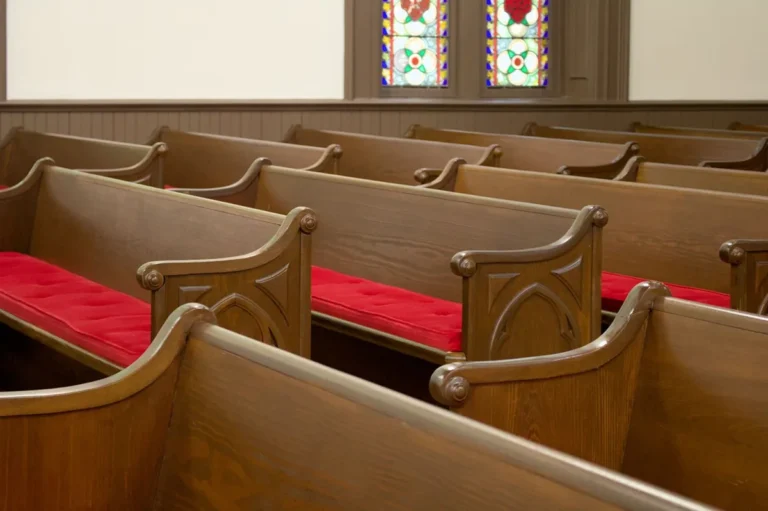
Church and worship seating manufacturers in China include solid-wood pew workshops, upholstered pew and kneeler makers, interlocking chair factories, stacking chair producers and full sanctuary furniture suppliers, and each prices a different scope under the same words “church seating”. A parish may need fixed pews for a nave; a multipurpose hall may need chairs that link, stack and store.
This guide sorts the supply side into five sourcing routes so a procurement team can send one brief to the right makers and compare the answers fairly. It is not a ranking. No factory is named or scored here, and no claim is made about strength, comfort, acoustics or fire performance of any product. The specification must define those requirements, and each maker must show evidence for the exact model it offers.
What should a worship seating brief state?
A brief that says only “church pews, oak colour, 30 rows” produces quotations that cannot be compared. State at least the following.
- Seating type: fixed pews, loose pews, individual chairs, or a mix, with a plan showing aisles and the number of seats per row.
- Pew dimensions: overall length, seat depth, seat height and back height, drawn against the room, so makers do not substitute their standard sizes.
- Timber and construction: the species or substitute named by the designer, whether panels are solid or veneered board, and how joints are made and reinforced.
- Cushions and covering: loose or fixed cushions, foam type if specified, and the covering reference with an approved sample. See our guide to upholstery foam in contract seating.
- Kneelers, book racks and fittings: whether each is included, and the finish and hardware.
- Fixing: fixed to the floor, free-standing or linked, with the fixing method stated by the architect.
- Finish: stain, lacquer or paint, with the colour reference and an approved sample kept in the purchase order.
- Fire and test evidence: the requirement the authority or consultant names for places of assembly, with its edition. Do not assume a rule from another market applies.
Five sourcing routes for church and worship seating
1. Solid-wood pew workshops
These makers build pews in timber with carved, turned or planed details. They suit traditional sanctuaries where the look of the timber matters. Ask which species is offered, how panels and joints are made, how moisture is controlled in the material before assembly, and how stain colour is matched between pews. Request a finished sample of an end panel and a seat section, not only photographs.
2. Upholstered pew and cushion makers
Pews with fixed or loose cushions, and padded kneelers, combine joinery with upholstery. Ask who makes the cushions, how the covering is cut and matched across a large order, and who is responsible for cutting loss if the project supplies the fabric. See our guide to supplying your own fabric before agreeing the split.
3. Interlocking and linking chair factories
Chairs that link together in rows suit multipurpose worship halls where the layout changes. Ask how the linking device works, whether chairs can be linked to the end of a row without gaps, how the frame is finished, and how the chairs store. Request a linked sample of at least two chairs.
4. Stacking chair producers
Stacking chairs serve halls, community rooms and overflow seating. Ask for a stacking sample and the stack height the maker states, check the seat and back material against the use, and ask about glides for the floor finish. Our guide to polypropylene stacking chairs covers the moulded end of this route.
5. Full sanctuary furniture suppliers
Some suppliers make pews and chairs together with altars, lecterns, choir stalls and joinery in one finish family. This route gives better coordination and one party to deal with, but ask the supplier to show capability in each product. Our guide to church and worship facility FF&E and building materials covers the wider package.
Sourcing this for a commercial project?
FBM Sourcing manages the entire China procurement package for overseas construction projects. We work with Developers · General Contractors · Builders · Commercial Project Owners · Interior Design & Construction Companies · FF&E Solution Providers. Send your BOQ, drawings or product schedule for review.
How to compare worship seating quotations
- What is included: frame, panels, cushions, kneelers, fittings, packing and delivery, shown in separate columns.
- Dimensions: the pew or chair size the maker quotes, matched to your drawing.
- Timber and finish: the exact species or board and finish reference quoted, so a cheaper substitute cannot appear later.
- Sample: what is approved, by whom, and how production will be matched to it.
- Fixing parts: the fixing hardware and any floor plates included, and who supplies them.
- Packing: how long pews are packed and protected, and how parts are marked by row.
- Exclusions and substitutions: any change to timber, foam, covering or hardware the maker proposes.
Approve one pew before ordering many
For a repeated pew, the strongest control is an approved production-standard sample. Agree what the sample represents (size, timber, finish, cushion), record who approved it and when, and make the order refer to it. If the church has accessibility, assembly or fire requirements, ask the designer or consultant which evidence is required for the exact model, and put that in the enquiry rather than adding it after quotation.
What evidence to ask each route for
Evidence should be requested for the exact pew or chair model, not for a product family. For each route above, ask for the following in writing and keep the answers with the quotation.
- Solid-wood pew workshops: a drawing of the end panel and seat section, the timber named, and a finished sample.
- Upholstered pew and cushion makers: the cushion build described, the covering reference and who cuts and sews it.
- Interlocking chair factories: a linked sample of at least two chairs and a description of the linking device.
- Stacking chair producers: a stacking sample, the glide type and the seat and back material.
- Full sanctuary furniture suppliers: a product sheet for each item quoted, so pews, chairs and joinery are judged separately.
Specification gaps to close before quotation
A quotation cannot answer the questions below for itself. Before sending the enquiry, check that the brief answers these questions.
- Does the plan show the number of seats per row, the aisles and any fixed positions, so every maker counts the same seats?
- Are pew lengths drawn for each position, or will makers use standard lengths and leave gaps?
- Who decides the timber or board and the finish, and is an approved sample kept in the purchase order?
- Are cushions and kneelers included, and who supplies the fabric?
- How will the pews be fixed to the floor, and who supplies the fixing parts?
- How will long pews be packed and marked so each row can be matched on site?
Next steps for a church or worship hall package
Send each maker the same brief: seating plan, dimensions, timber and finish references, cushion and covering details, fixing method and the evidence your consultant requires. For other assembly seating, see our guides to auditorium and lecture theatre seating and commercial upholstered furniture. FBM Sourcing also runs FBM Furniture’s contract seating pages for furniture-only packages.
Questions buyers ask about church seating from China
Which is better for a church, fixed pews or chairs?
It depends on how the room is used. Fixed pews suit a room whose layout does not change; linking or stacking chairs suit a multipurpose hall. The brief should show the plan and state the seat count.
Should we order a sample pew before a full order?
Yes. Approve a production-standard sample showing timber, finish and cushion, record the approval, and refer to it in the purchase order.
Can one maker supply pews, chairs and altar furniture together?
Some can. A single maker helps with finish coordination, but ask it to show capability in each product, because pews, chairs and joinery use different skills.
Who is responsible for cushion fabric on upholstered pews?
Either the maker or the project. Say which in the brief, and if the project supplies fabric, agree the delivery date, the cutting-loss allowance and the acceptance check at the factory.
How does FBM Sourcing support a worship seating package?
We review the brief, collect comparable quotations and manage the package for the project. For suppliers you nominate, we charge a 5% commission; for products we source for you, we quote a direct price. Our own team performs one inspection after bulk production is complete and before shipment, and the client’s project team is welcome to attend.
FBM Sourcing manages the entire China procurement package for overseas construction projects. We work with Developers · General Contractors · Builders · Commercial Project Owners · Interior Design & Construction Companies · FF&E Solution Providers.





