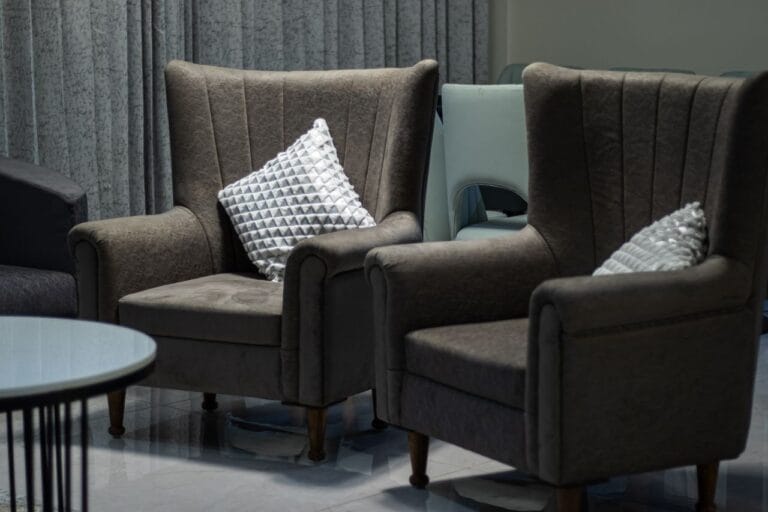
Commercial upholstered furniture is the one FF&E category where the factory name on your purchase order tells you the least about what you will actually receive. A hospitality lounge chair is assembled from a frame, a foam stack, a suspension system and a face fabric — and in China these four things routinely come from four different suppliers, only one of which is the company you contracted with. Buyers who compare quotes without knowing which of the four the quoting factory actually controls end up comparing numbers that were never comparable.
This guide is written for hotel owners, developers, main contractors and FF&E contractors who are about to issue a contract upholstery package. It explains how the Chinese contract upholstery supply base is actually structured, which factory type fits which project, and the specific documents that separate a real contract-grade producer from a residential sofa plant taking a hospitality order.
Why this article does not publish a ranked list of company names
Almost every “Top 10 upholstered furniture manufacturers in China” page you will find is unverifiable. Contract upholstery in China is overwhelmingly an OEM business: the plants that build hospitality seating for international brands are contractually barred from naming those brands, carry no consumer-facing identity, and do not appear in any public ranking. The companies that are publicly listed and easy to name built their businesses in domestic retail or residential export — a different product, a different specification, a different QC regime.
Publishing a ranked list would therefore mean ranking companies by how visible their marketing is, which is the opposite of what a project buyer needs. What follows instead is a typology: the four factory types that exist in this category, what each is genuinely good at, and the verification steps that tell you which type you are talking to. A buyer who can place a supplier into the right type has more decision-making power than a buyer holding a list of ten names.
The four factory types in Chinese contract upholstery
Type 1 — Dedicated contract upholstery plants
These plants build only to specification: frames to a drawn detail, foam to a stated density and ILD, fabric supplied or nominated by the buyer. They are set up for small quantities across many SKUs, because a hotel package is rarely more than a few hundred pieces of any one item. Their production floor is organised by operation (frame shop, cut-and-sew, upholstery line) rather than by model, and their sample room is usually larger relative to output than any other type.
They are the correct choice for guest room and public area seating on branded hotel projects, where the brand standard dictates construction and the only thing left to the factory is execution quality. They are usually the most expensive per piece of the four types — and the reason is visible on the floor, in the form of jigged frame assembly and a separate pre-upholstery inspection station.
Type 2 — Residential sofa plants running contract lines
This is the largest group by headcount and the one most project buyers actually meet. These are volume sofa manufacturers whose core business is domestic retail or residential export, running a side line for hospitality and commercial work. Their strength is genuine: deep frame-making capacity, mature foam sourcing, and a cost structure built on volume. Their weakness is that their default construction is a residential one, and residential defaults fail in commercial service.
Working with this type is entirely viable — a large share of successful hospitality projects are built here — but it requires the buyer to specify what a contract plant would have done by default: frame material and joinery method, foam density and resilience, seat suspension type, and fabric performance thresholds. Left unspecified, you will receive the residential default, and it will pass the factory’s own QC because by their standards it is correct.
Type 3 — Frame specialists and component makers
A significant part of the industry makes only frames — hardwood, plywood-laminate or metal — and sells them to upholsterers. You will occasionally be quoted by one directly, usually at a price that looks striking against the others. The quote is real, but it is for a component, and the difference will surface as an unallocated upholstery scope somewhere later in the programme. The same applies to foam converters and to cut-and-sew houses that take fabric and produce covers only.
These suppliers are useful to know about for a different reason: when a project’s cost is genuinely out of range, splitting a package into frame and upholstery scopes is sometimes the answer, and knowing this layer exists is what makes that option visible. For related structural work on the metal side, see our guidance on stainless steel fabrication in China.
Type 4 — Trading companies and showroom operations
A showroom in a furniture city with a company name and a catalogue is not a factory, and in this category the distinction matters more than in most. An intermediary who does not control the upholstery line cannot enforce a foam density, cannot hold a cut-and-sew tolerance, and cannot give you a straight answer when a fabric roll arrives short. Some are honest and useful; the problem is that the buyer usually cannot tell, because everything visible — catalogue, samples, showroom — is identical to what a real producer shows.
How do you tell which type you are actually dealing with?
Four questions separate them faster than any amount of catalogue review, and all four can be asked before you travel:
- “What is the foam density and ILD on this model, and who converts it?” A contract plant answers with two numbers and a supplier relationship. A residential line answers with a grade name. An intermediary changes the subject to price.
- “Show me the frame before upholstery.” A photograph of a bare frame on the jig tells you the joinery method, whether corner blocks are glued and screwed or stapled, and whether the frame is kiln-dried hardwood or a laminate substitute. This single request eliminates more unsuitable suppliers than any other.
- “Which seat suspension do you use as standard, and what is your alternative?” Sinuous spring, webbing and eight-way hand-tied are different price points with different service lives. A supplier who offers only one and cannot discuss the others is telling you the answer is a factory default, not a specification.
- “What happens if the nominated fabric fails inspection on arrival?” This exposes whether they have ever run a COM programme. A plant that regularly receives buyer-supplied fabric has a written procedure; a plant that has not will improvise, and the improvisation will cost you schedule.
Sourcing this for a commercial project?
FBM Sourcing works with project owners, developers, main contractors and FF&E contractors on hotel, apartment, school, office and other commercial building projects. Send us your BOQ, drawings or product list — our team will review it and get back to you.
The specification items that decide whether the furniture survives
Contract upholstery fails in commercial service for a small number of recurring reasons, and almost all of them trace back to an item the buyer never specified.
Foam. Density determines how long the seat holds its shape; ILD determines how firm it feels on day one. The two are independent, and the common failure is a foam that feels correct in the sample and collapses in eighteen months because the density was never stated. State both, and state that the foam supplier may not be changed without approval.
Frame. Commercial seating is sat in harder, more often, and by a wider range of body weights than residential seating. The specification should state the frame material, the joinery method at the load-bearing corners, and whether the frame carries a structural warranty. Our comparison of steel versus wood frame furniture for institutional projects covers the same decision in a heavier-use context.
Fabric. The fabric is where contract and residential diverge most sharply, because contract fabric is specified by performance: abrasion resistance, cleanability code, and flame performance to whatever standard governs your jurisdiction. If you are supplying the fabric yourself, our guide to supplying your own fabric on a COM or COL basis sets out how the handover actually works; if you are choosing between material families, the fabric versus vinyl comparison for commercial seating is the practical starting point.
Flame performance. This is jurisdictional and non-negotiable, and it is the single item most likely to stop a shipment or fail a handover inspection. The governing requirement comes from your project’s local code, not from the factory’s home market, and it applies to the assembled item — the combination of foam, interliner and face fabric — not to the fabric alone. A factory that quotes a fabric certificate as proof that the finished chair complies has misunderstood the requirement. Related documentation logic is covered in our guide to hotel FF&E fire safety certificates from China.
How the category behaves in a real project programme
Upholstered items are usually the longest-lead FF&E line on a hospitality package, and the reason is fabric rather than furniture. Frames and foam move quickly; a nominated fabric with a mill lead time, a fire-retardant backcoating step and a shipping leg to the upholsterer can add many weeks before a single chair is built. On projects where the opening date is fixed, the fabric decision is the schedule decision, and it should be closed before the furniture supplier is even appointed.
The second programme reality is sampling. Contract upholstery is one of the few categories where a photograph genuinely cannot substitute for a physical sample, because the things that fail — seat firmness, back angle, arm height against a specified table — are all tactile. Budget for a prototype round on any item that will be produced in quantity, and inspect it against the drawing rather than against the impression it makes.
The third is consolidation. Upholstered items are bulky and light, which means they pay for volume rather than weight and consolidate well with denser categories. Our guidance on mixed container consolidation on multi-category projects covers how this is planned. For a wider view of how hospitality furniture manufacturing is distributed across China, see our overview of hospitality casegoods manufacturing hubs.
Where the category is made in China
Contract upholstery capacity is not evenly distributed, and the geography is worth understanding because it affects both price and the practicality of factory visits. The Pearl River Delta in Guangdong carries the deepest concentration of export-oriented contract work and the widest range of ancillary trades — frame shops, foam converters, cut-and-sew houses and metalwork all within a short radius, which is what makes complex multi-component items practical there. Clusters in the Yangtze River Delta and in northern China carry very large volume capacity, typically with a stronger residential and domestic orientation.
For a project buyer this matters in one specific way: a package that contains several related categories — seating, casegoods, metal trim, stone tops — is easier to build and inspect where all of those trades are within reach of one another. A package that is a single simple item in high volume has no such constraint and should follow price.
Sourcing this for a commercial project?
FBM Sourcing works with project owners, developers, main contractors and FF&E contractors on hotel, apartment, school, office and other commercial building projects. Send us your BOQ, drawings or product list — our team will review it and get back to you.
Frequently asked questions
What is the minimum order quantity for contract upholstered furniture from China?
It varies by factory type rather than by category. Dedicated contract plants are built for project-sized runs and will quote modest quantities per SKU; volume residential plants set higher thresholds because their cost structure depends on run length. FBM Sourcing works on full-container-load orders, and a hospitality package containing several categories usually reaches that point comfortably even when no single item is large.
Can I supply my own fabric to a Chinese upholstery factory?
Yes, and it is standard practice on branded hotel projects. The mechanism is called COM (customer’s own material) or COL (customer’s own leather). What needs to be agreed in advance is who bears the freight and customs cost of getting the fabric to the plant, what the yield allowance is, and what happens if the roll arrives short or fails inspection. Our COM and COL guide covers the full handover.
How do I verify that a factory can actually meet a flame performance requirement?
Ask for test evidence on the assembled construction — the specific combination of foam, interliner and face fabric you are buying — not on the fabric in isolation, and check that the evidence covers the standard named in your project’s local code rather than a different market’s equivalent. If a supplier can only produce a fabric certificate, the finished item has not been demonstrated to comply.
What is the difference between contract-grade and residential upholstered furniture?
Frame construction, foam specification, seat suspension and fabric performance. A residential item is designed for intermittent domestic use; a contract item is designed for continuous public use, wider load variation and commercial cleaning. The visible difference is small and the service-life difference is large, which is why the specification rather than the appearance is what needs to be controlled.
Should I appoint one supplier for all seating or split the package?
One supplier per construction family is usually the right unit — all upholstered seating together, casegoods separately — because it keeps foam, frame and fabric decisions under one point of accountability. Splitting by room type across several upholsterers tends to produce visible inconsistency in items that sit in the same space.
Working with FBM Sourcing on a contract upholstery package
FBM Sourcing has been sourcing building materials and FF&E from China since 2014, and has shipped more than 1,000 containers for project buyers in over 20 countries. On upholstered packages our role is to establish which factory type each candidate actually is, hold the specification items that decide service life, manage the sampling round against the drawing, and run inspection before the goods ship rather than after they arrive.
If you have a seating package coming up, send the schedule, the specification and any nominated fabric information through our project procurement enquiry page and we will review it and come back to you.