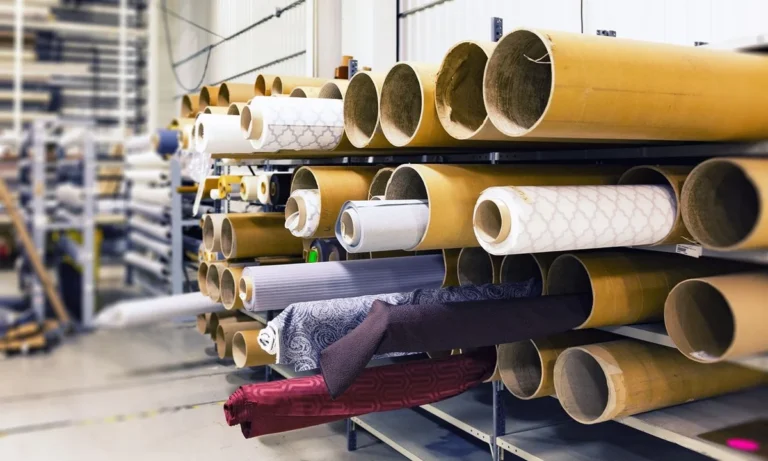
COM stands for Customer’s Own Material and COL for Customer’s Own Leather — the arrangement where the buyer or designer supplies the upholstery fabric and the factory supplies everything else: frame, foam, labour and finishing. On a China-sourced contract upholstery order it is a normal and workable arrangement, but it moves four things onto the buyer’s side of the line: yardage accuracy, fire compliance of the fabric itself, the fabric’s arrival date, and responsibility for defects in the material.
This article explains how COM/COL actually works on a project order from China, what changes in the quotation, how yardage is calculated, and the five failure modes that account for most COM-related delays.
Why Do Projects Specify COM Instead of Factory Fabric?
- Brand standards. Hotel brands and corporate interiors frequently mandate a specific mill and pattern across every property, and that fabric is not available from a Chinese furniture factory’s own range.
- Design continuity. A designer matching seating to curtains, wallcovering and carpet from a single palette may hold the fabric selection outside the furniture package entirely.
- Certification already in hand. A specified contract fabric usually arrives with its own fire and abrasion test reports, which removes one variable from the factory’s compliance obligations.
- Existing supply agreements. Larger operators sometimes buy fabric direct at volume across multiple projects, then allocate it per property.
What COM is generally not is a cost-saving device. Once fabric purchase, freight to the factory and overage allowance are counted, buyer-supplied fabric on a standard commercial pattern is rarely cheaper than the factory’s equivalent — it is a control decision rather than a price decision.
What Changes in the Quotation?
A COM quotation prices the item less fabric, and that has direct consequences for how you compare quotes:
- The quoted figure is frame, foam, mechanism, labour and finishing only. Comparing a COM price against a fully upholstered price from another factory is not a like-for-like comparison — one of them contains a material you still have to buy.
- Cut-and-sew labour may be quoted differently for COM. A factory working with an unfamiliar fabric — different weight, stretch, pattern repeat or backing — may allow more labour time than for a house fabric it cuts every week.
- A yardage figure must be stated per item. Without it you cannot buy the right quantity, and this is the single most important number in a COM quotation.
- Overage and wastage sit on the buyer. Cutting waste, pattern matching and repair allowance come out of your yardage, not the factory’s.
- Freight of the fabric to the factory is your cost, and it needs a route and a date, not just an intention.
How Is COM Yardage Calculated?
Yardage per unit is quoted by the factory against a nominal fabric width — commonly 54 inches (137cm) for contract upholstery. Four factors change the real requirement:
- Actual width. If your fabric is narrower than the nominal width the yardage rises, sometimes substantially, because fewer pieces nest across the roll.
- Pattern repeat. A plain fabric cuts efficiently; a large repeat that has to be centred on a seat and matched across a back can add substantially to the requirement. The repeat dimensions must be given to the factory before yardage is confirmed.
- Directionality and railroading. Whether the fabric can be turned 90 degrees to run along the roll changes the cutting plan completely. A railroadable plain fabric on a long sofa can save a great deal of material; a directional pile or a one-way pattern cannot be railroaded at all.
- Overage allowance. Contract practice is to add a margin above the calculated requirement to cover cutting waste, a flawed section of roll and later repairs. Agree the percentage explicitly and record who holds the leftover.
For leather (COL), the arithmetic differs: hides are irregular and measured in square feet, and yield is lower because of natural defects and the shape of the hide. Ask for the yield assumption the factory is using, not just a square-footage total.
Planning a COM or COL upholstery package?
FBM Sourcing works with project owners, developers, main contractors and FF&E contractors on commercial building projects, including receiving and scheduling buyer-supplied materials into production. Send the fabric specification and seating schedule for a priced package.
Who Is Responsible When Something Goes Wrong with the Fabric?
This is the clause worth agreeing in writing before the first roll ships, because the default answer surprises people:
- Fabric defects are the buyer’s risk. A flaw in the roll, a dye lot variation between rolls, or a shading difference is a matter between you and the fabric mill — the factory did not buy it and cannot warrant it.
- The factory should inspect on arrival and report, not proceed silently. Agree that incoming fabric is checked for width, roll length, visible flaws and dye lot consistency, and that anything abnormal is reported before cutting starts. Once fabric is cut, options narrow sharply.
- A shortfall stops the line. If yardage runs out at unit 180 of 200, the remaining units wait for more fabric, and a second dye lot may not match the first. This is why overage is not optional.
- Cutting errors are the factory’s risk. If the factory mis-cuts within an agreed yardage, replacing that material is properly a factory cost — but only if the yardage figure and the cutting plan were agreed in advance.
- Fire compliance follows the fabric. A frame built to a fire standard upholstered in a non-compliant fabric does not produce a compliant chair. If your destination requires a stated standard, the fabric’s own test evidence has to satisfy it, and any required backcoating or interliner must be specified. See fire safety and compliance certificates for hotel FF&E for how BS 7176, CAL 117 and AS/NZS 3744 differ.
How Does COM Affect the Production Schedule?
The critical point is simple: upholstery production cannot start until the fabric is physically in the factory and approved. That makes fabric arrival a hard dependency in the programme rather than a parallel activity, and it adds several steps that are easy to underestimate:
- Mill lead time for the fabric itself, which on a made-to-order contract pattern can be longer than the furniture.
- International freight to China and import formalities, handled by whoever you nominate.
- Inbound inspection and roll reconciliation at the factory.
- Approval of an upholstered sample in the actual fabric before the run proceeds.
The practical planning rule is to treat the fabric as a long-lead item ordered ahead of the furniture, and to build the furniture programme backwards from the confirmed fabric arrival date rather than from order confirmation. Where an order spans several categories, this dependency is one of the things a procurement schedule built around construction milestones is designed to expose early.
What Should Be Agreed Before the First Roll Ships?
- Yardage per item, the nominal width it assumes, and the agreed overage percentage.
- Pattern repeat, direction and railroading, confirmed against a physical cutting from the actual roll rather than a swatch card.
- Delivery address, marking and consignee at the factory, plus who arranges and pays freight and import.
- Inbound inspection protocol — what is checked, what is reported, and how fast.
- Fire and abrasion evidence for the fabric, and whether backcoating is required.
- What happens to leftover material — returned with the shipment as attic stock for future repairs, or disposed of. Returning it with the container costs almost nothing and is worth doing.
- Sample approval in the actual fabric, not in a house substitute.
For US projects, the fabric you supply also has to fit the federal smolder requirement: the 16 CFR 1640 label on contract upholstered seating certifies the finished piece against TB 117-2013, whose smolder tests include the cover fabric, so the evidence has to cover the fabric actually used.
When Is Factory-Supplied Fabric the Better Choice?
COM is worth the coordination when the fabric is genuinely specified and non-substitutable. When it is not, factory-supplied fabric removes an entire dependency chain from the programme and puts material risk back on the supplier. A middle path that works well on larger packages is to run COM only on the feature items — lobby and restaurant seating where the pattern is part of the design intent — and let the factory supply a matched-performance fabric on back-of-house and bedroom items. If you want the comparison made properly, ask for both prices: the COM price with a yardage figure, and a fully upholstered price against an equivalent abrasion and fire grade. See how to choose contract-grade upholstery fabric and fabric or vinyl for commercial seating for what an equivalent grade actually means.
About FBM Sourcing
Related guide: our notes on what a CFA (cutting for approval) and a strike-off mean.
FBM Sourcing manages the entire China procurement package for overseas construction projects. We act as a China-based sourcing partner to project owners, developers, main contractors and FF&E contractors — your eyes and your representative in China — covering sourcing, factory selection, pre-shipment quality control, consolidation and shipping documentation. Buyer-supplied materials are received, reconciled and scheduled into production as part of that package. For suppliers you nominate, we charge a 5% commission; for products we source for you, we quote a direct price. We ship by full container, consolidating across factories — never less-than-container-load. More on our China building materials and FF&E procurement page.
If you have a COM or COL package to plan, send the fabric specification and the seating schedule — use the quote button above or WhatsApp +86 135 6007 5057.