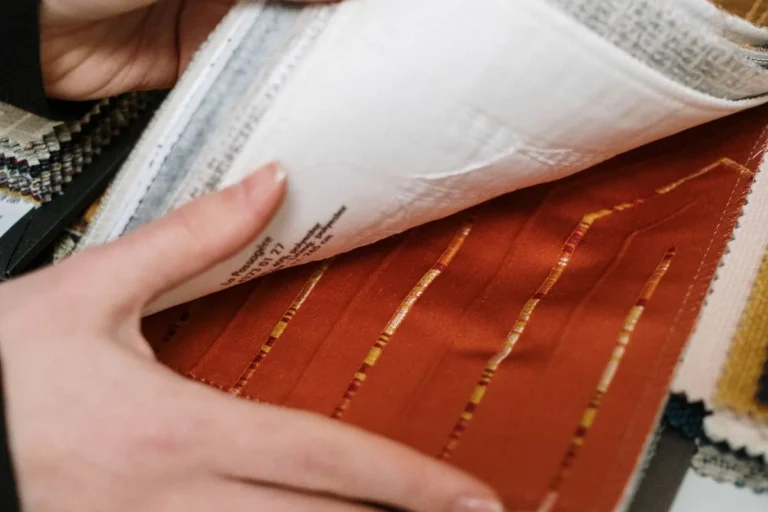
A CFA, short for cutting for approval, is a piece of fabric cut from the stock your order will come from, sent so the buyer can approve colour and quality before ordering. A strike-off is a small sample made before production of a custom fabric, trim or carpet, to show colour, pattern or texture for approval. Both are approval steps that come before bulk fabric is cut for furniture.
This guide explains both terms, how they differ from an ordinary swatch, and how to use them when upholstered furniture is made in China from fabric that the project supplies or specifies. The definitions come from published fabric-trade and interior-design sources read on 5 October 2026, listed at the end of the first section; the process advice is FBM’s practical reading of how to apply them and is not a rule of any standard.
What do CFA and strike-off mean?
CFA. One interior design dictionary defines CFA as “Cutting for Approval” and says that when you order fabric you should always get one, because it is an actual piece of the fabric roll your fabric will come from; since dye lots can differ, you want to check that the roll is what you want (Capella Kincheloe design dictionary). Another designer glossary says a designer should require the fabric manufacturer to send a swatch of the exact dye lot before an order is placed, and notes the CFA is sometimes too different from the original sample, in which case the designer looks for the fabric in another dye lot (A. Morgan Interiors glossary).
A fabric house’s published terms use the same idea. The terms of one decorative fabric company say that if an exact colour match is required, the buyer should request a cutting of present stock for approval (CFA) or send a cutting to be matched, and that colour variations often cannot be avoided from one dye lot to another (Kravet terms and conditions). The same terms say that cuttings for approval are held for 14 calendar days after being sent from that company’s warehouses. That holding period is one company’s policy, not an industry rule, so ask each fabric house for its own.
Strike-off. The Morgan Interiors glossary defines a strike-off as follows: when a designer wants to use a fabric, trim or carpet that is custom made, the manufacturer creates a strike-off for approval, a small sample to show colour, pattern or texture. It applies to custom production, where the colour or pattern does not yet exist in stock.
Sources read on 5 October 2026: the three pages linked above. Definitions vary slightly between companies, so confirm the meaning your fabric house uses before you rely on it.
CFA, strike-off, swatch and production sample: the differences
- Swatch or memo sample: a small sample for choosing a fabric. It may come from a different dye lot from the fabric you will receive, so it does not confirm the colour of your order.
- CFA: a cutting from the stock the order will come from. It confirms colour and quality for that dye lot, for an existing fabric.
- Strike-off: a first sample of a custom fabric, trim or carpet, made before production for approval of colour, pattern or texture.
- Production-standard sample (of the furniture): a finished chair, sofa or panel made with the approved fabric. It confirms how the fabric behaves once it is cut, seamed and upholstered, which a CFA cannot show.
Treat them as steps in sequence: choose from a swatch, approve a CFA or strike-off, then approve the finished sample. Skipping the middle step is how a project ends up with a fabric that looks different from the swatch the designer chose.
Why dye lots make the CFA worth asking for
The sources above agree on the reason: fabric is made in batches, and colour can differ from one dye lot to the next. If a project needs one colour across a large order, the approval has to be tied to the dye lot that will be used. A CFA does this because it is cut from the stock the order will come from. A swatch chosen months earlier does not.
For multi-phase projects, such as a hotel delivered in stages, ask whether the same dye lot can be held for later phases, how much extra to reserve for repairs, and what happens if a later phase must come from a different lot. Record the answer in writing, because the approval of one lot does not carry over to another.
Sourcing this for a commercial project?
FBM Sourcing manages the entire China procurement package for overseas construction projects. We work with Developers · General Contractors · Builders · Commercial Project Owners · Interior Design & Construction Companies · FF&E Solution Providers. Send your BOQ, drawings or product schedule for review.
Using CFAs when the project supplies fabric to a China factory
Many commercial upholstery orders use customer’s own material (COM) or customer’s own leather (COL), where the project buys the fabric and sends it to the furniture factory. Our guide to supplying your own fabric to a China factory covers the commercial split. The CFA fits into that flow in four steps.
- Step 1 — request the CFA from the fabric house for the specific pattern and colour, and note the dye lot or lot reference if the fabric house gives one.
- Step 2 — approve it in writing (designer, project manager or client, whoever holds sign-off) and keep the approved cutting. Label it with the pattern, colour and lot reference.
- Step 3 — send a matching reference to the factory so it can check the delivered rolls against the approved cutting on arrival. Agree the cutting-loss allowance and the acceptance check at the factory before the rolls ship.
- Step 4 — approve the finished sample upholstered in the approved fabric before bulk production starts. Fabric direction, pattern matching and seam placement are decided at this stage, not at the CFA stage.
For fabric the factory buys, the same logic applies. Ask the factory to show the lot it plans to use, approve a cutting from that lot, and refer to it in the order. See our guides to contract-grade upholstery fabric for hotel furniture and fabric versus vinyl upholstery for the specification side.
A checklist for approving fabric before bulk production
- The approved cutting is labelled with pattern, colour and lot reference, and stored with the project file.
- The fabric order and the CFA refer to the same pattern, colour and lot.
- The factory has a reference cutting to check delivered rolls against.
- The cutting-loss allowance and the acceptance check are agreed in writing.
- A finished sample in the approved fabric has been approved before bulk cutting.
- For multi-phase delivery, lot holding or reserve quantity for later phases is agreed.
- Fire and performance requirements for the fabric are named by the designer for the destination, and evidence is requested for the exact fabric. See our guide to contract upholstery fabric sourcing.
Common mistakes with CFAs and strike-offs
- Approving a swatch and ordering from a different lot. The swatch shows the design; only a CFA from the lot to be used shows the colour you will receive.
- Letting the approval lapse. The fabric house that publishes terms for its CFAs states a holding period for them. Ask about the holding period and place the order before it ends.
- Forgetting later phases. Approval of one lot does not cover a later order from another lot.
- Skipping the finished sample. A CFA does not show how the fabric looks once cut, seamed and upholstered.
- Losing the record. Keep the approved cutting, the lot reference and the approval email together, so a later dispute can be checked against them.
What to write when you request a CFA
Give the fabric house the pattern name and colour, the quantity you expect to order, the date you expect to order, and the delivery address for the cutting. Ask for the lot reference to be stated, and ask how long the cutting and the lot will be held. When the project buys a custom fabric, ask for a strike-off instead, and state what it must show: colour, pattern or texture. Keep the request and the reply with the approved cutting.
Next steps
If you are specifying upholstered furniture for a hotel, restaurant or care project, send your fabric references, quantities by item and phase plan with the enquiry, and state whether the project or the factory will buy the fabric. For the foam side of upholstered seating, see our guide to upholstery foam for contract seating. FBM Furniture’s notes on fabrics and foam are on its page on contract upholstery fabrics and foam.
Questions buyers ask about CFAs and strike-offs
What does CFA stand for in fabric?
CFA stands for cutting for approval: a piece cut from the fabric stock an order will come from, sent so the buyer can approve it before ordering.
What is the difference between a CFA and a strike-off?
A CFA is cut from existing stock of an existing fabric. A strike-off is a first sample of a custom fabric, trim or carpet made before production, to show colour, pattern or texture.
Why does the dye lot matter?
Fabric is produced in batches and colour can differ between dye lots. Approving a cutting from the lot that will be used ties the approval to the actual fabric.
Does a CFA replace a finished furniture sample?
No. A CFA confirms the fabric. A finished sample in that fabric confirms how it looks once cut, seamed and upholstered, including pattern direction and seam placement.
How does FBM Sourcing support an upholstered furniture package?
We review the brief, collect comparable quotations and manage the package for the project. For suppliers you nominate, we charge a 5% commission; for products we source for you, we quote a direct price. Our own team performs one inspection after bulk production is complete and before shipment, and the client’s project team is welcome to attend.
FBM Sourcing manages the entire China procurement package for overseas construction projects. We work with Developers · General Contractors · Builders · Commercial Project Owners · Interior Design & Construction Companies · FF&E Solution Providers.