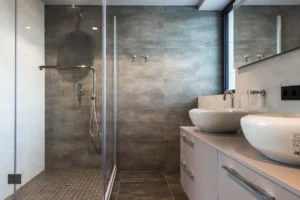
Bathroom vanity manufacturers in China supplying US multifamily projects fall into three recognisable types: listed sanitaryware groups with cabinet lines, listed cabinetry groups that run project joinery, and specialist vanity plants that build to a drawing. For such a package the deciding factors are three documented things: whether the unit falls inside the scope of the antidumping and countervailing duty orders on wooden cabinets and vanities from China, whether the composite wood inside it carries a compliant TSCA Title VI label and paper trail, and whether the plant can repeat one carcass hundreds of times without dimensional drift.
It is written for developers, general contractors, builders, commercial project owners, interior design and construction companies and FF&E solution providers working on garden-style, podium and mid-rise apartment projects in the United States, who are buying by unit type and schedule rather than by catalogue code.
What Makes a US Multifamily Vanity Package Different from a Hotel One?
A hotel guest bathroom vanity is usually one or two designs repeated across a key count, judged on finish quality and on matching the ceramic and brassware; our shortlist of hotel bathroom vanity manufacturers in China is organised around that problem. A US multifamily package is a different exercise:
- Unit mix drives the schedule. One property may need four or five vanity widths across studio, one-bedroom, two-bedroom and accessible unit types, each repeating dozens or hundreds of times, dimensioned in inches on a module set by US cabinet convention rather than by the metric modules a Chinese plant uses domestically.
- Trade compliance sits on the critical path. Wooden vanities from China are subject to standing AD and CVD orders, so classification has to be settled before a purchase order, not at the port.
- Kitchen cabinetry usually travels with it through the same plants and duty analysis, which makes our kitchen cabinet manufacturers for US multifamily article a companion to this one.
Which Trade Rules Decide Whether a China-Made Vanity Can Enter?
The US Department of Commerce published AD and CVD orders on wooden cabinets and vanities and components thereof from China on 21 April 2020 (cases A-570-106 and C-570-107). After the first five-year sunset review it published a notice of continuation, applicable 9 September 2025, stating that US Customs and Border Protection will continue to collect AD and CVD cash deposits at the rates in effect at the time of entry. Points from the published scope that matter to a vanity package:
- It covers wooden cabinets and vanities for permanent installation (floor mounted, wall mounted, ceiling hung or by attachment of plumbing) made substantially of wood products, including solid wood and engineered wood products, or bamboo.
- Coverage applies whether or not the unit is imported attached to faucets, metal plumbing, sinks, sink bowls or countertops; where it is, only the wooden cabinet or vanity is covered.
- Wooden component parts are named separately: frames, boxes, doors, drawers and drawer components, back panels and end panels.
- Unassembled, assembled and ready-to-assemble units, commonly known as flat packs, are all included.
- Merchandise further processed in a third country (trimming, cutting, drilling, painting, finishing, assembly and similar) remains in scope.
- Medicine cabinets are excluded only if they meet all five published criteria: wall mounted, assembled at entry, containing one or more mirrors, packaged for retail sale at entry, and a maximum depth of seven inches.
In a final scope determination published on 17 July 2024, Commerce implemented a certification regime for wooden cabinets entered from Malaysia and Vietnam and rescinded the related circumvention inquiries, so a carton marked with a third-country origin does not by itself close the question. Settle this with your customs broker or trade counsel before a purchase order; our article on US anti-dumping duties on China cabinets, quartz and flooring covers the related packages.
What Formaldehyde Evidence Has to Travel with the Goods?
Any vanity built from hardwood plywood, MDF or particleboard is a finished good containing composite wood products, so 40 CFR part 770 applies. Its emission standards, based on ASTM E1333-14, are 0.05 ppm for hardwood plywood made with a veneer core or a composite core, 0.11 ppm for medium-density fiberboard, 0.13 ppm for thin MDF and 0.09 ppm for particleboard, and they apply whether the product is a panel, a component part or incorporated into a finished good. California’s airborne toxic control measure sets the same Phase 2 numbers for the same panel types. Two obligations follow that belong in the purchase documents:
- Labelling. Fabricators must label every finished good, or every box or bundle containing finished goods, carrying at minimum and in legible English the fabricator’s name, the production date in month and year format, and a statement that the finished goods are TSCA Title VI compliant.
- Records. Importers must keep, for three years, bills of lading, invoices or comparable documents including a written supplier statement that the goods are TSCA Title VI compliant, plus records identifying the panel producer and the production date, available to EPA within 30 calendar days of a request. Since 22 March 2019 importers of articles containing regulated composite wood products also fall under the import certification regulations at 19 CFR 12.118 through 12.127.
Our article on CARB Phase 2 and TSCA Title VI for furniture and cabinets from China follows the certification chain in more detail.
Which Performance Standard Do US Multifamily Specifications Reference?
The US performance standard written for this product type is ANSI/KCMA A161.1-2022, whose stated scope covers factory assembled kitchen and vanity cabinets and which is expressly a performance and construction standard, not a design or materials standard. Where a specification calls it up, its named tests are the language to use when asking for evidence:
- Static loading on shelves and bottoms: loaded uniformly at 718 Pa (15 lb./ft2) for seven days, with deflection limited to 1.6 mm (0.0625 inch) per 305 mm (lineal foot) and 6.4 mm (0.25 inch) maximum between any two supports.
- Door operation: 25,000 cycles at 20 cycles per minute, after which the door must stay operable, keep its recorded shape and show sag at the measured point of no more than 1.6 mm (0.065 inch).
- Drawer operation: 25,000 cycles loaded at 718 Pa (15 lb./ft2), after which the drawer must stay operable with no failure in the assembly.
- Finish tests for shrinkage and heat resistance, hot and cold check resistance, chemical resistance, detergent and water resistance, and water holdout of interior surfaces.
- Construction requirements with specific exceptions for vanity units, vanity bowl fronts and vanity drawer units — a vanity carcass is not simply a shortened kitchen base cabinet.
Have a US multifamily vanity schedule to price?
Send us the unit mix and the vanity schedule and we will turn it into a specification Chinese plants can quote against, with the compliance evidence named up front.
Which Chinese Manufacturers Can Be Named With Verifiable Listing Evidence?
We only name companies whose listing and product lines we have checked against exchange records and the company’s own published annual report. There is no score column and no ranking, because a rank implies a comparison we have not run against your specification. These companies are named for what their filings state, not as a recommendation.
- Arrow Home Group Co., Ltd. (Shenzhen Stock Exchange, 001322), registered in Sanshui, Foshan, Guangdong. Its 2025 annual report reports bathroom furniture as one of its product revenue segments, alongside sanitary ceramics, tapware and hardware, tubs and shower enclosures, and tiles.
- Huida Sanitary Ware Co., Ltd (Shanghai Stock Exchange, 603385), registered in Hebei. Its 2025 annual report lists bathroom cabinets as a separate reported product line within sanitary ware, alongside sanitary ceramics, tapware and shower enclosures, and reports production and sales volumes for that line.
- GuangZhou Seagull Kitchen And Bath Products Co., Ltd. (Shenzhen Stock Exchange, 002084), registered in Panyu, Guangzhou, Guangdong. Its 2025 annual report describes the business as covering bathroom cabinets among prefabricated kitchen and bath components, names a subsidiary producing bathroom cabinets, and describes a capacity layout in which its China plants serve the domestic and European markets while a Vietnam plant serves the US market — a reminder that origin needs checking rather than assuming.
- Oppein Home Group Inc. (Shanghai Stock Exchange, 603833), registered in Guangzhou, Guangdong. Its 2025 annual report reports a bathroom product line as a separate segment from its kitchen cabinet, wardrobe and wooden door segments; it does not break out vanities as a line of their own.
Manufacturer Types We Do Not Name, and the Evidence to Request
Most plants that build US multifamily vanity packages are not listed companies, so we describe them by type rather than inventing names. Each ends with the product evidence to ask for.
- American-format cabinet plants running face-frame and frameless boxes to inch dimensions. Evidence to request: an ANSI/KCMA A161.1 certificate with number and issue date, plus the reports behind it.
- Vanity lines inside sanitaryware groups, supplying vanity, basin and mirror cabinet as one package and removing coordination risk between plants. Evidence to request: basin and cabinet cut sheets showing the actual bowl cut-out and overflow arrangement, plus the cabinet finish test reports.
- Panel-integrated plants that press or laminate their own substrate. Evidence to request: the panel producer’s name and third-party certifier number, the TSCA Title VI compliance statement on the invoice, and a photograph of the finished-good label showing month and year of production.
- Ready-to-assemble specialists built around flat-pack packing efficiency. Evidence to request: the carton drawing, the hardware pack list and a written statement of how the units are to be classified at entry.
- Non-wood vanity plants. Aluminium, stainless steel, PVC and rock-plate carcasses behave differently under both moisture and trade rules. Evidence to request: a full material breakdown of carcass, door and drawer box, and a written classification opinion from your customs broker.
How Do In-Unit Dimensions and Accessible Units Change the Schedule?
Repetition is the economics of a multifamily vanity package, and where dimensional mistakes multiply. Chinese plants work in millimetres while US drawings are in inches, so every width, depth, toe kick height and countertop overhang has to be converted once, checked on a physical sample, then frozen. We cover the general problem in China versus US building material sizes and the vanity detail in the bathroom vanity procurement guide. Only a sample approved against the converted dimensions, not the catalogue, is worth putting into production.
Accessible units deserve their own drawing and sample. Where a vanity serves a lavatory complying with the 2010 ADA Standards, section 606.3 sets the front of the higher of the rim or counter surface at 34 inches (865 mm) maximum above the finish floor, and section 606.2 requires clear floor space for a forward approach with knee and toe clearance complying with section 306. Section 306.3 requires knee clearance 11 inches (280 mm) deep minimum at 9 inches (230 mm) above the floor and 8 inches (205 mm) deep minimum at 27 inches (685 mm); section 306.2 requires toe clearance extending 17 inches (430 mm) minimum under the element. Section 606.5 requires pipes below to be insulated or otherwise configured to protect against contact, with no sharp or abrasive surfaces underneath. Which units are covered, and under which code, is a question for the design and code consultant on the project.
How Does Container Cadence Work to a US Job Site?
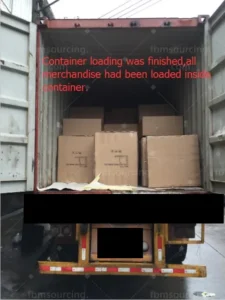
Sometimes, on a large project, the vanities alone fill full containers; sometimes the vanities share containers with the other product categories of the same project; and sometimes, in one batch, we combine a dozen or more product categories from several projects of the same client into a few containers — always full containers, and for us this is routine, well-practised work.
On a phased property that means splitting the production run so containers land against the turnover sequence. Agree the split before the first purchase order: packing density, carton marking by building and unit type, and the order in which the plant runs the widths all follow from it.
What FBM Sourcing Does on a Multifamily Vanity Package
As your sourcing partner in China, FBM Sourcing turns the vanity schedule into something a plant can price: converted dimensions, substrate and finish specification, hardware specification, and the documents the package has to carry into the United States. We shortlist plants against that specification, run samples against the converted dimensions, and collect the evidence named above from the plant rather than from a catalogue.
There is one inspection by our own team at the factory after bulk production is finished, before shipment, with photo and video records, and that report goes to the client before the balance is paid. At that inspection we check the finished-good labels and documents against what the package should carry, and confirm the carton marking matches the building and unit-type split. Consolidation and shipping are handled from the same place, and sea freight is quoted to you before shipment. We do not issue certifications, test panels ourselves or install.
Have a US multifamily vanity schedule to price?
Send us the unit mix and the vanity schedule and we will turn it into a specification Chinese plants can quote against, with the compliance evidence named up front.
Frequently Asked Questions
Are all bathroom vanities from China subject to antidumping and countervailing duties?
No. The orders cover wooden cabinets and vanities for permanent installation made substantially of wood products, including solid wood and engineered wood products, or bamboo, together with named wooden component parts, and they include unassembled, assembled and ready-to-assemble units. Whether a particular unit falls inside that written description is a classification question for your customs broker or trade counsel, and the published scope states that the written description, not the tariff number, is dispositive.
Does a vanity made in Vietnam or Malaysia avoid the question entirely?
Not automatically. In a final scope determination published on 17 July 2024 Commerce implemented a certification regime covering wooden cabinets entered from Malaysia and Vietnam and rescinded the related circumvention inquiries, and the published scope separately states that in-scope merchandise further processed in a third country remains covered. Confirm with your broker which certifications apply before shipping.
What formaldehyde label should be on a vanity arriving in the United States?
Under 40 CFR 770.45 the fabricator must label every finished good, or every box or bundle containing finished goods, with at minimum the fabricator’s name, the production date in month and year format and a statement that the finished goods are TSCA Title VI compliant, in legible English; importers separately hold a written supplier statement of compliance and panel producer records for three years.
Is ANSI/KCMA A161.1 certification mandatory for a US multifamily project?
It is a voluntary performance and construction standard, not a legal requirement, so it applies to your project only if your specification calls it up. Where it does, it is a practical way to compare plants, because its named tests, including 25,000-cycle door and drawer operation tests and a seven-day static shelf loading test, describe measurable outcomes rather than adjectives.
How should accessible-unit vanities be handled in the package?
Treat them as a separate unit type with their own drawing and sample. The 2010 ADA Standards set a maximum lavatory rim or counter height of 34 inches (865 mm) and require pipes below to be insulated or otherwise configured to protect against contact, which generally rules out a standard closed base carcass. The design and code consultant on the project confirms which units and which code apply.
About FBM Sourcing
FBM Sourcing manages the entire China procurement package for overseas construction projects. Since 2014 we have worked with developers, general contractors, builders, commercial project owners, interior design and construction companies and FF&E solution providers across more than 20 countries and over 1,000 containers, as their sourcing partner in China — from the schedule or BOQ through factory selection, sampling, inspection by our own team before shipment, consolidation and shipping. All quotations, invoices and shipping documents are issued by FBM Sourcing, and sea freight is quoted to you before shipment. If you have a bathroom vanity package to price, start at China building materials and FF&E procurement.