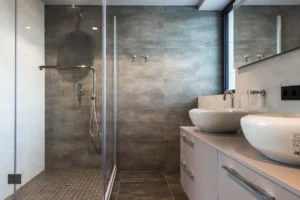
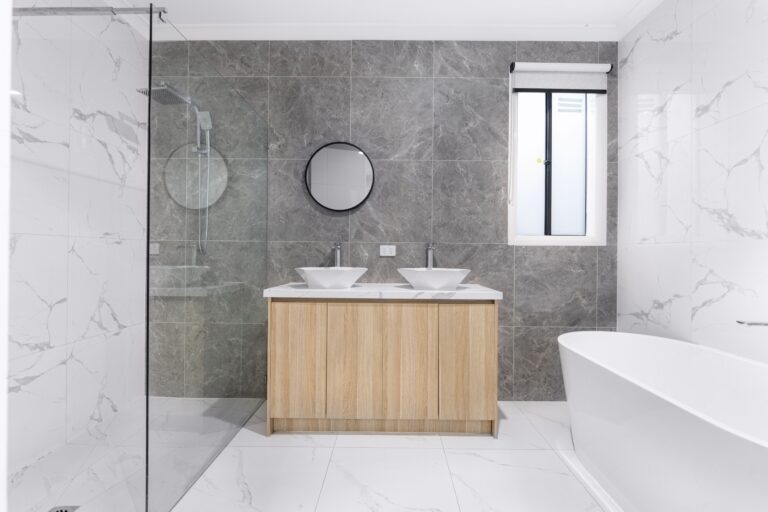
Procuring bathroom vanities from China for a hotel or apartment project comes down to five decisions made in the right order: the specification tier (carcase board, door finish, hardware level), the mounting method (wall-hung or floor-standing), the dimensional and basin interface details that must be frozen before quotation, the moisture specification that determines service life, and how the vanity order is coordinated with the rest of the sanitaryware package. Get those five right and the factory side is straightforward — Chinese factories produce vanities to any of the tiers below at volume, with production runs of 30–45 days for a typical project order. This guide is the project decision path; for the product scope, configurations and how to brief us directly, see our bathroom vanity cabinet sourcing page. On projects like this, FBM Sourcing works as your dedicated sourcing partner.
The audience is project buyers — hotel developers, apartment builders, main contractors and FF&E contractors — specifying 50 to 500+ bathrooms, not single-unit retail purchases.
Which Vanity Specification Tier Does Your Project Need?
Vanity quotations only become comparable once the tier is fixed, because the same-looking cabinet can be built three different ways. The tiers are defined by materials, not by appearance:
Budget tier — moisture-resistant particleboard carcase, PVC-wrapped door, ceramic drop-in basin, laminate countertop. Appropriate for budget hotels and affordable rental housing where the replacement horizon is short.
Commercial tier — 18mm moisture-resistant MDF (MRMDF) carcase, PU lacquer door, undermount ceramic basin, quartz countertop, soft-close hardware. The standard for 3–4 star hotels and mid-market apartments, and the most commonly specified tier on project orders.
Premium tier — 18mm MRMDF or solid wood carcase, high-gloss lacquer or veneer door, integrated stone basin or designer ceramic, sintered stone countertop, Blum-grade hardware. Specified for 5-star hotels and luxury residential.
The decision rule: match the tier to the operator’s maintenance model and replacement cycle, not to the render. Under-specifying a premium project shows up in warranty claims; over-specifying budget housing wastes budget that the pro forma never recovers. Cost between tiers moves with the material structure — carcase grade, door finish system, countertop material and hardware level are the four lines that drive the difference.
Wall-Hung or Floor-Standing: Which Should the Project Specify?
This is a construction decision as much as a design one, and it must be made before the factory quotes because it changes the cabinet structure.
Wall-hung vanities read as more premium, make floor cleaning easier for housekeeping, and are now the default in 4–5 star hotel design. They require a reinforced mounting substrate in the wall — blocking or a steel frame coordinated with the wet-wall build-up — and a cabinet engineered with a load-rated hanging system rather than a decorative back panel. Confirm wall construction with the builder before committing.
Floor-standing vanities tolerate ordinary wall construction, hide floor-mounted plumbing, and suit apartment projects where wall reinforcement was never in the structural package. Adjustable feet behind a kick panel handle floor tolerance.
Standard finished height is 850mm from floor to countertop; some luxury hotel brand standards specify 900–920mm for ergonomics. Confirm the brand standard in writing — a 50mm height error across 300 bathrooms is not fixable on site.
What Must Be Frozen Before the Factory Can Quote?
Vanity orders fail on interfaces, not on cabinets. Five details must be locked before quotation, because each one crosses between trades:
- Width against the bathroom plan. 600mm, 750mm and 900mm are the standard commercial widths; a vanity 10mm too wide simply does not fit between finished walls. Quote from dimensioned drawings, never from a room list.
- Basin model and mounting. Undermount ceramic is the commercial standard — easier to clean than drop-in and required by most hotel brand standards. The exact basin model must be chosen at brief stage so the countertop cutout is cut to it in the factory.
- Tap hole configuration. Single hole for a monobloc mixer, three holes for separate taps, or no hole for wall-mounted tapware. Drilling stone on site voids the countertop warranty; drilling nothing strands 300 mixers in a warehouse.
- Countertop overhang. 20–30mm beyond the cabinet front is standard; on wall-hung units confirm the overhang against towel rail and accessory positions in the bathroom elevation.
- Mirror scope. Plain mirror or mirrored cabinet, and its width relative to the vanity — matched widths read as designed, mismatched widths read as procurement error.
Sourcing this for a commercial project?
FBM Sourcing works with project owners, developers, main contractors and FF&E contractors on hotel, apartment, school, office and other commercial building projects. Send us your BOQ, drawings or product list — our team will review it and get back to you.
What Moisture Specification Separates a 10-Year Vanity from a 3-Year One?
A bathroom cabinet lives in continuous elevated humidity, so moisture specification is the single largest driver of service life — and the easiest place for a low quote to hide a substitution. Write these four lines into the purchase order:
- Carcase board: moisture-resistant MDF with the green dye core, 18mm, as the minimum. Standard particleboard swells and delaminates in bathroom conditions — confirm the board grade in writing, and verify the green core on the sample’s cross-section at inspection.
- Back panel: 6mm MRMDF or moisture-resistant hardboard. The back panel is where budget factories economise first, and where delamination starts.
- Edge banding adhesive: PUR (polyurethane reactive), not standard EVA — EVA softens and releases in sustained humidity, and a lifted edge is the first visible failure on a lacquered door.
- Door substrate and sealing: MDF is fine for lacquered and PVC-wrapped doors; solid wood doors need fully sealed edges against moisture ingress.
If the destination market regulates formaldehyde emissions — E1/E0, CARB or TSCA Title VI — the board certification belongs in the purchase order too; our guide to formaldehyde standards for cabinets from China explains which applies where.
How Should Vanities Be Coordinated with the Rest of the Bathroom Package?
A vanity is one component of a bathroom package that also includes toilets, shower enclosures, tapware, accessories and sometimes bathtubs — and procuring the components together is materially more efficient than buying them separately. Coordinated procurement means the tap hole drilling matches the actual mixer body, the basin matches the actual countertop cutout, finish tones are approved side by side, and everything ships in the same containers, loaded by floor or by room type so site receiving is fast. It also concentrates volume with one coordinator instead of splitting it across category buyers. How the wider package is structured is covered in how to source commercial toilets and sanitaryware for a hotel or apartment project, and for hotel-specific vanity configurations see hotel bathroom vanity sourcing.
How Do QC, Packing and Shipping Work for a Vanity Order?
Production for a typical project vanity order runs 30–45 days after sample approval. Final inspection before loading — performed by FBM Sourcing’s own QC team in the factory and documented in photo and video records delivered to the client — covers:
- Board verification: green MRMDF core confirmed on carcase cross-sections, against the purchase-order specification
- Finish: doors and panels checked under raking light for pinholes, orange peel and batch colour variation
- Dimensions: width, height and depth measured on random units against approved drawings, to ±2mm
- Basin fit: basin flush in the countertop cutout, no gaps or proud edges
- Hardware: hinges and drawer runners cycled on completed units
- Packing: stone countertops and ceramic basins packed separately from cabinets, with corner protection engineered for ocean freight — packing failures on stone and ceramic are the most expensive defects in the category
Add roughly 2–3 weeks ocean freight to Australian east-coast ports and 3–5 weeks to the US and Europe, plus clearance and delivery. Sea freight is charged per container, so vanities normally share containers with the wider bathroom or joinery package rather than shipping alone.
Get a Vanity Package Quote for Your Project
Send bathroom drawings, the vanity schedule with widths and quantities, basin and tapware references, destination port and target delivery window. As a China building materials and FF&E procurement agent working on a 5% commission for suppliers you nominate (products we source for you are quoted at a direct price), FBM Sourcing comes back with tier recommendations, comparable factory quotations and a production and shipping schedule aligned to your fit-out programme.