How Do Pharmacy and Health Retail Chains Source a Repeatable Store Fit-Out from China?
A retail chain does not buy products from China — it buys a kit of parts, once, and then buys it again forty times. The whole discipline of a pharmacy or health retail rollout is to design one store, build one physical prototype, freeze the kit of parts down to the laminate decor code and the shelf bracket, and then order in store-sized packs that arrive labelled by store and by zone. Chains that do this get store 40 looking like store 1 — the same discipline that governs a convenience store chain rollout. Chains that reorder from a product list get gradual drift — a slightly different white, a slightly different shelf pitch — and end up unable to move a fixture between their own stores.
This guide is written for retail chain owners and development teams, property and construction managers, shopfitting contractors and the design firms who write the standard store specification. It covers what belongs in a China package for a pharmacy or health retail rollout, the regulated items that need particular care, and the rollout mechanics that decide whether the thirtieth store is as good as the first.
What Goes into the Kit of Parts
- Shopfloor fixturing — wall bays and gondolas, shelves, brackets, base plinths, end caps, sign holders, hook and pegboard systems, promotional units.
- Counters and dispensary joinery — front counter and point-of-sale joinery, consultation room joinery, and the back-of-counter dispensary run with its drawers, pull-outs and secure storage.
- Refrigeration — open multideck chillers for shopfloor, and pharmacy-grade refrigerators for temperature-controlled stock. These are two different products with two different rule sets.
- Lighting — general shopfloor, accent, dispensary task lighting and illuminated signage.
- Flooring and finishes — vinyl or tile, skirting, wall finishes, ceiling.
- Signage and wayfinding — fascia, category signage, shelf-edge systems.
- Back of house — racking, staff lockers, workbenches, trolleys and stock-handling equipment, much of it shared with supermarket and grocery chain procurement.
Of these, fixturing, joinery, lighting, signage and back of house source extremely well from China because they are repeatable and specification-driven — which is also why commercial sourcing behaves nothing like retail buying. Refrigeration sources well but needs the most technical scrutiny. Flooring sources well when the slip and fire classification route is settled first.
Why Does the Prototype Store Decide Everything?
Because a drawing cannot tell you that the shelf pitch fights the product height, and a rendering cannot tell you that the dispensary drawer is 40 mm too shallow for the fastest-moving pack size.
The prototype is not a marketing exercise. It is the last cheap opportunity to find errors. Build one complete store — or, where that is impossible, one complete bay of every fixture type plus the full dispensary run — and then trade in it, or at least stock it and work it, before the rollout order is placed. The specific things a prototype catches that drawings do not:
- Shelf pitch against real product. Shelf spacing set from a drawing is almost always wrong for at least one category, and changing shelf pitch after rollout means changing every bay.
- Ergonomics of the dispensary run. Reach heights, drawer depths and the sequence of operations are only testable with a pharmacist standing in it.
- Real light levels on real stock. A dispensary is a task-lighting environment, and the reference for lighting of work places, EN 12464-1, treats dispensing as a task requiring a substantially higher maintained illuminance than general shopfloor. Measure it in the prototype rather than trusting a lighting calculation.
- Assembly time per bay. The single most valuable number the prototype produces. Multiply it by the number of bays across the rollout and it will change the fixture design.
Once the prototype is signed off, freeze it. A frozen kit of parts means a numbered part list where every item has a code, a drawing, a material and finish reference including the decor code, and a supplier reference. From that point the chain orders part numbers, not descriptions.
The Regulated Items That Need Particular Care
Refrigeration
Pharmacy refrigeration splits into two products that should never be confused. Shopfloor multidecks are commercial display refrigeration. Pharmacy-grade refrigerators for temperature-controlled medicines are a different class of equipment, and what makes them acceptable is not the cooling but the evidence: tight temperature stability across the whole cabinet, continuous monitoring with a calibrated probe, an alarm on excursion, and a data record that can be produced on inspection. Ask for the temperature mapping data for the cabinet, the alarm specification, and how the record is retained.
For both types, two regulatory questions decide whether the unit can be imported at all. The first is refrigerant: fluorinated refrigerants are being phased down under the EU F-Gas rules and equivalent programmes elsewhere, and a cabinet built for the Chinese domestic market may use a refrigerant that cannot be placed on the destination market. Hydrocarbon refrigerants such as R290 are now common in commercial display refrigeration and bring their own charge-size and installation constraints. The second is energy performance: refrigerated cabinets with a direct sales function carry energy labelling obligations in the EU and comparable efficiency rules in other markets, and a cabinet without the right label is not sellable. Confirm both in the enquiry, in writing, before sampling.
Joinery and panel products
Dispensary and counter joinery is panel product, and panel product carries a formaldehyde emission limit at the destination. For the United States, composite wood panels are regulated under TSCA Title VI, harmonised with the CARB Phase 2 standard, and the panels must be certified and labelled accordingly. For EU projects, the REACH limit of 0.062 mg/m³ for furniture and wood-based articles placed on the EU market after 6 August 2026 applies to the finished article. This is an import compliance issue rather than a quality preference — ask for the panel certification at enquiry stage and require the certificate to name the panel mill.
Electrical items
Lighting, illuminated signage and refrigeration all need an electrical certification route valid for the destination voltage and frequency. For North America that means a listing on the finished fitting — UL or ETL — rather than a certificate on a component; a CE declaration does not transfer. For Europe and the UK it means the conformity route covering low voltage and electromagnetic compatibility. Certificates are issued per model, so a listing for one luminaire length does not cover another.
Sourcing this for a commercial project?
FBM Sourcing works with project owners, developers, main contractors and FF&E contractors on hotel, apartment, school, office and other commercial building projects. Send us your BOQ, drawings or product list — our team will review it and get back to you.
How Should a Rollout Order Be Packed?
By store and by zone — never by product type. This single decision separates rollouts that install cleanly from rollouts that turn a new store into a warehouse.
The packing standard that works:
- Every carton carries the store code, the zone, the part number and a sequence number — for example “Store 27 / Dispensary / DR-014 / 3 of 9” — in a fixed position and in the destination language.
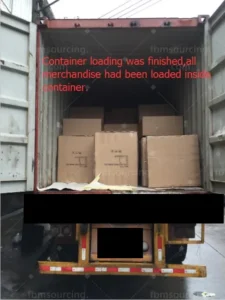
- Each store’s consignment ships as an identifiable block within the container, with a store-level packing list, so a store can be unloaded without opening the whole container.
- Fixings, brackets and small parts ship per bay in their own bagged sets, not in bulk boxes. A bulk box of brackets on a shopfit site becomes a floor covered in brackets.
- An assembly instruction set ships with each store, in the language the installers read, referenced to the same part numbers.
- A store-level attrition allowance of around 2–3% on small parts — brackets, sign holders, shelf clips, end caps — ships with each store rather than being held centrally, because the part that goes missing is always small and always needed that day.
On container planning, the practical rule is to plan by volume and by installation sequence rather than by value. A 40 ft high-cube container gives roughly 68 m³ of usable packed volume, and depending on store size that is typically one to three stores’ worth of fixturing. Our minimum order commitment is a full container load rather than part-load consolidation, which suits rollout buying well because rollouts naturally order in multiples.
How Do You Stop Store 30 Drifting from Store 1?
Drift is not caused by bad factories. It is caused by unfrozen references and by reorders placed against descriptions instead of part numbers. Four controls hold the line:
- Record decor and finish codes, not colour names. “Warm white laminate” will drift. A named decor reference with a retained physical control sample will not. Keep two control samples — one with the chain, one with the buying side — and compare against them at every reorder.
- Batch the finishes that are visible side by side. Where several stores will be built in one phase, run the visible laminate and paint items in one production batch, because shade varies between batches in a way that is invisible until two fixtures sit together.
- Re-approve on any change of component. A substituted hinge, edge band or LED strip is a change to the kit of parts and needs a sample, not an email.
- Keep a maintained master file. One numbered kit-of-parts document, version controlled, is the difference between a rollout and a series of similar projects. It is also the asset that survives a change of contractor or a change of buyer.
How the Quality Control Works
All inspection on FBM Sourcing packages is carried out by our own team at the factory before shipment, with photo and video records. On a rollout, the pre-shipment inspection checks the goods against the retained control sample and the frozen kit of parts, and verifies the store-level packing and labelling — which on a rollout is where the real risk sits, since a mislabelled consignment is discovered by an installation crew standing in an empty store. Manufacturer and laboratory certificates are reviewed for model coverage, scope and validity rather than accepted at face value.
FBM Sourcing acts as a sourcing partner on the chain’s side of this: we hold the kit-of-parts file, run the technical exchange with the manufacturers across fixturing, joinery, refrigeration and lighting, and keep the reorder discipline consistent across phases so that the chain is buying the same parts each time rather than a fresh interpretation of the same drawing.
Frequently Asked Questions
Can pharmacy refrigerators be sourced from China?
Yes, but they must be specified as pharmacy-grade equipment rather than as commercial refrigeration. The requirements that matter are temperature stability mapped across the whole cabinet, continuous monitoring with a calibrated probe, an excursion alarm and a retainable data record. Separately, confirm that the refrigerant and the energy labelling are valid for the destination market before sampling, because both can make an otherwise good cabinet unimportable.
Should a chain build a prototype store before ordering a rollout?
Yes, and it is the highest-return decision in the whole programme. A prototype catches shelf pitch against real product, dispensary ergonomics, actual light levels and — most valuably — the assembly time per bay, none of which are visible on a drawing. Fixing those before the rollout order costs one store; fixing them afterwards costs all of them.
How should a retail rollout order be packed and labelled?
By store and by zone, with every carton marked with store code, zone, part number and sequence number in the destination language, a store-level packing list, fixings bagged per bay rather than in bulk, and assembly instructions shipped with each store. Add a small attrition allowance of small parts to each store’s consignment rather than holding it centrally.
What certification do store fixtures and joinery need?
Panel products carry formaldehyde emission requirements — TSCA Title VI harmonised with CARB Phase 2 for the United States, and, for EU projects, the REACH limit of 0.062 mg/m³ for furniture and wood-based articles placed on the EU market after 6 August 2026. Electrical items need a listing valid for the destination on the finished product: UL or ETL for North America, and the low-voltage and electromagnetic compatibility conformity route for Europe and the UK. Certificates are issued per model, so check the model numbers.
How do you keep finishes consistent across a multi-phase rollout?
Record decor and finish codes rather than colour names, retain two physical control samples and check against them at every reorder, batch the visible finishes for stores that will be built in the same phase, and treat any component substitution as a change requiring a new sample. Reorder against part numbers from a version-controlled kit-of-parts file, never against a written description.
Sourcing this for a commercial project?
FBM Sourcing works with project owners, developers, main contractors and FF&E contractors on hotel, apartment, school, office and other commercial building projects. Send us your BOQ, drawings or product list — our team will review it and get back to you.
Get a China Procurement Quote for Your Project
FBM Sourcing has managed China procurement packages for commercial building projects since 2014, across more than 20 countries and over 1,000 containers. We manage the entire China procurement package on the buyer’s side: we hold the kit-of-parts file, run the technical exchange with manufacturers, check certification against the models actually specified, inspect with our own team and control the store-level packing and labelling that a rollout lives or dies on.
Send your standard store drawings, fixture schedule and rollout programme with the destination port, and we will review them and come back to you. More on how a full package is put together: China building materials and FF&E procurement.