Only one publicly listed Chinese company has uPVC window profiles as its core disclosed business, and it makes profile, not windows. The plants that weld, reinforce, glaze and ship finished uPVC windows for multifamily projects are private companies that no overseas buyer can verify from public records, and the hardware inside them comes from a separate listed maker. This guide sets out what is actually checkable, how the supplier types differ, and the evidence a multifamily project team in the United States, Australia or the United Kingdom needs in hand — NAFS and AAMA 303, AS 2047, EN 14351-1 and BS EN 12608, corner-weld and reinforcement data, stabiliser type and acoustic ratings — before a purchase order for several hundred openings is issued.
What are you actually buying when you buy “uPVC windows” from China?
The phrase covers at least six different businesses, and the answer to “who makes it” depends on which one is quoting:
- Resin and compound suppliers. They make the PVC resin and the dry blend — resin, impact modifier, titanium dioxide, stabiliser. They do not make profile. Their quality question is stabiliser chemistry and titanium dioxide content, which decide whether the profile yellows or chalks in a hot climate.
- Profile extruders. They own the extrusion lines and the tooling and sell profile by the metre or the tonne. This is where the one listed company sits. They do not make windows.
- Foil laminators and colour finishers. Exterior foils, co-extruded acrylic caps and painted finishes for anything other than white. On a dark-coloured window in a sunny market this is the component that fails first.
- System houses. They design the profile system — chamber layout, gasket geometry, drainage, reinforcement pockets, hardware groove — and license it to fabricators together with the test evidence that belongs to the system.
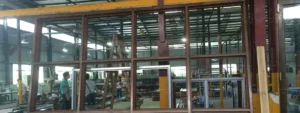
- Window fabricators. They cut, weld, clean, reinforce, glaze and assemble the finished unit. This is the company whose name should be on the purchase order and whose plant the inspection covers.
- Hardware and glass processors. Espagnolettes, tilt-turn gears, hinges and locks from a hardware maker; insulated glass units from a glass processor. Both are named on a good quotation and anonymous on a poor one.
Mixing these up is the single most common cause of a quotation that looks 30% cheaper than the rest of the field. An extruder quoting profile and a fabricator quoting finished, tested, glazed and reinforced units are not quoting the same thing. The same problem shows up on the drawing side, which is why a window and door takeoff has to get from the schedule to an order sheet before anyone can price it comparably. And before the material is fixed at all, the frame decision itself — set out in aluminium vs uPVC windows from China — should already have been made on thermal, acoustic and facade-height grounds.
Publicly listed companies a multifamily project buyer can verify
We name only companies whose listing and disclosures are public and checkable, and we state plainly what each one actually does. Everything else in this guide is written as a supplier type.
- Conch (Anhui) Energy Saving and Environment Protection New Material (海螺新材), Shenzhen Stock Exchange: 000619. Based in Wuhu, Anhui, and part of the Conch group. Its disclosed core business is the extrusion of uPVC door and window profiles, with production bases across China and a capacity it describes as among the largest in the world for this product. Role note: a profile extruder, not a window maker — it is the company behind the profile that a private fabricator may be quoting, and its name on a profile is a verifiable fact. Evidence to request from any fabricator claiming to use its profile: the extruder’s delivery note and profile classification certificate, the stabiliser type declared for that profile series, and whether the exterior surfaces carry a co-extruded weathering layer for your climate.
- Kinlong Hardware (坚朗五金), Shenzhen Stock Exchange: 002791. Listed March 2016. Its disclosed core is building hardware built around door, window and curtain wall hardware systems, including tilt-turn gears, sliding hardware and locks. Role note: a hardware supplier, not a window maker — but on a multifamily window the hardware is what the maintenance team replaces first, so knowing the brand behind a quoted window is a real due-diligence step. Evidence to request: the hardware series proposed for each opening type, its cycle-test evidence, and the corrosion class for a coastal site.
Listed status confirms scale and disclosure obligations. It does not confirm that a fabricator using these components has ever shipped a compliant window into your market, and it is not a substitute for the test evidence set out below.
The supplier types that make up the rest of the market
- Export-oriented window fabricators. Plants whose output is mostly project work for overseas markets, usually holding at least one set of North American, Australian or European test reports. Evidence to request: the test report numbers, the laboratory that issued them, and the specific profile system, configuration and size tested against what you are ordering.
- Domestic-market fabricators. Very large, very capable, and tested only to Chinese national standards. Adapting a domestic line to a certified export product is an engineering exercise, not a paperwork exercise. Evidence to request: proof of at least one completed project in your market, not a promise to obtain certification later.
- System houses. Where the thermal, structural and drainage performance actually originates. Evidence to request: which system is being used, whether the test evidence belongs to that system, and whether it covers the fabricator building your units.
- Profile extruders other than the listed one. Regional extruders in Guangdong, Shandong, Zhejiang and Liaoning, many of them competent and none of them verifiable from outside. Evidence to request: profile classification to BS EN 12608-1 or AAMA 303, wall thickness class, stabiliser declaration and titanium dioxide content for the climate.
- Trading intermediaries. Companies that broker between the buyer and one or more of the above without owning production. Evidence to request: which factory will fabricate, whose profile it will use, and whether the intermediary will place its own name on the documents and carry the responsibility.
Sourcing this for a commercial project?
FBM Sourcing works with project owners, developers, main contractors and FF&E contractors on hotel, apartment, school, office and other commercial building projects. Send us your BOQ, drawings or product list — our team will review it and get back to you.
Which supplier route fits which multifamily project?
| Project scenario | Shortlist from this list | Why it fits | What would change the answer |
|---|---|---|---|
| Garden-style or mid-rise apartments, repeated opening types, white frames | Export fabricator using a verifiable profile | Repetition suits a plant already holding test evidence for that configuration; white profile removes the colour-durability question | A facade above the height at which the local code or the system’s test envelope stops covering uPVC |
| Dark or woodgrain frames in a hot, sunny market | Fabricator whose profile carries a co-extruded acrylic cap or a tested exterior foil | Colour and heat build-up decide whether the frame distorts; the finishing system, not the extruder, is the risk | A cooler climate or a light colour, which relaxes the finish question |
| Urban site with a traffic-noise condition | Fabricator with acoustic test reports for the exact glazing build-up | The acoustic rating belongs to the unit as tested, not to the profile; ask for Rw or STC on your configuration | A double-facade or secondary glazing strategy handled by the facade engineer |
| Coastal high-velocity hurricane zone | Only fabricators already holding impact approval for a uPVC product | Approval is per product and cannot be added after shipment; the buyer guide for that route is impact-rated hurricane windows from China | An inland site with no wind-borne debris requirement |
| Student housing or build-to-rent with a long-term maintenance contract | Fabricator plus a named hardware brand with spares availability | Hardware cycle life and spares are the real cost over the lease term | An operator standard that specifies aluminium for all openings |
What evidence must be in hand before you order?
This is where a uPVC window purchase most often goes wrong, because the factory’s own reports are usually to Chinese standards and are not interchangeable with your market’s. The following are the documents a multifamily project team should hold, grouped by market:
- United States. NAFS certification under AAMA/WDMA/CSA 101/I.S.2/A440 for the specific product line, configuration and size range; profile conformance to AAMA 303 for rigid PVC exterior profiles; component reports to ASTM E283, E331 and E330; an NFRC label certificate for U-factor and SHGC, explained in NFRC ratings and U-factor for windows on US projects; safety glazing to 16 CFR 1201; and, on multifamily buildings, window opening control devices to ASTM F2090 where the code requires fall protection at openings.
- Australia. Compliance with AS 2047 for windows and glazed doors, including the test methods it calls up, glass to AS 1288, and a WERS or equivalent energy rating where the project’s energy assessment relies on it. Ask for the test report on the same profile system and size envelope you are ordering.
- United Kingdom and Europe. Profile classification to BS EN 12608-1, unit performance and CE or UKCA marking to EN 14351-1, security to PAS 24 where Approved Document Q applies to new dwellings, and an energy rating from a recognised scheme where the specification asks for one.
- Universal, whatever the market. Corner-weld strength test results; galvanised steel reinforcement specification and the chambers it occupies; stabiliser type, with a calcium-zinc declaration where lead-based stabilisers are restricted; titanium dioxide content and any co-extruded weathering layer for hot climates; and the glazing build-up, whose trade-offs are set out in double glazing vs Low-E vs triple glazing for commercial windows.
- Hardware evidence. Brand, series and cycle-test data for every opening type, and a corrosion class for coastal sites; the specification questions are set out in window hardware from China: a specification guide.
Check that the tested configuration and size envelope covers your largest unit, not the smallest, and that the acoustic report is for the glazing you are actually buying. A cross-market comparison of what each jurisdiction demands is set out in window and door export certifications by market.
How do uPVC windows ship on a multifamily project?
Windows are a volume cargo rather than a weight cargo: a container of glazed units reaches its cubic limit long before it reaches its payload limit, and the packing method is the difference between a clean delivery and a damage claim. uPVC frames are lighter than aluminium but less stiff in the frame, so units are shipped upright in steel or timber A-frames or purpose-built crates, braced so nothing racks, with glass edges protected and interleaved. Dark-coloured frames need additional care against heat build-up inside a container on a summer voyage.
Sometimes, on a large project, the uPVC windows alone fill full containers; sometimes the uPVC windows share containers with the other product categories of the same project; and sometimes, in one batch, we combine a dozen or more product categories from several projects of the same client into a few containers — always full containers, and for us this is routine, well-practised work.
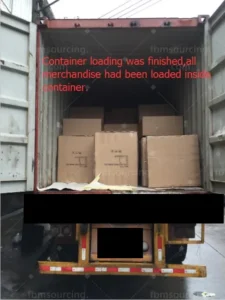
Three points decide whether the delivery works: the loading sequence has to match the installation sequence by floor or elevation, the packing list has to identify every unit against the window schedule mark, and the loading itself has to be documented before the doors close. What that documentation should contain is set out in what a container loading report should show for a commercial project.
Why this list has no scores, ratings or supplier links
We publish no score column and no outbound links to the companies named. A score would imply we had audited every company against the same criteria in the same period, which we have not. What we do instead is state what is publicly verifiable, describe the supplier types honestly, and set out the evidence to request — the judgement stays with the project team, its facade consultant and the authority having jurisdiction. That is also why a multifamily project team often uses a China sourcing partner or sourcing agent for this category: not to be handed a ranked list, but to have the evidence above collected, checked on the factory floor before shipment and tied to one set of documents.
We also publish no prices for windows. Unit price moves with profile system, reinforcement, glass build-up, hardware, colour, size and quantity, and a number published today would mislead a reader next year.
About FBM Sourcing
FBM Sourcing manages the entire China procurement package for overseas construction projects. Sourcing since 2014, we have shipped 1,000+ containers to project sites in 20+ countries, working with project owners, developers, main contractors and FF&E contractors on hotels, apartment buildings, schools, offices and other commercial buildings. All quotations, invoices and shipping documents are issued by FBM Sourcing — you deal with us, and we carry the responsibility. For suppliers you nominate, we charge a 5% commission; for products we source for you, we quote a direct price.
If you have a window package for a multifamily project, send us the window schedule, the elevations and the country and city the project sits in at https://fbmsourcing.com/china-building-materials-ffe-procurement/.
Frequently asked questions
Are there listed Chinese companies making uPVC windows?
One listed company, Conch (Anhui) Energy Saving and Environment Protection New Material (000619, Shenzhen), has uPVC door and window profile extrusion as its core disclosed business, and Kinlong Hardware (002791, Shenzhen) is a listed maker of the hardware used in them. Neither fabricates finished windows. The plants that weld, reinforce and glaze uPVC windows for export are private companies without public disclosure.
Does a Chinese test report satisfy a US, Australian or UK building authority?
Generally no. US authorities work from NAFS certification and ASTM reports plus an NFRC label; Australian projects require AS 2047 compliance; UK and European projects require CE or UKCA marking to EN 14351-1 and profile classification to BS EN 12608-1. A Chinese national standard report is not interchangeable and will normally be rejected.
Is uPVC suitable for dark-coloured frames in a hot climate?
Only with a finishing system designed for it: a co-extruded acrylic weathering cap or a tested exterior foil, adequate titanium dioxide in the compound, and steel reinforcement sized for the thermal movement of a dark frame. White profile avoids most of the problem, which is why it remains the default on large multifamily orders.
What reinforcement should a uPVC window for a multifamily building have?
Galvanised steel reinforcement in the main chambers of frame and sash, sized to the opening dimensions and the wind load, with the reinforcement specification and the corner-weld strength results stated on the quotation. Larger openings, dark colours and taller buildings all push the reinforcement requirement up.
What is the minimum order for uPVC windows from China?
We do not handle loose freight. The practical minimum is a full container load consolidated for one client, and uPVC windows can share containers with the other product categories of the same project.