
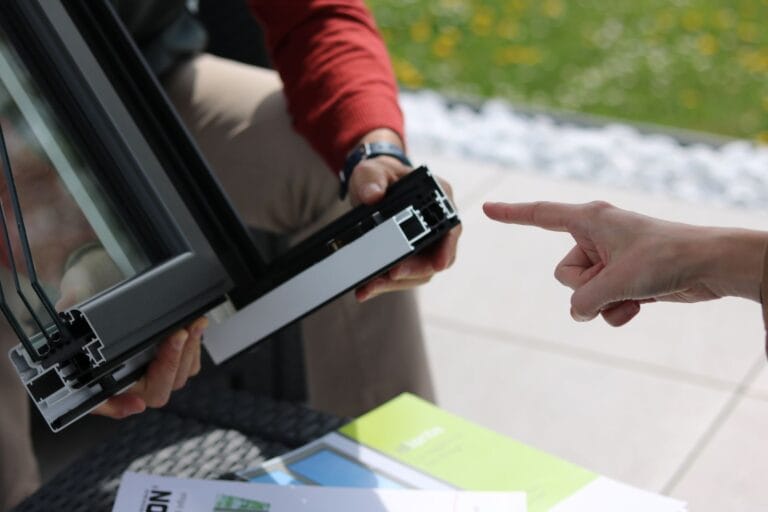
For most commercial projects the answer is aluminium, and the question is really about the small number of openings where it is not. Thermally broken aluminium is the default frame material for commercial glazing because it is light, corrosion-resistant, available in almost any finish, and supported by an enormous manufacturing base. Steel windows are specified where aluminium cannot do the job: where a fire rating is required in the frame, where sightlines have to be genuinely slim, or where the opening is large enough that structural stiffness governs.
This page sets out the decision on the axes that actually change a specification — sightline, thermal performance, fire rating, corrosion, weight, cost and lead time — rather than as a general merits comparison. For the choice of opening type rather than frame material, see casement vs sliding vs single-hung windows; for the choice of glazing system on a tall building, see curtain wall vs window wall.
What actually separates aluminium and steel windows?
- Sightline. Steel is far stiffer than aluminium, so a steel frame carrying the same glass unit can be substantially narrower. Where an architect has drawn a slim, gridded, industrial-look window, steel is usually what makes the drawing buildable. Aluminium can imitate the look but not the dimension.
- Thermal performance. Aluminium and steel are both highly conductive, so both need a thermal break to perform. Thermally broken aluminium systems are mature, widely tested and available across a broad U-value range. Thermally broken steel systems exist but are a narrower market with fewer tested configurations, and the thinner frame gives less room for an effective break.
- Fire rating. This is the clearest dividing line. Where a window or screen has to hold a fire rating — a stair enclosure, a boundary condition, an internal separation — steel frames with fire-rated glazing are the normal answer. Aluminium softens at temperatures a fire test will reach, so rated aluminium windows are a specialist, limited product.
- Corrosion. Aluminium forms its own oxide layer and, once anodised or powder-coated, performs well in most environments including coastal ones with the right specification. Steel depends entirely on its coating system; a scratch that reaches the substrate starts corroding. In a marine environment this is a maintenance liability that has to be planned and budgeted.
- Weight and handling. Steel frames are heavier, which affects structural fixing, crane and hoist planning, installation labour, and container weight limits on the shipping side.
- Cost. For an equivalent opening, steel windows are typically several times the cost of a standard thermally broken aluminium window. The gap widens as the fabrication becomes more bespoke.
- Lead time. Aluminium window production in China is a volume industry with short cycles. Steel window fabrication is a smaller, more specialised trade, and the lead time reflects that.
When should you specify steel windows?
Four situations regularly justify the cost:
- A fire-rated opening. If the code requires an integrity or integrity-plus-insulation rating in a window or screen, steel is the practical route. The rating belongs to the tested assembly — frame, glass, seals, hardware and fixing together — not to the frame alone.
- A heritage or industrial-look elevation. Restoration and conservation work, and the steel-look aesthetic in hospitality interiors, both depend on a genuinely narrow sightline that aluminium cannot reach at the same dimension.
- Very large single openings. Where a screen or pivot door is tall enough that deflection under wind load governs, steel’s stiffness can avoid the intermediate transom that would otherwise be needed.
- Security and impact requirements. Where a frame has to resist forced entry or impact beyond what an aluminium section can achieve.
Outside those cases, specifying steel usually means paying a large premium for a performance characteristic the project does not need.
Sourcing this for a commercial project?
FBM Sourcing works with project owners, developers, main contractors and FF&E contractors on hotel, apartment, school, office and other commercial building projects. Send us your BOQ, drawings or product list — our team will review it and get back to you.
What does a hybrid specification look like?
On most commercial projects the sensible answer is not one material for the whole building. It is thermally broken aluminium for the general window and door schedule, with steel used only at the openings that require it: rated screens at stair and corridor separations, a feature entrance screen, and any restoration elevation.
This has a practical consequence for procurement. Aluminium and steel windows come from different factories — they are different trades with different equipment — so a hybrid specification means two suppliers, two sets of shop drawings and two sets of test evidence, even though it reads as one window schedule. Planning that split early avoids the situation where a fire-rated screen is discovered late and delays the whole glazing package.
What test evidence should you ask for either way?
Frame material does not change the evidence a project buyer should be requesting. What changes is the standard the destination market names:
- United States — AAMA/WDMA/CSA 101/I.S.2/A440 (NAFS) for structural, water and air performance, with NFRC certification for U-factor and SHGC where an energy code applies. Coastal Florida and other high-velocity hurricane zones add impact and cyclic pressure testing.
- Australia — AS 2047 for windows and external glazed doors, tested to the AS/NZS 4420 series, with AS 1288 governing the glass selection. This is a system-plus-fabricator certification, so the test report has to belong to the actual fabricator supplying you.
- Europe and the UK — EN 14351-1 with CE or UKCA marking, and the declared performance values that go with it.
- Fire-rated assemblies — the rating comes from a test report on the complete assembly to the relevant standard for the market (for example EN 1364/1634 in Europe, or the UL/NFPA route in the US). Ask for the report, and check that the tested size envelope covers the sizes on your schedule.
Two questions apply to every certificate on a window package, and they resolve most disputes before they start: is your model or system printed on the certificate schedule, and are the sizes on your schedule inside the tested size limits. A supplier who answers “we have a similar system that passed” or “that is the higher-specification version” has not answered either question. Our China window buyer’s guide works through the full QC and specification sequence.
How does the choice affect shipping and site delivery?
Steel windows are heavier per unit and per square metre of opening, which matters in two places. First, a container is far more likely to reach its weight limit before it reaches its volume limit, changing how the package consolidates. Second, heavier frames need more substantial fixings and more installation labour on site, which sits in the main contractor’s budget rather than the supply cost. Aluminium packages more often reach the volume limit first, which is why frame nesting and crating design has more effect on the freight cost.
Either way, glazed units travel badly when crated carelessly. How to import windows from China covers packing, freight and site delivery sequencing in more detail.
Where do these windows come from in China?
Aluminium window and door fabrication is concentrated in Guangdong — the Foshan aluminium belt in particular — alongside Shandong and Jiangsu, and is supported by a very large extrusion industry. Steel window fabrication is a smaller and more specialised trade, generally found at metalwork fabricators rather than at window factories, which is why a steel screen often ends up in the architectural metalwork package rather than the window package.
Where a destination-market certification is required, the number of qualified factories drops sharply — see, for example, our page on aluminium window and door manufacturers for Australian projects, where AS 2047 certification is the filter that does most of the work.
Sourcing this for a commercial project?
FBM Sourcing works with project owners, developers, main contractors and FF&E contractors on hotel, apartment, school, office and other commercial building projects. Send us your BOQ, drawings or product list — our team will review it and get back to you.
Frequently asked questions
Are steel windows better than aluminium windows?
Not generally — they are better at specific things. Steel gives slimmer sightlines, greater stiffness for very large openings, and the ability to carry a fire rating. Aluminium is lighter, more corrosion-resistant, cheaper, faster to produce and available in a wider range of tested thermal configurations. For a typical commercial window schedule, thermally broken aluminium is the appropriate default.
Can aluminium windows be fire-rated?
Only in a limited and specialist way. Aluminium loses strength at temperatures reached in a fire test, so where an opening must hold an integrity or insulation rating, steel-framed fire-rated glazing is the normal solution. The rating always belongs to the complete tested assembly — frame, glass, seals, hardware and fixing — not to the frame material.
How much more do steel windows cost than aluminium?
Materially more — commonly a multiple rather than a percentage, and the gap widens with bespoke fabrication. We do not publish price figures for products we have not quoted, because the answer depends on section, glazing, finish, hardware and quantity. Send the schedule and our team will review it and get back to you.
Do steel windows rust in coastal projects?
They corrode wherever the coating system is breached, so a coastal project needs a specified coating system, a maintenance regime and a realistic view of the whole-life cost. Aluminium with a marine-grade anodised or powder-coat finish is generally the lower-maintenance option in that environment.
Can one supplier provide both aluminium and steel windows?
Rarely as one manufacturer. Aluminium window fabrication and steel window fabrication are different trades with different equipment and different test evidence. A hybrid specification usually means two factories, coordinated into one delivery programme — which is straightforward to manage if it is planned at the start rather than discovered at shop drawing stage.
Which standard should my window specification name?
The one your destination market enforces: NAFS (AAMA/WDMA/CSA 101/I.S.2/A440) plus NFRC in the United States, AS 2047 with AS 1288 in Australia, and EN 14351-1 with CE or UKCA marking in Europe and the UK. Name it explicitly in the specification, then check that the certificate schedule lists your model and that your sizes sit within the tested limits.
About FBM Sourcing
FBM Sourcing is a China procurement partner for commercial building projects. We manage the entire China procurement package for project owners, developers, main contractors and FF&E contractors — supplier selection, technical review against your specification, order management, pre-shipment quality control and full-container consolidation. Windows are one of the categories where certification scope, not price, decides the shortlist — we check the certificate schedule against the actual window schedule before an order is placed.
If you have a project package to price, start here: China building materials and FF&E procurement.





