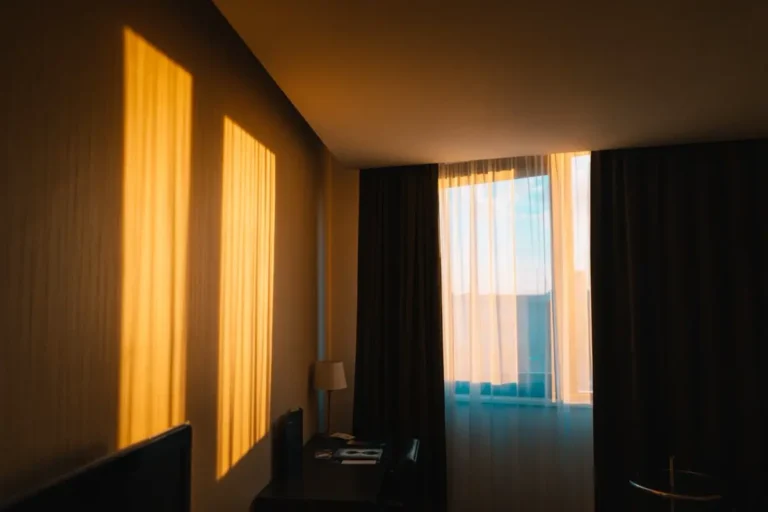
For hotel guest rooms, the practical default is a layered treatment: a sheer plus a lined blackout curtain for full-service and upscale properties, a cassette-guided blackout roller blind for select-service and extended-stay properties, and motorized shades reserved for luxury projects, high or hard-to-reach glazing, and public areas. The decision drivers are blackout performance, housekeeping durability, fire certification and lifetime cost rather than fabric fashion — and all three systems are produced at contract grade in China, where a furniture sourcing agent and sourcing partner can consolidate window treatments into the same FF&E production and shipping programme as the rest of the room package.
For a look at who actually makes these systems, see our roller blind manufacturers in China.
This comparison covers how each system performs in hotel service, what to specify for fire compliance and blackout levels, what drives cost, and how window treatments fit the wider procurement package described in our guide to the hotel FF&E package from China.
What Are the Real Differences in Hotel Service?
Blackout curtains remain the hospitality standard because they solve three problems at once: light control, acoustics and the perceived quality of a fully dressed window. A typical spec is a decorative face fabric with a 3-pass blackout lining (or a woven blackout fabric), on a heavy-duty commercial track with an overlap arm at the centre closure — the overlap and side returns are what separate a hotel blackout from a residential one, because light leaks at the edges, not through the fabric. Contract drapery fabrics run 280–300cm wide, which lets most guest-room drops sew without horizontal seams.
Roller blinds win on housekeeping and lifetime cost. A dual-roller system — one sunscreen mesh roller, one blackout roller — has no fabric to launder, no hooks to rehang, and a wipe-clean surface. For genuine darkness a naked roller is not enough: specify side channels and a cassette headbox, which cut edge light-gap leakage from roughly 20–30mm of open glow to near zero. Fabric options at 1–5% openness handle glare control; 0% openness PVC-free blackout fabrics handle the sleep function. Standard commercial rollers run to about 3m width per unit; wider spans split into coupled blinds.
Motorized shades are a controls decision as much as a furnishing one. Wired 24V or 110/230V AC motors integrated with the room management system suit new-build luxury and conference rooms; battery-tube motors retrofit without wiring but add a recharge cycle to maintenance. Specify quiet motors (≤38–44 dB is the usual contract band), and decide the control protocol — dry contact, RS485, or a wireless standard — at spec-book stage, because the motor choice locks the electrical rough-in. Reputable Chinese motor and system suppliers produce to CE and UL/ETL listings; require the listing certificate for the destination market with the shipment documents.
Which Fire Standards Apply to Hotel Window Treatments?
Window treatments are one of the most tightly fire-regulated soft categories in a hotel, and the standard must be named per jurisdiction in the purchase order:
- US projects: NFPA 701 flame propagation for curtains, drapes and roller-shade fabrics — hotel AHJs routinely ask for the test report at fire inspection
- UK projects: BS 5867 Part 2 Type B for curtains and drapes
- EU-standard projects: EN 13773 classification for curtains, with EN 13501-1 classes referenced for fixed shading fabrics
- Australian projects: AS 1530.2/AS 1530.3 indices as referenced by the NCC for the relevant application
- Composite specs: inherently flame-retardant (IFR) polyester — where the FR property is in the fibre, not a coating — survives commercial laundering; topically treated fabrics can lose certification after repeated washing, which matters for anything housekeeping launders on cycle
Certification logistics follow the same rules as the rest of the FF&E package — named standards in the spec, test reports delivered with shipping documents — covered in detail in our guide to fire safety certificates for hotel FF&E from China.
Sourcing this for a commercial project?
FBM Sourcing works with project owners, developers, main contractors and FF&E contractors on hotel, apartment, school, office and other commercial building projects. Send us your BOQ, drawings or product list — our team will review it and get back to you.
How Do the Three Systems Compare on Cost and Lifecycle?
Ranked by installed cost per window, roller blinds are the least expensive, layered blackout curtains sit in the middle (fabric quantity and sewing labour dominate), and motorized systems carry a premium driven almost entirely by the motor, controls and commissioning rather than the fabric. Lifecycle behaviour differs more than purchase price:
- Curtains: expect re-laundering on a housekeeping cycle and fabric refresh at the 6–7 year soft-goods renovation; tracks and hardware survive multiple refresh cycles if specified at commercial grade
- Roller blinds: 8–10 year service life for quality tubes, springs and fabrics; the failure points are cheap chain clutches and undersized tubes on wide spans, both avoidable at specification
- Motorized shades: quality motors are rated around 5 years’ warranty in contract use; the practical risk is control-system obsolescence rather than mechanics, another reason to fix protocols early
Two procurement notes at project scale. First, measure-and-make tolerance: guest-room windows in a new build are rarely identical, so window treatments are produced from a site measure or from confirmed construction dimensions late in the programme — they are typically in the last production wave before shipping, alongside other measure-dependent items. Second, dye-lot control: order all fabric for a phase in one batch and confirm with a CFA cutting, exactly as described in our contract-grade fabric guide — a corridor of guest rooms with two visibly different curtain dye lots is a snag-list classic.
Which Should You Specify for Your Project?
A working decision rule for hotel projects:
- Full-service and upscale guest rooms: sheer + lined blackout curtain on commercial track with centre overlap; IFR fabric to the destination fire standard
- Select-service, extended-stay and student/apartment rooms: dual roller (sunscreen + blackout) with cassette and side channels — the durability-per-dollar winner
- Luxury suites, conference rooms, lobbies and high glazing: motorized shades or motorized drapery tracks, protocol-matched to the building controls
- Exterior solar control is a separate scope — see our page on motorized sunshade systems from China for facade-side shading
Mixed specifications are normal — curtains in guest rooms, rollers in back-of-house and apartments, motorization in public areas — and consolidating them with one china sourcing agent keeps fabric batches, fire certificates and delivery waves coordinated within the master FF&E schedule alongside every other trade in the container plan.
Get a China Procurement Quote for Your Project
Specifying window treatments for a hotel, apartment or student accommodation project? Send us your window schedule, drawings, fabric direction and destination port. As a building material sourcing agent we will confirm fire-certified fabric options, motorization requirements and a production window that matches your fit-out programme — start with our China procurement service page or the quote form below.