Motorized sunshade systems — zip-guided external screens, motorized external venetian blinds, retractable louvered roofs and drive-operated facade blades — have become the default on commercial shade schedules because building operators want shading that responds to sun and wind without a member of staff walking the terrace with a crank handle. Guangdong and Zhejiang factories build these systems in export volume, with Somfy and Dooya drive units packaged as standard rather than premium options, and a project team can buy them factory-direct through a china sourcing agent and sourcing partner instead of paying destination-market system-house margins. Motorized sunshade systems sourcing from China works best at project scale: a hotel automating shade across sixty balconies, an office building fitting zip screens to two elevations, or a rooftop bar specifying an operable louvered roof over its entire deck.
Key numbers a specifier should hold before requesting quotes:
- Production lead time: 25–35 days for motorized zip screens and external blinds after drawing sign-off
- Drive units: Somfy or Dooya tubular motors, 110 V/60 Hz or 230 V/50 Hz windings, hand-override options
- Wind performance: zip screens tested to EN 13561 wind class 3; external venetians to EN 13659
- Motor cycle testing: reputable factories rate drives at 7,000–10,000 operating cycles
- FBM Sourcing agency fee: a 5% commission for suppliers you nominate (direct price for products we source)
Motorized Sunshade Types and Specifications
The motorized shade category spans four distinct product families, and they are frequently combined on one project — which is precisely why quoting them through one procurement channel saves both money and coordination.
| System Type | Typical Commercial Use | Key Specification Points |
|---|---|---|
| Zip-guided screen (zip track) | Balconies, terraces, glazed facades | Fabric retained in side channels; widths to 5–6 m per unit; openness factors 1–10% |
| Motorized external venetian | Office facades, hotel rooms | 50–80 mm aluminum slats, tilt + raise control, concealed head box |
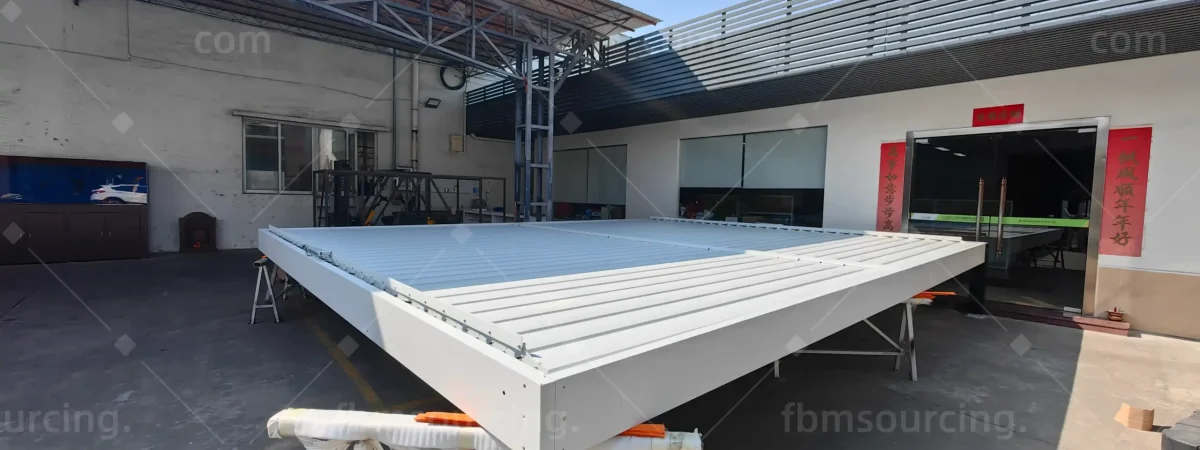
| Retractable louvered roof (bioclimatic pergola) | Rooftop bars, hotel F&B terraces | Rotating + sliding aluminum blades, integrated gutters, spans to 4–7 m per module |
| Retractable fabric roof / conservatory system | Atriums, courtyard dining | Track-guided fabric, waterproof PVC or acrylic membranes, motor drive standard |
| Motorized facade blades | Feature elevations needing tracking shade | Rotating aerofoil blades on linked actuators — engineered with facade shading systems |
Drives, sensors and building integration
The motor package decides more of the lifetime cost than the frame does. Somfy drives (European brand, China-assembled) carry the widest global service network; Dooya (domestic) prices lower and has matured into a credible commercial option. Both are available with mechanical or electronic limit setting and radio or wired control. Wind sensors that auto-retract fabric above a set threshold are effectively mandatory on screens and pergola roofs over public areas — an extended shade in a gust is the classic insurance event. Sun and rain sensors, multi-channel remotes, wall switches and dry-contact or RS-485 interfaces for building management systems are all standard catalog items; what matters is stating the control philosophy once, in writing, at inquiry stage. Retro-fitting group control across sixty installed motors is an electrician’s week that a two-line specification would have avoided.
Fabric screens run solution-dyed polyester or fiberglass-PVC mesh at 1–10% openness for view-through solar control, and blockout membranes for projection screens and privacy applications. Simpler fabric products in the same freight — folding-arm units and fixed canopies — are covered on our awnings sourcing page, and fixed-frame outdoor structures under outdoor pergolas.
For rollout buyers — hotel groups and restaurant chains standardizing one shade system across many sites — the specification file matters as much as the first order. FBM Sourcing holds the approved drawings, fabric references, motor part numbers and coating codes on record, so location twelve matches location one without re-running the approval loop, and replacement fabrics or drives ordered two years later still match the installed base. A spares line — typically one motor and one fabric panel per twenty units — is agreed at order stage and travels in the same container, which is far cheaper than air-freighting a single drive when a unit is damaged on site.
Sourcing Process for Motorized Sunshades from China
Motorized shading is part building product, part electrical package, and the procurement sequence has to respect both halves.
- Inquiry. Send elevations or a marked-up plan with opening sizes, unit count, system type, fabric or slat preference, destination country and — critically — motor voltage and control philosophy: individual switches, grouped remotes or BMS integration.
- Factory comparison — 5–7 days. FBM Sourcing prices the package across two to four vetted factories and normalizes the quotes: motor brand and origin, side-channel extrusion weight, fabric grade, sensor package, warranty terms.
- Sampling — 7–12 days. Fabric swatch cards, powder-coat plates and a working corner sample of the zip channel or louver blade are the usual approval set; a full powered unit sample is justified above roughly 30 units.
- Drawing approval. The factory issues production drawings with fixing positions, cable entry points and clearances. Because these systems carry power, the drawings are also the coordination document for the project’s electrical contractor — FBM Sourcing circulates them before metal is cut, not after containers are sealed.
- Production — 25–35 days. Standard RAL colors and stock fabrics sit at the short end; bioclimatic pergola modules and custom-width screens run toward the long end.
- Inspection and shipping. Powered cycle-testing and pre-shipment QC (below), then consolidated loading — motorized shades rarely fill a container alone, so FBM Sourcing ships them with balcony shades, doors, lighting or other packages from the same project. Ocean transit runs 18–22 days to the US West Coast, 28–35 days to the East Coast, and 12–18 days to Australian ports.
A project that signs off drawings promptly can hold motorized shading on site within 9–11 weeks of first inquiry. Every motor is cycle-tested at the factory before the goods are released for shipment.
Sourcing this for a commercial project?
FBM Sourcing works with project owners, developers, main contractors and FF&E contractors on hotel, apartment, school, office and other commercial building projects. Send us your BOQ, drawings or product list — our team will review it and get back to you.
Quality Standards and Inspection
Motorized shade failures concentrate in the drive, the electrics, the fabric and the coating, so FBM Sourcing’s inspection program concentrates there.
Function testing. Every unit is powered up at the factory on destination voltage — 110 V/60 Hz for North America, 230 V/50 Hz for Australia, the UK and Europe — run through full open-close cycles, limit stops set, and remotes paired and labeled against the unit schedule. Motors carry CE marking for European and Australian destinations; projects requiring UL or ETL recognized components for North America must state it at inquiry, because it narrows the motor options. Wind-class ratings — EN 13561 class 3 for zip screens, EN 13659 for external venetians — must appear on test reports, not just brochures.
Electrical safety. Motor IP ratings (IP44 minimum for sheltered positions, IP54–IP65 for exposed drives), cable specification and plug or hard-wire termination are checked against the destination’s wiring practice. Sensor and receiver serial numbers are logged per unit so warranty claims can be traced to a specific drive.
Fabric and coating. Fabric roll labels are verified against the approved sample before shipment — substitution between quotation and production is the single most frequent quality problem in the shade category. Powder coat is measured at 60–80 μm with cross-hatch adhesion testing; coastal projects should require salt-spray reports to ASTM B117.
Packing. Head boxes, side channels and blades ship in crush-protected cartons with fixing kits packed per unit and a manifest keyed to the drawing reference, so the installer sends each carton straight to its bay without opening ten boxes to find one bracket bag.
Why Source Motorized Sunshades Through FBM Sourcing
The price spread on motorized shading is wide because the cost sits in components a buyer never sees in a rendering: motor origin, spring cycles, channel wall thickness, sensor logic. A sourcing agent’s job is to make those differences visible before the order, not after the first warranty call. FBM Sourcing works on a 5% commission for suppliers you nominate (products we source for you are quoted at a direct price), audits the factories before they quote, holds the approved samples as the enforceable standard, inspects the finished goods and witnesses powered testing before shipment.
Enforcement after delivery is the quieter half of the value. A motor that fails in month eight gets replaced not because a clause says so, but because the factory’s next three projects depend on its relationship with us — that is what buying through an agent with continuing order flow means in practice. And because FBM Sourcing procures the whole shade category, from fixed brise-soleil to the complete sunshade range, a hotel or apartment developer can run every shading line on the project through one approval loop, one QC program and one shipping plan.
Get a Quote for Your Project
Send us your elevations or terrace plans, the number of motorized units, your control philosophy, destination port and installation deadline. You will receive one quotation covering motor packages, fabric grades and lead time — with every line mapped to your schedule. Reach FBM Sourcing through the contact form, WhatsApp or email, and put motorized shading on the same procurement track as the rest of your project.