A 100-room hotel FF&E package from China typically ships in 10–11 forty-foot high-cube (40HQ) containers. The math behind that number: guest-room furniture packs at 4.5–6 m³ per key depending on the property’s tier, public areas add 20–30% on top for a full-service hotel, and a 40HQ loads 65–68 m³ of furniture in practice. Multiply your room count by the per-key figure, add the public-area allowance, divide by 66 — and you have a defensible container count, and therefore a freight budget, months before final pricing exists. FBM Sourcing is your sourcing partner in China: it holds no inventory and has no product range of its own.
FBM Sourcing runs this calculation at the first quotation on every hotel and apartment project we consolidate — recent shipments range from 3×40HQ for a Melbourne office fit-out to 12×40HQ of custom furniture for a Melbourne apartment project. This guide gives you the full planning method: per-key volumes by hotel tier, what each container type actually holds, how the volume splits across FF&E categories, the full-container threshold, and how loading order affects installation.
- Guest-room FF&E packs at 4.5–6 m³ per key for export — select-service at the low end, luxury at the high end.
- A 40HQ holds 76 m³ nominal but 65–68 m³ of furniture in practice; a 20GP holds 33 m³ nominal, 25–28 m³ in practice.
- Public areas add 20–30% to guest-room volume on a full-service property.
- Full-container threshold: from roughly 20 m³, booking your own container beats shipping loose freight.
- Worked example: 100 keys × 5.5 m³ + 25% public areas ≈ 690 m³ ≈ 10–11 × 40HQ.
How Do You Calculate Container Count From a Room Count?
The formula is: keys × m³ per key × (1 + public-area factor) ÷ 66, rounded up. The only judgment call is the per-key figure, and it tracks the property tier because room size, furniture count and construction weight all rise together.
Select-service and economy properties — compact rooms, no sofa, wall-mounted desks — pack at 4.5–5.0 m³ per key. Midscale and standard upscale rooms with a full casegoods set and a lounge chair run 5.0–5.5 m³ per key. Upper-upscale and luxury properties — larger rooms, suites in the mix, heavier construction, assembled rather than flat-packed wardrobes — reach 5.5–6.0 m³ per key and above. Suite-heavy room mixes push the average up fast: one suite typically displaces the volume of two standard keys.
Two levers move these numbers meaningfully. Flat-packing wardrobes and closet units instead of shipping them assembled reduces the number of containers required of casegoods volume, at the cost of assembly labor on site — a trade that usually pays in high-freight-cost destinations and fails where site labor is the bottleneck. And the public-area factor is tier-dependent too: a full-service hotel with restaurant, bar and meeting rooms adds 20–30% to guest-room volume, while a select-service property with a lobby and breakfast area may add only 10–15%.
How Much Does Each Container Type Actually Hold?
Nominal container capacities overstate what furniture actually loads, because carton geometry, protective packing and void space consume volume. The planning figures that hold up in practice: a 40HQ is 76 m³ nominal and loads 65–68 m³ of mixed furniture; a 40GP is 67 m³ nominal and loads roughly 58–60 m³; a 20GP is 33 m³ nominal and loads 25–28 m³. Hotel FF&E almost always ships in 40HQs — the extra height suits headboards, wardrobe panels and sofas, and the per-m³ freight cost is the lowest of the three.
Weight is rarely the constraint. A 40HQ of furniture typically weighs 8–12 tonnes against a payload limit around 28 tonnes — furniture cubes out long before it weighs out. The exceptions are stone-top casegoods and tile or stone building materials in mixed procurement packages, where weight planning re-enters the calculation and heavy cartons must spread across containers rather than concentrate in one.
How Does the Volume Split Across FF&E Categories?
Knowing the internal split matters because different categories come from different factories and consolidate at different times. For a typical midscale-to-upscale key packing at about 5.5 m³, the volume divides approximately as follows:
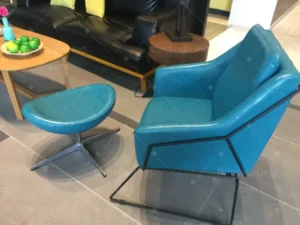
Casegoods, 2.2–2.5 m³ per key — headboards, wardrobes, desks, bedside tables and TV panels; at 35–45% of guest-room volume, the largest single block and the first thing to plan containers around. Mattresses and bed bases, 0.8–1.0 m³ — bulky, light and box-shaped, they load efficiently on top of casegoods cartons. Upholstered seating, 1.0–1.2 m³ — lounge chairs, desk chairs and suite sofas; irregular shapes that generate the most void space. Soft goods, 0.4–0.5 m³ — drapery, bedding and cushions compress well and act as the load’s filler material. Lighting, 0.3–0.4 m³ — low density but fragile, packed in reinforced cartons that must not carry weight. Artwork, mirrors and accessories, 0.2–0.3 m³ — flat, glazed and last to load.
The practical use of this table: it tells you what share of the shipment each factory’s output represents, which is what a consolidation warehouse uses to plan mixed loads. It also explains why a package spread across 8–15 factories cannot simply “ship when ready” — a container of nothing but lounge chairs wastes a third of its volume, while a planned mix of casegoods, mattresses and soft goods reaches the 65–68 m³ practical maximum. What sits inside each category is covered in our breakdown of the complete hotel FF&E package. For pieces that will not fit the box at all, see how oversized items ship from China by flat rack, open top and breakbulk.
Sourcing this for a commercial project?
FBM Sourcing works with project owners, developers, main contractors and FF&E contractors on hotel, apartment, school, office and other commercial building projects. Send us your BOQ, drawings or product list — our team will review it and get back to you.
When Does a Project Need Its Own Full Container (FCL)?
The working threshold is about 20 m³: from that volume upward, booking a dedicated 20GP (which loads 25–28 m³ in practice) costs about the same as shipping the goods loose — and wins decisively on risk. Loose freight is priced per cubic meter with fixed documentation and destination-handling charges layered on top, so its unit cost climbs steeply; more importantly for furniture, loose cargo is transloaded at shared depots at origin and destination, and every additional handling event is a damage opportunity for upholstered and veneered goods.
In hotel terms, the threshold arrives early. At 4.5–6 m³ per key, a project of just 4–5 rooms’ worth of furniture already justifies its own container — which is why genuine hotel and apartment projects essentially always ship FCL, and why attic stock and pre-opening top-ups are best planned into those same container loads rather than left to ship on their own. A boutique property of 20–30 keys lands at roughly 100–180 m³ — a clean 2–3 × 40HQ program.
How Should Containers Be Loaded for Installation?
Container count is only half of container planning; loading order is the other half, and it is decided at the consolidation warehouse, not at the port. The principle: load containers so they can be installed in sequence, not merely transported. On a hotel or apartment project that means mixed loads grouped by floor or room-type block — each arriving container opens into a set of rooms the crew can complete, instead of delivering an entire hotel’s wardrobes before the first bed frame appears.
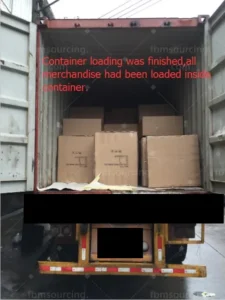
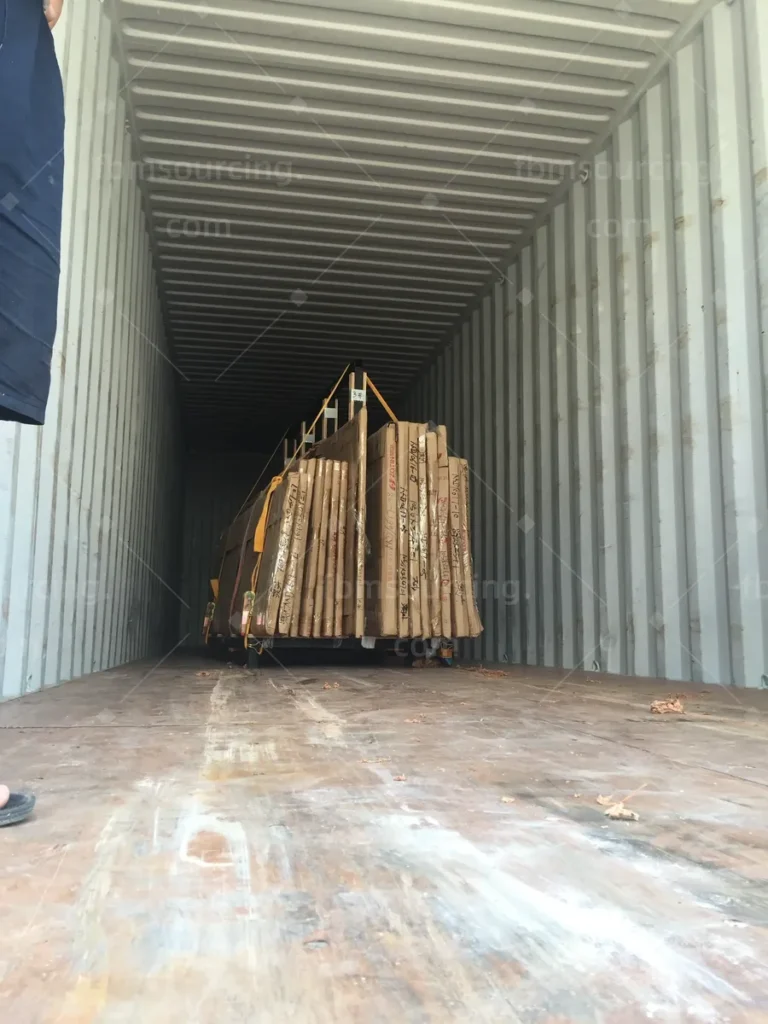
Inside each container the physics are fixed: casegoods and other heavy cartons on the floor, mattresses and bed bases above them, compressible soft goods filling voids, fragile lighting and glazed artwork in protected top positions that carry no load. Every carton carries its spec-book item code, and the packing list maps codes to containers — so “container 4, cartons CG-101/1–40” routes to floors 3–5 without opening a box. On a 100-key project that coding discipline saves the installation crew roughly a week of sorting time. Loading is also where quality control has its last checkpoint: FBM Sourcing’s own QC team supervises and documents every container loading in photos and video, so the record shows what entered each container and in what condition. Where loading sits in the overall program — after production, inspection and consolidation — is mapped in our hotel FF&E procurement timeline.
Do All Containers Ship at Once?
Rarely — and on a well-run project, deliberately not. A complete package is produced by 8–15 specialized factories over 8–11 weeks, and the factories do not finish on the same day. The consolidation warehouse absorbs that spread: finished goods arrive, pass final checks, and are staged until a full, correctly mixed container can be built. A 10–11-container hotel program typically releases in two to four sailings a week or two apart, sequenced so the first containers to arrive hold the floors the installation crew will start on.
Staggered release also de-risks the schedule. If one factory slips a week, one sailing moves — not the entire shipment — and the site keeps working through the containers already landed. The container plan therefore needs sea transit built in: roughly two to three weeks from South China to Australia’s east coast, about three weeks to the US West Coast, and four to five weeks to the US East Coast, the Gulf and the Caribbean, before adding customs clearance and inland haulage at destination. Working backward from the opening date through transit, loading, production and sampling is exactly what the procurement timeline exists to do — the container plan is its final page, not a separate document.
What Do Real Project Container Counts Look Like?
Two recent FBM Sourcing projects show the per-key math holding at different scales. A Melbourne apartment development shipped 12 forty-foot high-cubes of custom furniture — apartment FF&E behaves like hotel FF&E with a higher casegoods share, since every unit carries a full wardrobe and kitchen-adjacent joinery. A Melbourne office project shipped 3×40HQ of workstations, task seating and meeting furniture — roughly 200 m³, comfortably past the FCL threshold from the first quotation. In both cases the container count was fixed at budgeting stage from the schedule of quantities, and the final loading matched the plan within one container.
That predictability is the point of the exercise. Container count × the current freight rate to your port is a logistics budget line you can defend in a development pro forma long before factory pricing is final — and the same per-key figures feed the product budget itself, broken down in our guide to the cost to furnish a 100-room hotel from China. Getting both numbers from one china sourcing agent, built on one consolidated loading plan, is what keeps the freight line and the product line from drifting apart as the project moves.
Related guide: see our walkthrough of staggered delivery from China factories for how this applies at project level.
Get a China Procurement Quote for Your Project
If you are budgeting a hotel, apartment or office FF&E package, FBM Sourcing will convert your room count and schedule into a container plan — per-key volumes, container count, loading sequence and a freight-ready logistics line — alongside factory-level product pricing. Submit your drawings or FF&E schedule, room count and mix, destination port and target timeline through our China procurement inquiry page, and we will come back with a consolidated sourcing plan built on the same numbers used in this guide.