Top Swimming Pool Tile & Equipment Manufacturers in China for Hotel & Resort Projects
A hotel pool package fails in one of two ways, and both are decided before the tile is made. Either the tile is right and the adhesive system is wrong, in which case mosaic starts letting go of the wall within a season or two and the repair is a drained pool in peak occupancy. Or the tile is right and the surround is wrong, in which case a wet barefoot surface fails a slip test that nobody ran until the insurer asked. Neither problem is a manufacturing problem. Both are specification problems that a manufacturer will happily quote around if the enquiry does not close them off.
This guide is written for developers, project owners, main contractors, resort and hotel operators, interior design and construction companies and FF&E contractors. It covers the manufacturer types behind a pool tile and pool equipment package from China, the test evidence each has to produce, and the specification decisions that have to be made before an enquiry is worth sending.
Four Specification Decisions That Come Before Any Factory
Water absorption. Pool tile is a wet-and-frozen product in half the world and a permanently submerged product everywhere. The classification that matters is water absorption: fully vitrified porcelain in the lowest absorption group under ISO 13006, meaning absorption of 0.5% or less, is the baseline for pool tank and wet surround use, and for any destination with a freeze-thaw cycle it is not negotiable. Glass mosaic is effectively non-absorbent, which is why it is used in tanks, but glass brings its own adhesive requirements.
Slip resistance, stated as a class and a test. “Anti-slip” is not a specification. Barefoot wet areas in Europe are classified under DIN 51097 as class A, B or C, with pool surrounds and shower areas typically requiring B or C; shod areas use the DIN 51130 R-rating scale. North America works to a dynamic coefficient of friction test, with ANSI A326.3 and a wet DCOF of 0.42 as the common threshold for level interior wet areas. Australia classifies to AS 4586 with P ratings. Decide which scheme governs at the destination, write the required class into the enquiry, and require a test report on the actual product and finish — not on the range.
The adhesive and grout system. This is where pool packages most often go wrong. Glass mosaic in a submerged tank is not a cement-adhesive job. The normal specification is an epoxy adhesive and epoxy grout — a reaction resin system, classified under ISO 13007 as an R2 type adhesive with the corresponding epoxy grout, or under the North American scheme as an ANSI A118.3 epoxy — because epoxy gives the chemical resistance to pool water treatment and the bond performance that cementitious systems do not in permanent immersion. The tile supplier will not supply this by default and will not volunteer it. It has to be specified, and the adhesive has to be compatible with both the mosaic backing and the waterproofing membrane below.
The waterproofing and movement joint design. The tile is a finish, not a waterproofing layer. A bonded waterproofing membrane under the tile — the North American reference is ANSI A118.10 — and a movement joint layout that follows the tank geometry are both design decisions that have to be on drawings before ordering. Pools move, thermally and structurally, and a tiled tank without movement joints will telegraph that movement into the tile.
Publicly Listed Manufacturers a Buyer Can Verify
We name only companies whose listing and disclosures are public and checkable. All three sit in architectural ceramics; none of them is a pool specialist, which is itself the useful point.
- Monalisa Group (蒙娜麗莎), Shenzhen Stock Exchange: 002918. Founded 1992, based in Foshan, Guangdong, engaged in research, production and sale of architectural ceramic products including ceramic tiles, large-format ceramic panels and thin ceramic tiles. Role note: a large-format and porcelain tile manufacturer. Relevant to pool decks, changing areas and surrounds rather than to tank mosaic. Evidence to request: the ISO 13006 classification and water absorption figure for the exact product, and a slip test report on the specific surface finish to the destination’s scheme.
- Guangdong Dongpeng Holdings (東鵬控股), Shenzhen Stock Exchange: 003012. Founded 1972, headquartered in Foshan, producing glazed and unglazed ceramic tiles and also sanitary ware including sanitary ceramics, basins, toilets, bathtubs and taps. Role note: broad architectural ceramics with an adjacent sanitary range, which is useful when the pool package and the changing-room package are being bought together, alongside items such as hotel and resort bathtubs. Evidence to request: the same absorption and slip evidence, plus confirmation of which items are made in-house.
- DO&SHUIHUA Group Co., Ltd. (帝欧水华, Shenzhen Stock Exchange: 002798). Founded 1994, headquartered in Chengdu, engaged in research, design, manufacture and sale of ceramic wall and floor tiles; Foshan-based Oceano Ceramics sits within the group. Role note: architectural wall and floor tile at project scale. Evidence to request: as above, and batch planning, because the shade of a ceramic body varies between production batches.
Glass mosaic, pool-specific trim and pool equipment are supplied in China almost entirely by privately held manufacturers. A numbered ranking of those would be an opinion presented as a finding, so the rest of this guide is written as manufacturer types with the evidence to request. FBM Sourcing works as the buyer’s sourcing partner across those types — we hold the specification, run the technical exchange and manage the package as one order rather than four.
The Manufacturer Types That Make a Pool Package
1. Glass mosaic manufacturers
- Where: Guangdong, principally Foshan and Guangzhou, with a second cluster in Shandong.
- What they make: glass mosaic in sheets, blends and gradients, iridescent and matt finishes, and custom murals and pattern work.
- Evidence to request: the mounting system on the back of the sheet — paper-faced, mesh-backed or dot-mounted — because it determines what adhesive can be used and whether the adhesive can actually reach the glass. Mesh backing that covers too much of the tile back reduces the bonded area, and in permanent immersion that is the failure mechanism. Ask for the sheet dimensional tolerance, the chemical resistance data against pool water treatment, and a physical sample of the exact blend rather than a photograph, because blend ratios drift.
- Common failure: a beautiful mosaic sheet specified with a cement adhesive, or with a mesh backing that leaves too little glass in contact with the adhesive.
2. Porcelain and ceramic pool tile manufacturers
- Where: Foshan and the wider Guangdong cluster, with production also in Jiangxi, Fujian, Shandong and Sichuan.
- What they make: fully vitrified porcelain for tanks and surrounds — the same material question as porcelain pavers versus natural stone outdoors — anti-slip deck tiles, and the pool trim range — internal and external corners, grip edges, scum line and overflow channel pieces.
- Evidence to request: absorption to ISO 13006, slip class to the destination scheme on the actual finish, frost resistance where relevant, and — the one that gets forgotten — whether the full trim range exists in the chosen colour and finish. Pool geometry needs specials: edge grips, internal corners, step nosings, channel pieces. Many field tiles have no matching trim, and a pool detailed with a trim that does not exist becomes a cutting exercise on site.
- Common failure: selecting a field tile whose trim range is incomplete, then compromising the pool edge detail to suit what was available.
3. Pool equipment manufacturers
- Where: Guangdong and Zhejiang.
- What they make: circulation pumps, sand and cartridge filters, heat pumps, chlorination and salt chlorination systems, dosing and control, underwater lighting, grating and channel systems, ladders and handrails.
- Evidence to request: certification against a recognised scheme for recreational water equipment — NSF/ANSI 50 is the common reference for pool equipment in North America — plus electrical listing for the destination on pumps, heat pumps and lighting. For any suction outlet, ask specifically about anti-entrapment drain cover compliance; in the United States this is a federal safety requirement and covers must be compliant to the applicable standard, commonly referenced as ANSI/APSP-16. Underwater lighting must be low-voltage and certified for immersion, with the transformer position specified. For stainless steel items in chlorinated or saline environments, specify the grade: 316 rather than 304, and ask for a salt-spray result to ASTM B117 if the pool is coastal or salt-chlorinated.
- Common failure: 304 stainless handrails and fittings around a salt-chlorinated resort pool, showing tea-staining within the first year.
Sourcing this for a commercial project?
FBM Sourcing works with project owners, developers, main contractors and FF&E contractors on hotel, apartment, school, office and other commercial building projects. Send us your BOQ, drawings or product list — our team will review it and get back to you.
Batch, Attic Stock and the Repair You Will Need Later
Every tiled pool needs a repair at some point — a cracked tile at a step nosing, a patch of mosaic lifted by a fixing, damage from furniture. The repair is trivial if the material exists and close to impossible if it does not, because ceramic shade and glass blend ratios both vary between production runs and a patch from a later batch is visible from across the deck.
Three rules follow. Order the whole pool from a single production batch and require the batch to be stated on the packing list. Order an attic stock allowance of around 3–5% on mosaic and 2–3% on field tile, above cutting waste, and store it dry at the property rather than on the contractor’s site. And order the matching adhesive and grout for the repair at the same time, because an epoxy system from a different manufacturer will not necessarily colour-match the original grout.
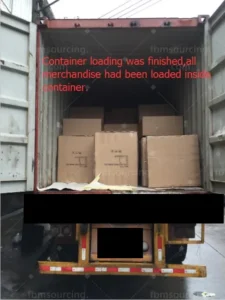
On shipping: tile and mosaic are dense, so a pool package reaches container weight limits long before it reaches volume limits. Palletised tile has to be loaded to keep the container within its payload, which means a pool order is normally consolidated with lighter FF&E to make an efficient load. Our minimum order commitment is a full container load rather than part-load consolidation.
How the Quality Control Works
All inspection on FBM Sourcing packages is carried out by our own team at the factory before shipment, with photo and video records. For a pool package, the pre-shipment inspection checks the goods against a physical control sample, confirms that the run is one batch, counts the trims against the pool detail drawings, and checks palletisation, batch marking and the attic stock. Test reports issued by manufacturers’ laboratories or certification bodies are reviewed for scope, product coverage and validity rather than accepted as a logo on a PDF.
Frequently Asked Questions
What adhesive should be used for glass mosaic in a swimming pool?
An epoxy adhesive with an epoxy grout is the normal specification for permanently submerged glass mosaic — a reaction resin system, R2 class under ISO 13007 or an ANSI A118.3 epoxy under the North American scheme. Cementitious adhesives are not generally appropriate for immersed glass mosaic in a commercial pool. The adhesive must also be compatible with the waterproofing membrane underneath it, so the two should be specified together.
What slip rating does a hotel pool surround need?
It depends on the destination’s scheme. In Europe, barefoot wet areas are classified to DIN 51097 as A, B or C, with pool surrounds commonly requiring class B or C. In North America the reference is a wet dynamic coefficient of friction test to ANSI A326.3, with 0.42 as the usual threshold for level wet areas. In Australia the scheme is AS 4586 with P ratings. Specify the class in the enquiry and require a test report on the exact product and finish.
Can porcelain tile be used inside the pool tank?
Yes, provided it is fully vitrified with water absorption of 0.5% or less, the full trim range exists for the pool geometry, and the adhesive and grout system is specified for immersion. Many projects use porcelain in the tank and mosaic only as a feature or waterline band, which is a perfectly sound approach and usually simpler to detail.
Do pool pumps and lights from China meet North American requirements?
Some products do and many do not, and it must be checked per model rather than per supplier. Look for certification against a recognised recreational-water equipment scheme such as NSF/ANSI 50, an electrical listing valid for the destination voltage on pumps, heat pumps and lighting, and compliance evidence for suction outlet covers, which are a federal safety requirement in the United States. Certification is issued per model, so confirm the certificate covers the model and size you are ordering.
How much spare tile should a pool project order?
As a working rule, 3–5% attic stock on mosaic and 2–3% on field tile, above the normal tile and stone cutting wastage allowance, from the same production batch, stored dry at the property. Order the matching epoxy adhesive and grout at the same time. This is the cheapest insurance on the entire package, because the alternative to attic stock is a visible mismatched patch or a fully re-tiled feature wall.
Sourcing this for a commercial project?
FBM Sourcing works with project owners, developers, main contractors and FF&E contractors on hotel, apartment, school, office and other commercial building projects. Send us your BOQ, drawings or product list — our team will review it and get back to you.
Get a China Procurement Quote for Your Project
FBM Sourcing has managed China procurement packages for commercial building projects since 2014, across more than 20 countries and over 1,000 containers. We manage the entire China procurement package on the buyer’s side: we hold the tile schedule and the pool details, run the technical exchange with mosaic, tile and equipment manufacturers, check that the slip, absorption and certification evidence covers the exact product before production, inspect with our own team and consolidate the package into one shipment.
Send your pool drawings, tile schedule and equipment list with the destination port and target programme, and we will review them and come back to you with a route through the manufacturer types above. More on how a full package is put together: China building materials and FF&E procurement.