Office phone booths and acoustic pods made in China come from five kinds of manufacturer: dedicated pod specialists, full-line office furniture groups with a pod line, glazed partition system makers, acoustic material converters, and metal enclosure fabricators that build to another company’s design. Two companies listed on mainland Chinese stock exchanges, Henglin Home Furnishings (Shanghai, 603661) and Loctek Ergonomic Technology (Shenzhen, 300729), describe pod products in their 2025 annual reports, and neither reports pods as a separate revenue line. For every other supplier, compare the manufacturer type and the product evidence it can hand over, led by a speech level reduction test report to ISO 23351-1:2020.
This guide is written for developers, general contractors, builders, commercial project owners, interior design and construction companies and FF&E solution providers who have phone booths, focus pods or meeting pods on an office schedule to price from China.
What Counts as an Office Phone Booth or Acoustic Pod?
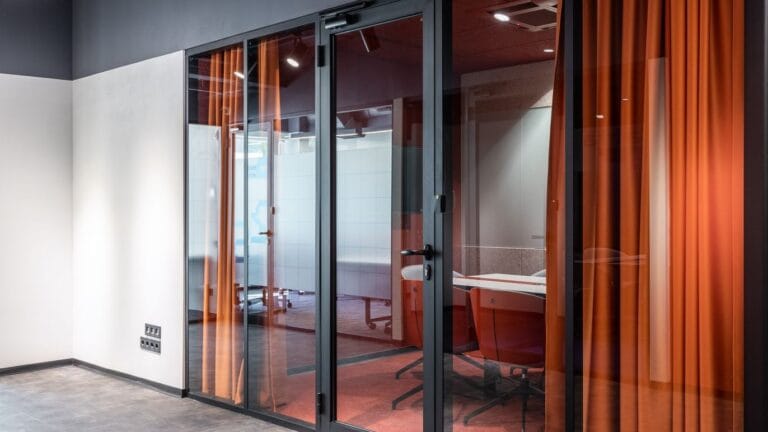
A pod is a freestanding, factory-built room that sits on the finished floor of an open-plan office. It arrives as a kit of wall, roof, floor and door modules, is assembled on site without being fixed to the structure, and can be moved later. Two neighbouring categories should stay separate lines:
- Acoustic panels and baffles are surface treatments rated by sound absorption, not by how much speech they keep in. We cover them in our guide to acoustic panel manufacturers in China.
- Demountable glazed partitions run floor to ceiling and are fixed to the building. A pod stops below the ceiling and carries its own roof, ventilation and lighting.
Inside the category, schedules usually separate four products:
- Single-person phone booths: a standing or perch-height enclosure for calls, with a shelf, light, fan and power outlet.
- Single-person focus pods: a seated enclosure with a desk for longer occupation, where ventilation and lighting matter more.
- Two-person and four-person meeting pods: facing seats around a table, often with a screen mount and a wider door.
- Large meeting pods: six seats and above, built from repeated wall modules. At this size fire protection, accessibility and floor loading become project questions.
Which Listed Chinese Companies Report Pod Products?
We name a company only when we have read the exchange register and its annual report ourselves. We confirmed two mainland-listed companies whose 2025 annual reports mention pod products in the original Chinese text, both checked on 21 September 2026. Neither filing gives a pod revenue, capacity or test figure, so none appears here.
Henglin Home Furnishings Co.,Ltd (Shanghai Stock Exchange: 603661)
- Listing: the Shanghai Stock Exchange listed-company register shows A-share code 603661 on the main board, listing date 21 November 2017, with no risk-warning prefix on the trading abbreviation.
- What the filing says: the 2025 annual report describes a systems office line covering office, meeting and training tables and chairs, intelligent storage and movable partition systems, lounge furniture, professional lighting and acoustic equipment. In the same passage it lists quiet pods for focused thinking and undisturbed meetings among its solutions for different office settings.
- Where it manufactures: the report states production bases in China, Vietnam and Switzerland, and defines LO as its Swiss subsidiary Lista Office Group AG.
- Role in this category: an office seating and systems furniture group for which the pod is one element of a complete office offer.
- Evidence to request: the ISO 23351-1 test report for the exact pod model and size quoted, and the country of origin for that line item.
Loctek Ergonomic Technology Corp. (Shenzhen Stock Exchange: 300729)
- Listing: the Shenzhen Stock Exchange company profile shows A-share code 300729 on the ChiNext board, listing date 1 December 2017, registered in Yinzhou District, Ningbo, Zhejiang, with no risk-warning prefix.
- What the filing says: the 2025 annual report names height-adjustable desks, lifting workstations, study desks, office chairs and electric beds as main products. Pods appear in the research and development table: a meeting pod quietness project (composite materials and air-duct design) and a modular four-person pod are marked completed and applied to a new generation of meeting pod products; a presence-sensing radar project for quiet pods is marked as in testing.
- Where it manufactures: the report says core components are made in Ningbo and in Beihai, Guangxi, with a Vietnam base for peripheral manufacturing and assembly, and that sales are mainly under the company’s own brands with some ODM business.
- Role in this category: a height-adjustable desk manufacturer that has developed meeting pods as an adjacent product. Its desk business is covered in our list of office furniture manufacturers in China.
- Evidence to request: whether the pod model is offered for project supply, the ISO 23351-1 report for that model, and the electrical certification for the destination.
Why the Rest of This List Is Manufacturer Types, Not Factory Names
We have not confirmed pod products in any other listed company’s filing. The other pod makers a project team will meet are privately held, publish no audited filings, and the floor areas and decibel figures on a sales page cannot be checked against an original document. So this guide describes five manufacturer types and the product evidence that settles the question for a specific pod, with no scores and no ranking.
How Is the Acoustic Performance of an Office Pod Measured?
The international test method written for this product is ISO 23351-1:2020, Acoustics, Measurement of speech level reduction of furniture ensembles and enclosures, Part 1: Laboratory method. ISO published it in June 2020, and as of September 2026 the ISO catalogue shows it as published and under periodic review. Its abstract explains the method:
- The sound power level is measured in two scenarios: with the sound source in an empty room and the product absent, and with the source inside the product in the occupant’s position.
- Level reduction is the difference between the two in octave bands from 125 Hz to 8 000 Hz.
- Speech level reduction is a single-number quantity expressing the corresponding reduction in the A-weighted sound power level of standard speech across that frequency range.
- The method applies to entire furniture ensembles or enclosures that serve one or several occupants. It is not intended for single components such as a screen, a table, a wall absorber or a ceiling absorber.
A pod is tested as a whole product, so a report for one size does not transfer to another size. And the figure is not comparable with the numbers quoted for acoustic panels (absorption) or for partitions (sound insulation between rooms).
A second part now exists. ISO 23351-2:2026, Part 2: Field method, was published in August 2026 as a first edition; its abstract says it determines the apparent speech level reduction of furniture ensembles and enclosures in field conditions.
Have phone booths or meeting pods on your office schedule?
Send us the pod types, counts and destination. We match the schedule to the right kind of Chinese manufacturer and quote it together with the rest of your office package.
The Five Manufacturer Types Behind China-Made Office Pods
1. Dedicated Pod Specialists
These factories make pods as their main product, and the stronger ones have had their main models tested by an accredited acoustic laboratory. The same wall build-up is reused across sizes, which keeps a large order consistent. The trade-off is flexibility: colours and upholstery can change, but module width, door position and roof height are fixed by tooling.
Evidence to request: the full ISO 23351-1 test report for each size on the schedule, naming the model and the laboratory’s accreditation; the wall build-up drawing; and the electrical certification for the destination.
2. Full-Line Office Furniture Groups With a Pod Line
Large office furniture manufacturers show pods next to workstations and seating, as the Henglin filing illustrates. Some groups build pods themselves; others buy them from a specialist and add their own label. Either is workable, but the test report must belong to the pod that ships. If workstations are on the same schedule, see our guide to office workstation manufacturers in China.
Evidence to request: the production address for the pod line item, the test report in the name of the company that built the tested unit, and finish samples next to the desk finishes.
3. Glazed Partition System Makers
Factories that make aluminium-framed office partitions already own the skills a large meeting pod needs: framing, glazing, door sets and perimeter seals. They suit large pods and non-standard footprints. Their weak point is what a partition does not have: a roof with fans and lighting, a floor module and a cable route.
Evidence to request: safety glazing evidence to the destination’s standard, the ventilation design, and an acoustic test of the assembled pod rather than of the wall panel alone.
4. Acoustic Material Converters
Makers of polyester fibre panels and fabric-wrapped absorbers build semi-open booths from their own material: high-backed nooks, call hoods and felt-walled focus corners. With no sealed door they do not contain speech like a closed booth and should be scheduled as a different product.
Evidence to request: the sound absorption test report for the panel material, its reaction-to-fire report, and a statement of whether any speech level reduction test has been done on the assembled product.
5. Metal Enclosure Fabricators Building to Drawing
Sheet metal and tube-frame workshops with powder coating lines build pods to a client’s design, which suits a furniture brand or chain that owns its pod design. The fabricator follows the drawing; acoustic performance, airflow and electrical safety have to be engineered by the design owner and proven on a prototype before the order is placed.
Evidence to request: a prototype built from the production drawings, acoustic and electrical testing of that prototype by an accredited laboratory, and the coating specification.
Ventilation, Electrical, Fire and Glazing: What to Ask For by Destination
A pod is furniture, an electrical appliance and a small occupied space at once, and the rules differ by country. We quote no standard numbers here, because they depend on the destination and on how the local authority classifies the pod. The documents to ask for are consistent:
- Ventilation: the design airflow for each pod size, how the fans are switched, and the sound level inside the pod with the fans running.
- Electrical: certification of the complete power assembly to the destination’s electrical safety scheme, issued by a conformity assessment body recognised there. Component certificates alone are not a certificate for the assembly.
- Fire: reaction-to-fire reports for the wall lining, acoustic infill, carpet and upholstery, to the destination’s classification system. Whether an enclosed pod needs its own sprinkler head or detector is decided by the project’s fire engineer and the local authority. Raise it before ordering, because a roof prepared for a sprinkler drop is a factory option.
- Glazing: evidence that the glass is safety glass to the destination’s standard, marked on each pane.
- Emissions: for projects in the United States, the Environmental Protection Agency states that composite wood products (hardwood plywood, medium-density fibreboard and particleboard) and finished goods containing them must be labelled as TSCA Title VI compliant.
Packing, Container Loading and Assembly on Site
Pods ship knocked down. Wall modules, glass, roof and floor travel flat in crates or on pallets. The largest module has to fit the building’s goods lift, so module dimensions and weights should be checked before the order is confirmed. Glass needs upright crating with edge protection. Our guide to office furniture container loading from China explains how mixed furniture loads are planned.
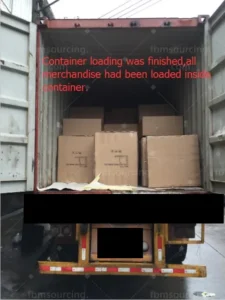
A pod order normally travels with the rest of the package. Sometimes, on a large project, the office pods alone fill full containers; sometimes the office pods share containers with the other product categories of the same project; and sometimes, in one batch, we combine a dozen or more product categories from several projects of the same client into a few containers — always full containers, and for us this is routine, well-practised work. For where office furniture is made in China, see our China office furniture market data page.
How FBM Sourcing Handles a Pod Package
FBM Sourcing acts as the sourcing partner in China for the company types named at the top of this guide. We are based in Guangzhou, one hour from Foshan, and a pod package follows the same sequence as any other category.
- Turn the schedule into a factory specification: pod types and counts, the acoustic evidence required, destination voltage and plug, finishes and lift limits.
- Quote from the manufacturer types that fit. The quotation is issued by FBM Sourcing and covers the goods; sea freight is quoted to you before shipment.
- Confirm a sample, usually one complete unit of the most numerous type, together with the test reports and certificates for that model.
- Inspect once, after bulk production is finished and before shipment. Our own team inspects at the factory, with photo and video records, checking module counts, glass marks, labels, electrical fittings and finishes against the confirmed sample. An inspection report goes to the client before the balance is paid.
- Load full containers with the other categories of the project and hand over the shipping documents.
We do not issue acoustic ratings, certify electrical assemblies or install pods. Those sit with the accredited laboratory, the conformity assessment body and the client’s installer.
Have phone booths or meeting pods on your office schedule?
Send us the pod types, counts and destination. We match the schedule to the right kind of Chinese manufacturer and quote it together with the rest of your office package.
Frequently Asked Questions
Which standard measures how well an office phone booth contains speech?
ISO 23351-1:2020 is the laboratory method for the speech level reduction of furniture ensembles and enclosures. It compares a speech source in an empty room with the same source inside the product and reports a single-number speech level reduction. ISO 23351-2:2026, published in August 2026, adds a field method.
Are there listed office pod manufacturers in China?
We confirmed two mainland-listed companies whose 2025 annual reports mention pods: Henglin Home Furnishings (Shanghai Stock Exchange, 603661), which lists quiet pods in its systems office line, and Loctek Ergonomic Technology (Shenzhen Stock Exchange ChiNext, 300729), whose research and development table includes meeting pod projects. Neither reports pods as a separate revenue line.
What is the difference between an acoustic pod and acoustic panels?
Acoustic panels are surface treatments rated by sound absorption. An acoustic pod is a freestanding enclosure with walls, a roof, a door and its own ventilation, rated by how much it reduces the speech level of the person inside. They are tested differently and should be separate lines on a schedule.
Do office pods need their own sprinkler or smoke detector?
That is decided by the project’s fire engineer and the local authority, and it depends on the destination and the pod size. Settle it before ordering, because a roof prepared for a sprinkler drop or a detector is a factory option.
How are office pods shipped from China?
Pods ship knocked down in crates or on pallets and are assembled on site. They normally travel in full containers with the rest of the project’s furniture. Check the largest module against the building’s goods lift before ordering.
About FBM Sourcing
FBM Sourcing manages the entire China procurement package for overseas construction projects. Since 2014 we have worked with developers, general contractors, builders, commercial project owners, interior design and construction companies and FF&E solution providers across more than 20 countries and over 1,000 containers, as their sourcing partner in China — from the schedule or BOQ through factory selection, sampling, inspection by our own team before shipment, consolidation and shipping. All quotations, invoices and shipping documents are issued by FBM Sourcing, and sea freight is quoted to you before shipment. If you have an office pod package to price, start at China building materials and FF&E procurement.