
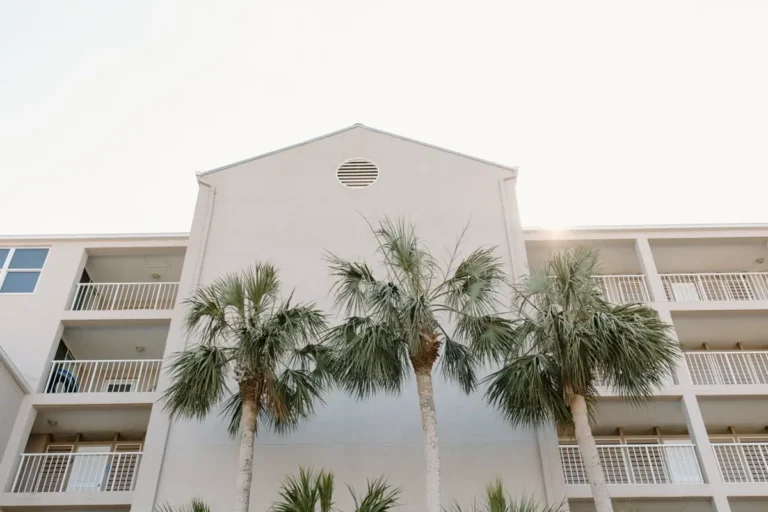
“Marine-grade” is not a standard. On a coastal project it has to become three separate, checkable requirements: a named coating specification for the aluminium (AAMA 2605, whose active edition as of September 2026 is AAMA 2605-26, or a QUALICOAT class), a coating plant holding the QUALICOAT SEASIDE endorsement where the European scheme is used, and a named stainless steel grade, such as Type 316, for every piece of hardware and every fastener. Each is proven by a different document, and an order that says only “marine-grade finish” has specified none of them.
This guide is for developers, general contractors, builders, commercial project owners, interior design and construction companies and FF&E solution providers ordering aluminium windows, doors, louvres, railings or cladding from China for sites exposed to salt air. It covers what each document controls, which edition is current and what evidence to request.
What Does “Marine-Grade” Mean in a Finishes Specification?
A coastal site brings two different problems to an aluminium package. One is wind and debris: frames, glass and anchors must resist design pressures and, in cyclone and hurricane regions, impact. That side is covered in our guide to hurricane impact standards for Caribbean projects. The other, and the subject here, is corrosion. For corrosion, three layers of the product need specifying, each controlled by a different document:
| Layer | Governing document (September 2026) | Issued by | Evidence to request |
|---|---|---|---|
| Organic coating on aluminium (US-style) | AAMA 2605-26; AAMA 2604-26 and 2603-26 are the lower tiers | Fenestration and Glazing Industry Alliance (FGIA) | Coating supplier’s documentation stating compliance with the named edition |
| Organic coating on aluminium (European-style) | QUALICOAT Specifications, 26th Edition, valid from 1 January 2026 | QUALICOAT, Zurich | Coating approval (P-No.) and class for the powder; licence certificate of the coating plant |
| Coastal pretreatment at the coating plant | QUALICOAT SEASIDE endorsement (or SEASIDE PRE-OX) | QUALICOAT | The coating plant’s SEASIDE certificate |
| Stainless hardware and fasteners | ASTM A240/A240M-26, ASTM A276/A276M-25, ASTM F593-24 | ASTM International | Mill certificate naming grade and ASTM specification, per component |
No row can stand in for another.
What Is AAMA 2605, and Which Edition Is Current?
AAMA 2605 is published by the Fenestration and Glazing Industry Alliance (FGIA). Its full title is “Voluntary Specification, Performance Requirements and Test Procedures for Superior Performing Organic Coatings on Aluminum Extrusions and Panels (with Coil Coating Appendix)”. FGIA describes it as setting test procedures and performance requirements for superior performing organic coatings on aluminium extrusions and panels for architectural products, with an appendix for coatings applied on a coil coating line.
As of September 2026, the FGIA store lists AAMA 2605-26 as active. Earlier editions listed are 2605-22, -20, -17a, -13, -11, -05, -02 and -98. The same family also has active 2026 editions:
- AAMA 2603-26: pigmented organic coatings.
- AAMA 2604-26: high performance organic coatings.
- AAMA 2605-26: superior performing organic coatings, the top tier.
- AAMA 611-26, a separate document, covers anodized architectural aluminium.
It is voluntary. The word is in the title. AAMA 2605 binds a coating supplier or fabricator only when the project specification or purchase order names it. A frame described as “PVDF” or “super durable” is describing a chemistry, not compliance.
The edition matters. A test report written against 2605-22 or 2605-17a is evidence against that edition. If a specification says “AAMA 2605” with no year, the order should state which edition the project accepts. We have not reproduced the numerical limits of 2605-26 here; they are in the purchased document, and the project’s specifier or facade consultant should confirm which clauses the project relies on.
It is not a hardware specification. AAMA 2605 says nothing about the hinges, friction stays or screws on the same window. Those need their own clause.
If your project is still choosing between an organic coating and anodizing, that question is covered in our comparison of powder coating vs anodized aluminum for commercial projects. This article assumes the finish type is chosen and deals only with the coastal grade and the hardware material.
What Does the QUALICOAT SEASIDE Endorsement Add?
QUALICOAT is a quality label for liquid and powder coatings on aluminium for architectural applications, based in Zurich. Its specifications are split into three volumes, for coaters, chemical pretreatment manufacturers and powder manufacturers. The current edition is the 26th, valid from 1 January 2026. Only its introduction is downloadable from qualicoat.net; the volumes are obtained through the scheme’s General Licensees or from QUALICOAT on request. The complete 2024 Specifications (valid from 1 January 2024) are still downloadable there, and the figures below come from that 2024 text.
The scheme works on two levels, and a coastal specification must address both.
Level 1: the coating material has a class
| Class | Florida natural weathering (2024, clause 2.13) | Minimum powder thickness (clause 2.3) |
|---|---|---|
| Class 1 | 1 year, facing 5 degrees south | 60 microns |
| Class 1.5 | 2 years, facing 5 degrees south | 60 microns |
| Class 2 | 3 years, facing 5 degrees south | 60 microns |
| Class 3 | 10 years, facing 45 degrees south | 50 microns |
The class belongs to the coating material. It says how that powder weathered in the approval programme, not how the aluminium under it was prepared.
Level 2: the coating plant has a licence, and may have SEASIDE
A QUALICOAT licence is held for a specific production site and cannot be transferred. SEASIDE is an endorsement on that licence. Under the 2024 text, standard pretreatment requires a total etching degree of at least 1.0 g/m2. The enhanced pretreatment for SEASIDE includes degreasing and requires at least 2.0 g/m2; for dual etching, the two final steps must each remove at least 0.5 g/m2. The plant must apply for the endorsement, and it is granted only after the enhanced pretreatment has been checked and filiform corrosion tests on finished products, run under ISO 4623-2, have been passed. Plants that pre-anodise before coating can hold a SEASIDE (PRE-OX) endorsement instead.
QUALICOAT UK & Ireland, the scheme’s association for that territory, says the Seaside class was introduced in 2008 and advises specifying it for projects within 5 km of the British coast or a tidal estuary. Elsewhere, the trigger distance should come from the project specification.
For a China order, this means a class 2 powder applied at a plant without SEASIDE is class 2 powder on standard pretreatment, whatever the quotation calls it. The evidence must come from the plant that will coat your profiles: its current licence and SEASIDE certificates.
The 26th Edition revised some of these clauses; its change list includes the filiform corrosion test (alignment with the standard) and a clarification of the acetic acid salt spray test. Confirm any figure quoted from an older edition against the current volume before it goes into a contract.
Ordering aluminium windows or railings for a coastal site?
Send us the finish clause and hardware schedule for your coastal package, and our team will review it against the coating and stainless grade requirements.
AAMA 2605 or QUALICOAT SEASIDE: Which One Does the Project Need?
AAMA 2605 is a performance specification for the coating system. QUALICOAT combines approval of the coating material with licensing of the plant that applies it, and SEASIDE sits on the plant side. Neither the FGIA listings nor the QUALICOAT documents we reviewed map one onto the other, so we do not treat them as interchangeable. The answer comes from the project documents:
- Specification cites AAMA 2605: the order names the edition, and the coating supplier’s compliance documentation is part of the submittal.
- Specification cites QUALICOAT: the order names the class and, for a coastal site, requires a licensed plant with SEASIDE.
- Specification cites both: both sets of evidence are required.
- Specification says only “marine-grade”: go back to the specifier before pricing, because quotations against an undefined term can only be compared on price.
Both AAMA 2605 (its coil coating appendix) and QUALICOAT (its provisions for rolled sheet and coil) cover coil-coated material, so a cladding package’s coating clause should say which provisions apply. For that side of the market, see our list of ACP facade cladding manufacturers in China.
Why Is 316 Stainless Steel Specified for Hardware Near Salt Water?
A coating clause does not cover the hinge pin, friction stay, lock body or handle screw, and “stainless” alone is not a specification.
Types 316 and 304 are both austenitic stainless steels. The difference that matters on a coastal site is molybdenum: 316 is a molybdenum-bearing grade, while 304 is the conventional chromium-nickel grade. A steel producer’s technical data describes Types 316 and 316L as more resistant to general, pitting and crevice corrosion than conventional chromium-nickel grades such as Type 304, and the US National Institute of Standards and Technology designates its AISI 316 reference material “Cr 18-Ni 12-Mo 2”. The chemical limits themselves are set in the ASTM product specifications, which are what an order should cite:
- ASTM A240/A240M-26: chromium, chromium-nickel and chromium-manganese-nickel stainless plate, sheet and strip, including for architectural, building and construction applications. Cite it for hardware made from sheet, strip or plate.
- ASTM A276/A276M-25: hot-finished and cold-finished stainless bars and shapes. Cite it for parts machined from bar or made from shapes.
- ASTM F593-24: stainless bolts, hex cap screws and studs from 0.25 to 1.50 in. nominal diameter. It puts 304 and 304L in Group 1 and 316 and 316L in Group 2, so “F593 Group 2” is a 316-family requirement that can be checked on the certificate.
Grade selection does not remove the need for drainage and cleaning access. How stainless fasteners and aluminium frames are isolated from each other is a detail for the project’s facade engineer to specify, not something to leave to the factory.
Where mixed grades hide in a package
The parts easiest to leave off a schedule are the ones nobody sees:
- Screws fixing handles, hinges and keeps to the frame.
- Friction stays and restrictors on awning and casement windows.
- Lock bodies, strikers and multipoint lock rods inside the profile.
- Glass clamps, spigot bolts and base plate anchors on balustrades.
- Threaded rods, washers and nuts packed as installation accessories.
Each should appear on the hardware schedule with its own grade. A schedule that says “all hardware 316” but lists only handles and hinges leaves the screws to the factory’s default. For the manufacturing side, see our overview of door and window hardware manufacturers in China and our list of railing and balustrade manufacturers in China.
QUALICOAT’s terminology names handles and fittings of door and window locking systems as examples of “accessories”, so a powder-coated aluminium handle can fall under the coating clause while the stainless screws inside it fall under the ASTM grade clause. Both apply to the same component.
What Do Salt Spray Hours on a Datasheet Actually Prove?
A quotation or datasheet may carry a line such as “salt spray tested, 1000 hours”. On its own, that proves very little, and the test standards say so.
- ASTM B117, “Standard Practice for Operating Salt Spray (Fog) Apparatus”, is at edition B117-26a, marked active by ASTM in September 2026. Its scope says it covers the apparatus, procedure and conditions of the salt spray environment, and does not prescribe the test specimen, the exposure period for a specific product, or the interpretation of results.
- ISO 9227, “Corrosion tests in artificial atmospheres – Salt spray tests”, is referenced by the QUALICOAT 26th Edition in its 2022 edition and is the method behind QUALICOAT’s acetic acid salt spray test.
Hours carry weight only when a named specification sets the method, specimen, scribe, duration and pass criteria together. In the 2024 QUALICOAT text, the acetic acid salt spray test runs 1000 hours for organic coatings other than class 3 powders and 2000 hours for class 3 powders, on scribed AA 6060 or AA 6063 panels, with limits on blistering and on infiltration from the scribe. Otherwise, ask which specification the test was run against, on which panels, and where the report is.
How Does FBM Sourcing Put a Coastal Finish Specification into a China Order?
As a sourcing partner in China, our part is making sure the requirement the project wrote is the one the factory works to, and that the documents proving it exist before shipment:
- Adjectives become references. “Marine-grade” becomes a named document and edition, as the project specification requires. If the specification is silent or ambiguous, we raise it with the client before quotations are compared.
- The coating plant is named. Where a fabricator sends profiles out for coating, the licence and SEASIDE endorsement that count are those of the plant that coats your profiles, and its current certificates are collected with the quotation.
- Coating approval and plant licence are kept separate. The powder’s approval and class, and the plant’s licence and endorsement, prove different things and are collected as different documents.
- Hardware grade is written per component. Each component, including screws and loose installation accessories, is listed with its grade and ASTM specification, with mill certificates requested.
- Colour and finish samples are signed before production and retained on both sides.
- Finished goods are checked against the order. One inspection by our own team at the factory once bulk production is finished, before shipment, with photo and video records, checks the goods against the finish clause, the hardware schedule and the approved samples. Your own project team is welcome to attend the inspection with us. The inspection report goes to the client before the balance is paid.
Ordering aluminium windows or railings for a coastal site?
Send us the finish clause and hardware schedule for your coastal package, and our team will review it against the coating and stainless grade requirements.
Frequently Asked Questions
What is the current edition of AAMA 2605?
As of September 2026, the FGIA store lists AAMA 2605-26 as the active edition, with AAMA 2604-26 and AAMA 2603-26 as the high performance and pigmented tiers; an order should name the edition it accepts, because a test report against 2605-22 or earlier is evidence against that edition only.
Is QUALICOAT Seaside a powder class?
No. SEASIDE is an endorsement on a coating plant’s QUALICOAT licence, granted when the plant runs an enhanced pretreatment (a total etching degree of at least 2.0 g/m2 in the 2024 Specifications, against 1.0 g/m2 for standard pretreatment) and passes filiform corrosion testing.
Does AAMA 2605 cover window hardware?
No. AAMA 2605 covers organic coatings on aluminium extrusions and panels, so hinges, friction stays, locks, handles and screws need their own clause naming the stainless grade and ASTM specification, such as ASTM F593 Group 2 for 316-family bolts and screws.
What is the difference between 304 and 316 stainless steel for coastal hardware?
Type 316 is a molybdenum-bearing austenitic grade and Type 304 is the conventional chromium-nickel grade; producer technical data describes 316 as more resistant to pitting and crevice corrosion, so a coastal hardware schedule should name 316 and confirm it on the mill certificate for each component.
Does a salt spray result prove a finish suits a coastal site?
Not on its own: ASTM B117 states that it does not prescribe exposure periods or the interpretation of results, so salt spray hours only carry weight when a named specification, such as the QUALICOAT acetic acid salt spray test under ISO 9227, sets the method, specimen, duration and pass criteria.
About FBM Sourcing
FBM Sourcing manages the entire China procurement package for overseas construction projects. Since 2014 we have worked with developers, general contractors, builders, commercial project owners, interior design and construction companies and FF&E solution providers across more than 20 countries and over 1,000 containers, as their sourcing partner in China — from the schedule or BOQ through factory selection, sampling, one inspection by our own team once bulk production is finished and before shipment, consolidation and shipping. All quotations, invoices and shipping documents are issued by FBM Sourcing, and sea freight is quoted to you before shipment. If you have a coastal aluminium window, door and hardware package to price, start at China building materials and FF&E procurement.





