
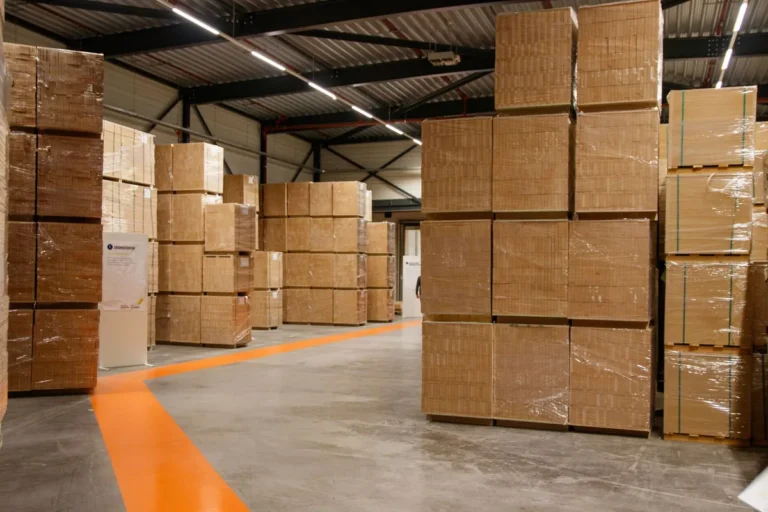
Regulation (EU) 2025/40 on packaging and packaging waste was adopted on 19 December 2024. Article 71 states that it shall apply from 12 August 2026, except that Article 67(5) applies from 12 February 2029. It sets requirements for the whole life cycle of packaging, including substances, labelling and the duties of manufacturers and importers, and it covers packaging used between businesses as well as packaging sold to consumers.
This article reads the Regulation as published (Official Journal text), read on 12 October 2026. It covers the Articles that matter to a buyer shipping furniture or building products from China into the EU: scope, the definitions of packaging, manufacturer and importer, the substance limit, the importer file, labelling dates and the empty space ratio. It is a reading of the legal text for procurement planning, not legal advice. We did not read the annexes or the implementing acts the Commission is to adopt, so check the Official Journal for those. For the separate phytosanitary mark on wooden pallets, see our reading of ISPM 15 and the wood packaging mark.
Scope: all packaging, including between businesses
Article 2(1) says the Regulation applies to all packaging, regardless of the material used, and to all packaging waste, whether the packaging is used in or the waste originates from industry, other manufacturing, retail or distribution, offices, services or households.
Article 3(1) defines packaging as an item, irrespective of the materials from which it is made, intended to be used by an economic operator for the containment, protection, handling, delivery or presentation of products to another economic operator or to an end user. Article 3 separately defines transport packaging as packaging conceived to facilitate the handling and transport of one or more sales units or a grouping of sales units, “but which excludes road, rail, ship and air containers”.
By its words, therefore, the definition reaches items used to protect and deliver goods to another business. Whether a given carton, crate, pallet or wrap is packaging for a particular shipment is a question for your adviser; Article 2(2) also says the Regulation applies without prejudice to Union requirements on safety, quality and transport.
Who is the manufacturer and who is the importer
- Manufacturer (Article 3): any person that manufactures packaging or a packaged product. Where a person has packaging or a packaged product designed or manufactured under its own name or trademark, that person is the manufacturer, regardless of whether another trademark is also visible.
- Importer (Article 3): any person established within the Union that places packaging from a third country on the market.
- Placing on the market (Article 3): the first making available of packaging, whether empty or with a product, on the Union market.
The practical point is the own-name rule. A project owner or contractor that has goods made in China under its own name or brand is the manufacturer of the packaged product for the Regulation, and the party that places packaged goods on the Union market from outside carries the importer’s duties.
What the manufacturer must do (Article 15)
- Conformity (Article 15(1)): place on the market only packaging that conforms to the requirements in Articles 5 to 12.
- Procedure and documentation (Article 15(2)): carry out the conformity assessment procedure in Article 38 or have it carried out, draw up the technical documentation in Annex VII, and, where compliance is shown, draw up an EU declaration of conformity under Article 39.
- Retention (Article 15(3)): keep the technical documentation and the declaration for 5 years from the date the packaging was placed on the market for single-use packaging, and for 10 years for reusable packaging.
- Identification (Article 15(5)–(6)): a type, batch or serial number or other identifying element, and the manufacturer’s name, trade name or trade mark and postal address, on the packaging or through a QR code or other data carrier, with a single contact point.
- Information on request (Article 15(10)): provide the information and documentation to a national authority in a language it can understand, within 10 days of receipt of a reasoned request.
What the importer must do (Articles 18 and 22)
- Before placing on the market (Article 18(2)): ensure the manufacturer has carried out the conformity assessment and drawn up the technical documentation, that the packaging is labelled in accordance with Article 12, that it is accompanied by the required documents, and that the manufacturer has complied with Article 15(5) and (6).
- Own details (Article 18(3)): indicate the importer’s name, trade name or trade mark and postal address on the packaging or, where not possible, through a digital data carrier or accompanying document.
- File (Article 18(7)): keep a copy of the EU declaration of conformity and make the technical documentation available to authorities on request, for 5 years for single-use packaging and 10 years for reusable packaging.
- Supply chain information (Article 22): on request, tell the market surveillance authority who supplied the packaging or packaged products and to whom they were supplied, and be able to do so for 5 years (single-use) or 10 years (reusable).
- On request (Article 18(8)): provide documentation within 10 days of receipt of a reasoned request.
Sourcing this for a commercial project?
FBM Sourcing manages the entire China procurement package for overseas construction projects. We work with Developers · General Contractors · Builders · Commercial Project Owners · Interior Design & Construction Companies · FF&E Solution Providers. Send your BOQ, drawings or product schedule for review.
Substances, labelling and the empty space ratio
- Substances of concern (Article 5(1)): packaging shall be manufactured so that the presence and concentration of substances of concern is minimised.
- Heavy metals (Article 5(4)): the sum of the concentrations of lead, cadmium, mercury and hexavalent chromium resulting from substances present in packaging or packaging components shall not exceed 100 mg/kg, without prejudice to other restrictions. Article 5(6) says compliance is demonstrated in the technical documentation.
- Labelling (Article 12(1)): from 12 August 2028, or 24 months from the entry into force of the implementing acts, whichever is the latest, packaging placed on the market shall carry a harmonised label with information on its material composition. Article 12(12) allows non-compliant packaging manufactured in or imported into the Union before those deadlines to be made available until 3 years from the date the labelling requirements enter into force.
- Empty space (Article 24(1)): by 1 January 2030, or 3 years from the entry into force of the implementing acts, whichever is the latest, economic operators who fill grouped packaging, transport packaging or e-commerce packaging shall ensure that the maximum empty space ratio is 50%. Article 24(3) says space filled by filling materials such as paper cuttings, air cushions, bubble wraps, foam fillers, wood wool or polystyrene is counted as empty space.
Article 24(2) sets the Commission’s deadline of 12 February 2028 to adopt the implementing acts for the calculation method, so the practical calculation rules were not yet fixed in the text we read.
What to put in a China purchase brief
The Regulation places duties on the parties named in it, not on a factory as such. The following are questions a buyer can write into the brief so the packaging file exists before goods ship. Put each answer in writing and keep it with the purchase order.
- Packaging list: for each product line, the cartons, inserts, wraps, straps, pallets and crates used, with the material of each.
- Who is the manufacturer and who is the importer in the sense of Articles 15 and 18? Name each party and the party that will hold the file.
- Identification and contact details: where the batch or serial element and the manufacturer’s and importer’s details will appear on the packaging or accompanying document.
- Substances: whether the factory can state, for the packaging materials used, the concentration of lead, cadmium, mercury and hexavalent chromium, and in what form.
- Filling materials: the filling materials used and the empty space in outer cartons and crates, so that the ratio can be checked later.
- Records: who keeps the technical documentation and the declaration for 5 or 10 years and where.
Questions buyers ask about the EU Packaging Regulation
From when does the Regulation apply?
Article 71 states that it applies from 12 August 2026, except that Article 67(5) applies from 12 February 2029. Several requirements, such as labelling and the empty space ratio, have their own later dates in the Articles concerned.
Does it cover packaging used between businesses?
Yes. Article 2(1) applies the Regulation to all packaging regardless of material and regardless of whether it is used in industry, retail, distribution, offices, services or households.
Are shipping containers packaging?
The definition of transport packaging in Article 3 excludes road, rail, ship and air containers. The cartons, pallets and wraps used inside the container are for your adviser to assess against the definition of packaging.
How long must the documentation be kept?
Articles 15(3) and 18(7) set 5 years from the date the packaging was placed on the market for single-use packaging and 10 years for reusable packaging.
What is the empty space ratio rule?
Article 24(1) sets a maximum empty space ratio of 50% for grouped, transport and e-commerce packaging from the later of 1 January 2030 and 3 years after the implementing acts enter into force. Filling materials count as empty space.
How does FBM Sourcing support this kind of project?
We review the brief, collect comparable quotations and manage the package for the project. For suppliers you nominate, we charge a 5% commission; for products we source for you, we quote a direct price. Our own team performs one inspection after bulk production is complete and before shipment, and the client’s project team is welcome to attend.
FBM Sourcing manages the entire China procurement package for overseas construction projects. We work with Developers · General Contractors · Builders · Commercial Project Owners · Interior Design & Construction Companies · FF&E Solution Providers.





