
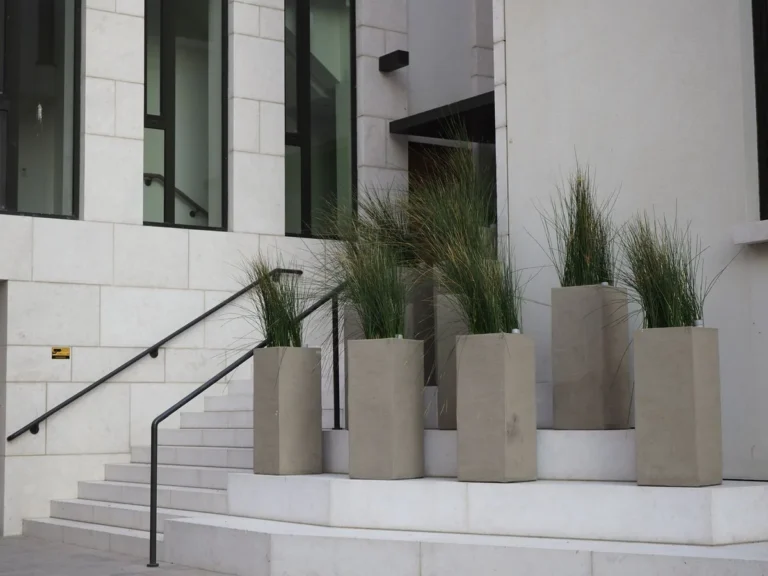
Commercial planter manufacturers in China include fibreglass and resin planter makers, powder-coated and weathering steel planter fabricators, cast concrete and stone composite planter makers, timber planter and raised bed makers, and landscape furniture companies that supply planters with benches and shade structures. A commercial planter is a large container for planting in hotels, resorts, plazas and streets, and each route supplies a different material, weight and drainage design under the same word.
This guide sorts the supply side into five sourcing routes so a procurement team can send one brief to the right makers and compare the answers fairly. It is not a ranking. No factory is named or scored here, and no claim is made about the strength, frost resistance or lifetime of any planter. The landscape designer, the project specification and the local authority define those requirements, and each maker must show evidence for the exact planter it offers. For related products, see our guides to street furniture and park bench manufacturers, outdoor furniture manufacturers and outdoor pergolas.
What should a planter brief state?
A brief that says only “large planter, grey, 80 cm” produces quotations that cannot be compared, because planters differ in wall thickness, drainage and liner. State at least the following, copied from the landscape drawings and the specification.
- Drawing reference and quantity: each planter type with its location on the landscape plan.
- Dimensions: external length, width and height, the interior planting depth and the shape as drawn.
- Material and finish: the material the specification names, the colour reference and the surface texture.
- Drainage: drainage holes, outlet position and whether a reservoir or liner is required.
- Planting load: the soil and plant weight the planter must carry, as the designer states it, and whether trees are planted.
- Weight and handling: empty weight limits for rooftops or podiums, and lifting points or base design for installation.
- Fixing: whether planters are freestanding, anchored or ballasted, particularly in windy or public locations.
- Environment: sun, salt air, frost or irrigation exposure, as the project states them.
- Packing and documents: packing for each type, and the data sheets and care instructions the project requires.
Five sourcing routes for commercial planters
1. Fibreglass and resin planter makers
Moulded planters in fibreglass or resin are made in many shapes and colours from a mould, which suits repeat quantities of one type. Ask for the laminate or resin description, the wall thickness, the finish system and the drainage design, and request a sample corner and a finished colour sample before bulk production. Ask how nested units are packed and protected.
2. Powder-coated and weathering steel fabricators
Steel planters are cut, folded and welded to the drawing, in powder-coated or weathering finishes, and are often made in bespoke shapes for architect-led projects. Ask for the steel thickness, the weld and edge treatment, the coating system and the drainage detail, and approve a sample of a corner and the finish. See our comparison of powder coating and anodising for coating questions on metal.
3. Cast concrete and stone composite planter makers
Concrete and composite planters are made for plazas, streets and large landscape areas. Ask for the mix or composite description, the reinforcement, the wall thickness, the drainage and the lifting method, and agree the delivery and installation equipment in advance. Ask for the packed weight of each type so that freight and handling can be planned.
4. Timber planter and raised bed makers
Timber planters are made from solid wood or composite boards for hospitality terraces and gardens. Ask for the species or board description, the treatment or finish, the liner and the fixings, and request the timber legality documents the destination requires. See our guides to WPC composite decking manufacturers and timber legality documents.
5. Landscape furniture companies supplying planters with benches and shade
Some companies supply planters together with benches, bollards, pergolas and lighting for one landscape package. This puts one party in charge of the coordination, but ask the company to price planters as their own lines and to name the maker whose product is used so that evidence can be checked. See our guide to landscape lighting for the lighting package.
Sourcing this for a commercial project?
FBM Sourcing manages the entire China procurement package for overseas construction projects. We work with Developers · General Contractors · Builders · Commercial Project Owners · Interior Design & Construction Companies · FF&E Solution Providers. Send your BOQ, drawings or product schedule for review.
How to compare planter quotations
- Size and wall thickness: external dimensions, interior depth and thickness on every line.
- Material and finish: the material description and coating or colour system.
- Drainage and liner: what is included and what is not.
- Weight: empty weight per planter and packed weight per package.
- Units: price per piece or per set, and what a set contains.
- Packing: how nested or stacked units are protected and the count per package.
- Exclusions and substitutions: any change of material, size or finish the maker proposes.
A quotation that is cheaper on one line may be thinner on another. Read the descriptions side by side before reading the totals.
Samples, approval and acceptance on delivery
Approve a sample of each type, showing the corner, the wall section, the drainage and the finish, before bulk production, and record the approval in writing against the drawing reference. Have the landscape contractor check the sample for fit with the planting and irrigation plan. Keep the approved sample as the reference for the bulk order.
On delivery, check packages against the order: type, size, finish, drainage fittings and quantity. Note any damage or difference in writing on the day with photographs, so the maker can respond while the evidence is fresh.
What evidence to ask each route for
Evidence should be requested for the exact planter, not for a product family. Ask for the following in writing and keep the answers with the quotation.
- Fibreglass and resin makers: laminate or resin description, wall thickness and finish samples.
- Steel fabricators: steel thickness, coating system and a corner sample.
- Concrete makers: mix or composite description, reinforcement and packed weight.
- Timber makers: species or board description, treatment and legality documents.
- Landscape companies: the name of the maker, separate price lines and an installation method statement.
Specification gaps to close before quotation
A quotation cannot answer the questions below for itself. Check that the brief answers these questions before it goes out.
- Is each planter drawn with external size, planting depth and drainage?
- Which material and finish does the specification require?
- What weight limit applies on rooftops or podiums?
- How are planters fixed or ballasted in exposed locations?
- Who supplies liners, drainage fittings and soil?
- What documents must arrive with each shipment?
Next steps for a planter package
Send each maker the same brief and ask for answers in writing, line by line, with samples or documents before bulk production. FBM Sourcing manages China procurement packages for overseas projects; furniture-only packages are also run through FBM Furniture.
Questions buyers ask about commercial planters from China
Can two planter quotations be compared by external size alone?
No. External size says nothing about wall thickness, material or drainage. Compare material, thickness, drainage and finish on each line before comparing totals.
Who decides the load a planter must carry?
The landscape designer decides from the planting and soil depth, and the structural engineer checks the supporting slab. State the load in the brief and ask each maker how the offered planter meets it.
How should heavy planters be quoted?
Ask for empty weight and packed weight per type, and agree the delivery and lifting equipment before ordering, so that freight and installation can be planned.
Do planters need a drainage design?
Most do. State the drainage outlets and any liner or reservoir in the brief, and approve them on a sample before bulk production.
How does FBM Sourcing support this kind of package?
We review the brief, collect comparable quotations and manage the package for the project. For suppliers you nominate, we charge a 5% commission; for products we source for you, we quote a direct price. Our own team performs one inspection after bulk production is complete and before shipment, and the client’s project team is welcome to attend.
FBM Sourcing manages the entire China procurement package for overseas construction projects. We work with Developers · General Contractors · Builders · Commercial Project Owners · Interior Design & Construction Companies · FF&E Solution Providers.





