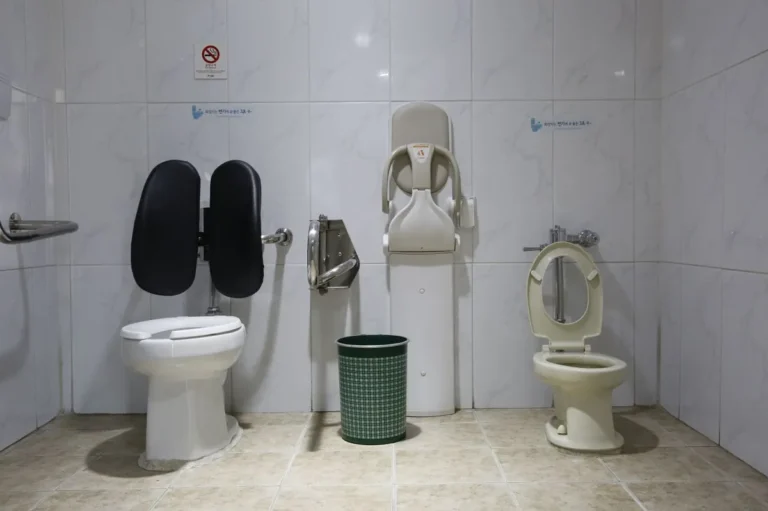
AS 1428.1 is the Australian design standard that sets the dimensions, reach ranges, forces and contrasts for accessible buildings, and it is called up by the National Construction Code (NCC Volume One Part D4 and Part F4) and by the Disability (Access to Premises — Buildings) Standards 2010. For a project buyer sourcing from China, the practical point is this: AS 1428.1 is not a product certification that a factory can hold — it is a set of geometry and performance rules that the grabrails, toilet pans, basins, tapware, shower seats, door hardware, mirrors and signage must satisfy once installed. The procurement job is therefore to translate the clause figures into the product schedule, reject the ADA-dimensioned stock many Chinese factories export to the US, and check assembled dimensions before the container is loaded. This guide lists the fixtures that AS 1428.1 touches, the numbers that matter, where Chinese products go wrong, and how a building material sourcing agent and sourcing partner keeps an Australian accessible-bathroom package compliant.
Where Does AS 1428.1 Apply in a Commercial Building?
AS 1428.1-2021 (Design for access and mobility — General requirements for access — New building work) replaced the 2009 edition and is referenced by NCC 2022. In Class 2–9 buildings — apartments, hotels, offices, shops, schools, healthcare and aged care — the NCC requires accessible paths of travel, accessible sanitary facilities, accessible car parking and signage, and it uses AS 1428.1 for the detail. Related standards complete the picture:
- AS 1428.1-2021 — doorways, circulation spaces, sanitary facilities (unisex accessible, ambulant, accessible showers), grabrails, basins, tapware, mirrors, hooks, controls and luminance contrast.
- AS 1428.2 — enhanced and additional requirements (used where the brief or an aged-care operator asks for more than the minimum, e.g. accessible kitchens).
- AS/NZS 1428.4.1 — tactile ground surface indicators (TGSIs) at stairs, ramps and hazards.
- AS 1428.5 — communication for people who are deaf or hearing impaired (hearing augmentation).
- AS 4586 / HB 198 — slip resistance of pedestrian surfaces, read alongside accessible wet areas.
- Plumbing Code of Australia (NCC Volume Three) — every tap, pan, cistern, basin and shower fitting must still carry WaterMark certification and, where applicable, a WELS rating; accessibility does not waive either.
Class 3 hotels and Class 9c aged-care buildings are where the product count is highest: every accessible guest room or resident room carries an accessible bathroom, and the fixtures in it are procurement items.
Which Fixtures and Fittings Does AS 1428.1 Govern?
The standard is written around the building, but a large share of its clauses land on products that arrive in a container. The figures below are the ones that decide whether an imported item can be installed without a variation; confirm them against the edition and any state amendment your certifier is working to.
- Grabrails: outside diameter 30–40 mm; clearance between rail and wall 50–60 mm; able to withstand a force of 1,100 N applied in any position and direction without failure; ends returned or terminated to avoid catching; luminance contrast with the wall to the level AS 1428.1 sets. Installed at the heights and configurations shown in the standard’s figures for pans (rear wall and side wall rails) and showers.
- Toilet pans: seat height 460–480 mm above finished floor; pan centreline 450–460 mm from the side wall; a backrest is required where the cistern does not provide one, positioned to the standard’s figure; flush control reachable from the seated position.
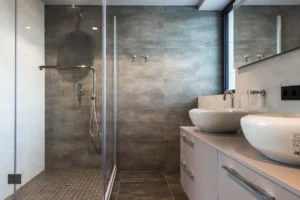
- Washbasins: rim height 800–830 mm above floor with clear knee and toe space underneath to the figure in the standard (wall-hung or semi-recessed basins, no vanity cupboard under the accessible basin); taps of lever, capstan or sensor type operable with one hand.
- Showers: hand-held shower on a vertical rail with a hose of at least 1,500 mm; folding seat with the seat surface 460–480 mm above the floor; grabrails and fittings in the configuration shown for the accessible shower; floor graded to a waste without a hob.
- Mirrors: bottom edge no higher than 900 mm and top edge no lower than 1,850 mm above the floor — in practice a tall mirror rather than a tilted one.
- Doors and hardware: minimum clear opening 850 mm; lever or D-type handles at 900–1,100 mm, operable with one hand without tight grasping; door leaf and frame with the luminance contrast to the adjacent wall that AS 1428.1 sets, or a contrasting strip.
- Controls, hooks and dispensers: within the reach ranges of the standard; coat hooks at accessible height; toilet roll holders and soap dispensers positioned relative to the pan and basin as drawn.
- Ambulant toilet compartments: compartment width and grabrails on both side walls, also 30–40 mm diameter; the fittings are often ordered in the same batch as the accessible compartment items.
- Signage and TGSIs: raised tactile and Braille signage to Clause 8; TGSIs to AS/NZS 1428.4.1 with the luminance contrast that standard sets for the type used.
Everything in that list except the door leaf itself is a catalogue item in Foshan and Chaozhou factories — stainless grabrails, accessible pans and care-height suites, wall-hung basins, sensor and lever tapware, shower rails, folding seats, mirrors and hardware. The bathroom accessories and sanitary ware pages cover the standard ranges; the accessible room schedule is a sub-set of those ranges with tighter dimensional rules.
Where Do Chinese Accessible Products Go Wrong on Australian Projects?
Chinese factories that export accessible fixtures usually built their ranges for the US market, and the US Americans with Disabilities Act Standards use different numbers. Our article on ADA compliance for hotel FF&E and bathrooms sets out the US side; the mismatches that cause rejections on Australian jobs are:
- Grabrail wall clearance: ADA allows 1½ inch (38 mm) between rail and wall; AS 1428.1 requires 50–60 mm. A “32 mm disabled grab bar” sold for the US market, with its standard flange, will often sit at 38–40 mm from the wall and fail. Specify the clearance, not just the diameter.
- Grabrail diameter: ADA permits 1¼–2 inch (32–51 mm) round; AS 1428.1 is 30–40 mm. Most 32 mm and 38 mm tube is fine; 42 mm and 50 mm “heavy duty” bars are not.
- Pan seat height: ADA is 17–19 inch (432–483 mm); AS 1428.1 is 460–480 mm. A standard Chinese export “comfort height” pan at 430–450 mm to the top of the seat is below the Australian minimum. Ask for the height to the top of the seat, not to the rim of the pan, with the actual seat fitted.
- Backrests: rarely in a US-oriented catalogue; they must be added and fixed to the standard’s geometry.
- Basin height and knee space: ADA rim height is up to 34 inch (864 mm); AS 1428.1 is 800–830 mm. Basins with an integral bowl that drops below the knee clearance line also fail.
- Fixings and load: grabrails need concealed or three-screw flanges fixed into noggings, steel plates or backing that can take the 1,100 N load. A pull-test report from the factory or a laboratory, and an installation detail, should be on file before the order.
- Material: 304 stainless is standard; 316 for coastal and pool areas; powder-coated or nylon rails are acceptable where the required contrast is needed and the rail still meets the load. Satin finish rather than mirror polish for glare control.
- WaterMark and WELS: tapware, pans, cisterns and shower fittings must be WaterMark-certified by a JAS-ANZ-accredited body and WELS-registered; an accessible lever mixer without WaterMark cannot be installed by a licensed plumber regardless of how well it meets AS 1428.1. See CUPC, WaterMark, WRAS and CE for sanitary ware.
Sourcing this for a commercial project?
FBM Sourcing works with project owners, developers, main contractors and FF&E contractors on hotel, apartment, school, office and other commercial building projects. Send us your BOQ, drawings or product list — our team will review it and get back to you.
What Evidence Should You Collect from the Factory?
Because AS 1428.1 is a design standard, there is no “AS 1428 certificate” to ask for, and a factory that offers one is offering a document with no legal meaning. The evidence set that satisfies an Australian certifier and the project’s access consultant is:
- Dimensioned drawings of each accessible fixture with the controlling AS 1428.1 figure noted: rail diameter and wall clearance, pan seat height with the specified seat, basin rim height and underside profile, shower seat height and fold-down clearance, mirror size, handle type and height.
- Load evidence for grabrails and shower seats — a test report showing the rail and its fixing withstand 1,100 N, and the installation detail (backing, fixing type, screw pattern) the test assumed.
- WaterMark certificates and WELS registration for every plumbing product, with the licence number and the exact model.
- Material and finish statements — stainless grade (304/316), finish, and for coated rails the coating system and its contrast colour.
- Slip-resistance reports for shower bases and wet-area tiles to AS 4586 (P ratings) where the floor finish is part of the package.
- A sample set of the accessible room fixtures approved before production — one pan with seat, one basin, one rail of each configuration, one shower seat and rail — photographed against a scale so the approved dimensions are on record.
Where a product claim is backed only by a factory’s own measurement, treat it as provisional; factory test reports vs accredited lab testing explains what each document can and cannot prove.
How Should the Accessible Schedule Be Written into the Order?
Keep accessible-room fixtures as their own BOQ lines, apart from the standard rooms, even when the product looks identical. A 60-room hotel might have 4–6 accessible rooms plus public accessible toilets on each floor: small quantities of pans, basins, rails and seats that are easy to lose inside a 300-piece sanitary ware order. Each line should state the AS 1428.1 clause it serves, the controlling dimension, the material and finish, and the WaterMark/WELS requirement. Mixed US/Australian specifications in one factory order — ADA rails for a US hotel and AS 1428.1 rails for an Australian one — are a common source of swapped cartons; label the cartons by project and room type, not only by SKU.
How FBM Sourcing Handles Accessible Fixtures on an Australian Package
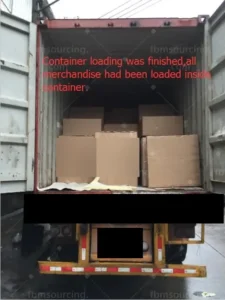
FBM Sourcing manages the entire China procurement package for overseas construction projects. On an Australian hotel, apartment, aged-care or education package the accessible sanitary schedule is separated from the standard rooms and each line is written against the AS 1428.1 figure it must meet. Factories are shortlisted on dimensional drawings, load evidence and WaterMark/WELS status for the exact models, not on catalogue claims; samples are approved before production; and before shipment our own team measures the assembled items at the factory — seat height with the seat fitted, rail diameter and wall clearance with the supplied flange, basin rim height on the mounting bracket — with photo and video records that go to you with the packing documents. All quotations, invoices and shipping documents are issued by FBM Sourcing — you deal with us, and we carry the responsibility. For suppliers you nominate, we charge a 5% commission; for products we source for you, we quote a direct price. We ship by full container; accessible fixtures travel with the rest of the bathroom package and the other categories from the same project.
Accessible fixtures are only one half of an aged care interior; the loose furniture beside them carries its own Australian requirements. Our round-up of healthcare and aged care furniture manufacturers in China for Australian projects sets out the manufacturer types, the furnishings the Aged Care Rules 2025 expect a residential care home to provide, and the AS/NZS seating standards and timber import documents to ask for.
Get a China Procurement Quote for Your Project
If you are specifying accessible bathrooms, grabrails, tapware or door hardware for an Australian hotel, apartment, aged-care, school or office project, send us the accessible room schedule, the standard room schedule, quantities, the destination port and the required-on-site dates. Our team will review the package line by line and set out a quotation.
Use the quote button above or WhatsApp +86 135 6007 5057 to start the conversation.