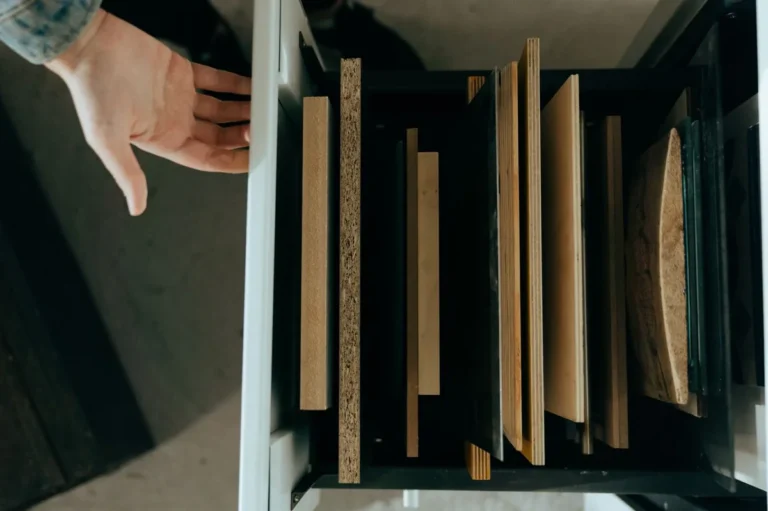
Veneered hotel casegoods, such as a wood-veneered headboard, nightstand or wardrobe built on a particleboard or MDF core, can fall under the US formaldehyde rule for composite wood, 40 CFR Part 770 (EPA’s TSCA Title VI rule). Since 22 March 2024, the text says producers of laminated products must also meet the requirements that apply to hardwood plywood panel producers, unless a specific exemption applies. This guide reads the rule text so a procurement team knows what to ask a Chinese casegoods maker.
It is a reading guide, not legal advice, and it covers US federal rules only. It was written from the eCFR text of Part 770, which eCFR marked as up to date as of 2 October 2026 when we read it on 6 October 2026. Rules change, so confirm the current text before you order, and do not treat any maker’s statement as proof of compliance.
What counts as a laminated product under Part 770?
Section 770.3 defines a laminated product as a product in which a wood or woody grass veneer is affixed to a particleboard core or platform, a medium-density fiberboard core or platform, or a veneer core or platform. The same section says a laminated product is a component part used to construct or assemble a finished good, and that it is produced either by the fabricator of the finished good or by a fabricator who uses it in a further component part.
A “laminated product producer” is a manufacturing plant or other facility that manufactures laminated products on the premises, excluding facilities that solely import products. The text adds that laminated product producers are fabricators, and, beginning 22 March 2024, are also hardwood plywood panel producers except as provided in section 770.4. Read the rule at the eCFR page for Part 770.
For a hotel project, the practical reading is this: a casegoods factory that presses or glues its own veneer onto a particleboard or MDF platform may be a laminated product producer, while a factory that buys finished veneered panels may not be. Ask each maker which of the two it is, for each product line, in writing.
What changed on 22 March 2024?
Section 770.2 sets the dates. Beginning 1 June 2018, all manufacturers (including importers), fabricators, suppliers, distributors and retailers of composite wood products, and of component parts or finished goods containing them, must comply, with a carve-out for laminated products. Under that carve-out, from 1 June 2018 laminated product producers had to meet the requirements that apply to fabricators. Beginning 22 March 2024, they must also meet the requirements that apply to hardwood plywood panel producers, except as provided in section 770.4.
The same section says producers of laminated products that are exempt from the definition of hardwood plywood under section 770.4 must, beginning 22 March 2024, comply with the recordkeeping requirements in section 770.40(c) and (d), in addition to the fabricator requirements. The definition of hardwood plywood in section 770.3 says it includes laminated products except as provided in section 770.4.
Composite wood products manufactured (including imported) before 1 June 2018 may be sold, supplied, offered for sale, or used to fabricate component parts or finished goods at any time, according to section 770.2. That clause concerns old stock, not new production.
Which laminated products does section 770.4 exempt?
Section 770.4 lists two current exemptions from the hardwood plywood definition. The first covers laminated products made by attaching a wood or woody grass veneer with a phenol-formaldehyde resin to a platform that has been manufactured in compliance with Part 770. The second covers laminated products made by attaching veneer with a resin formulated with no-added formaldehyde as part of the resin cross-linking structure to a platform that has been manufactured in compliance with Part 770.
In both cases the text says the platform must be one certified under section 770.15, or made with no-added formaldehyde-based resins under section 770.17, or made with ultra low-emitting formaldehyde-based resins under section 770.18. The exemption therefore depends on two facts: which resin attaches the veneer, and whether the platform itself was made in compliance. Ask the maker to state both for each product line, and to name the platform source.
Section 770.4 also lets any person petition EPA to start a rulemaking for additional exemptions. This guide does not describe any exemption beyond the two in the text.
What do the emission standards and records say?
Section 770.10 sets formaldehyde emission standards based on test method ASTM E1333-14: 0.05 parts per million for hardwood plywood made with a veneer core or a composite core, 0.11 ppm for medium-density fiberboard, 0.13 ppm for thin medium-density fiberboard, and 0.09 ppm for particleboard. The text says the standards apply whether the composite wood product is a panel, a component part, or incorporated into a finished good.
Section 770.30 covers buyers further down the chain. Importers must take reasonable precautions and show it by keeping, for three years, bills of lading, invoices or comparable documents that include a written statement from the supplier that the products are TSCA Title VI compliant (or were produced before 1 June 2018), and by ensuring records identifying the panel producer and the production date, and the supplier and purchase date if different, can be made available to EPA within 30 calendar days of request. Fabricators, distributors and retailers must obtain similar supplier statements.
Section 770.40 requires panel producers to keep test and production records for three years and to make certain testing records available to direct purchasers, and the text says that information may not be withheld from direct purchasers as confidential business information. Whether a given casegoods maker holds such records for its platform, or relies on a platform supplier’s records, is a question to put in writing.
Sourcing this for a commercial project?
FBM Sourcing manages the entire China procurement package for overseas construction projects. We work with Developers · General Contractors · Builders · Commercial Project Owners · Interior Design & Construction Companies · FF&E Solution Providers. Send your BOQ, drawings or product schedule for review.
What must the label say?
Section 770.45 sets labeling. Panels or bundles of panels sold in the United States must be labeled with the panel producer’s name (a producer number may be used instead, so long as EPA can determine the identity), the lot number, the number of the EPA TSCA Title VI certifier (TPC), and a statement that the products are TSCA Title VI certified.
Fabricators of finished goods containing composite wood products must label every finished good they produce, or every box or bundle containing finished goods. The label must include, in legible English text, the fabricator’s name, the date the finished good was produced (month and year), and a statement that the finished goods are TSCA Title VI compliant. If goods are not individually labeled, the importer, distributor or retailer must keep a copy of the label and be able to identify the products it applies to. Section 770.5 lists making false or misleading statements in a required certification or record as a prohibited act, which is a reason to check the wording of what a maker prints on cartons.
What to put in a veneered casegoods enquiry for a US project
- Construction: for each item, state the core (particleboard, MDF, veneer core), the face (wood veneer, paper, HPL) and where the veneer is applied.
- Laminated product producer status: ask whether the factory applies veneer to its own platforms, and which platforms.
- Resin and platform evidence: ask which resin attaches the veneer and how the platform meets Part 770, so the section 770.4 exemption can be checked against the facts.
- Supplier statement: ask for the written TSCA Title VI statement on the commercial invoice or comparable document, as section 770.30 contemplates.
- Label: ask for a sample carton label showing the fabricator name, production month and year, and the compliance statement.
- Importer records: confirm who is the importer and who keeps the three-year records.
- Other requirements: name any state or hotel brand rules separately from the federal rule.
Next steps for a hotel casegoods package
Send each maker the same brief and ask for the answers above in writing. For the background rules on cabinets and furniture, see our guide to CARB Phase 2 and TSCA Title VI. For the product side, see our guides to hotel casegoods manufacturers and HPL laminate versus wood veneer. FBM Sourcing also runs FBM Furniture’s hotel guestroom furniture pages for furniture-only packages.
Questions buyers ask about TSCA Title VI and veneered casegoods
Does TSCA Title VI apply to veneered hotel furniture made in China?
The rule text says the emission standards apply to composite wood products sold, supplied, offered for sale or manufactured, including imported, in the United States, whether in the form of a panel, a component part or a finished good. Check the exact product and the current text of 40 CFR Part 770 before ordering.
What is a laminated product producer?
Section 770.3 defines it as a facility that manufactures laminated products on the premises, excluding facilities that solely import. A laminated product is a wood veneer affixed to a particleboard, MDF or veneer core or platform.
What happened on 22 March 2024?
Section 770.2 says that beginning on that date, producers of laminated products must comply with the requirements that apply to hardwood plywood panel producers, in addition to the fabricator requirements, except as provided in section 770.4.
Which laminated products are exempt?
Section 770.4 lists two: veneer attached with a phenol-formaldehyde resin, or with a resin formulated with no-added formaldehyde, to a platform made in compliance with Part 770. Both depend on the platform’s compliance, so ask the maker for evidence on both points.
How does FBM Sourcing support a casegoods package?
We review the brief, collect comparable quotations and manage the package for the project. For suppliers you nominate, we charge a 5% commission; for products we source for you, we quote a direct price. Our own team performs one inspection after bulk production is complete and before shipment, and the client’s project team is welcome to attend.
FBM Sourcing manages the entire China procurement package for overseas construction projects. We work with Developers · General Contractors · Builders · Commercial Project Owners · Interior Design & Construction Companies · FF&E Solution Providers.