Compact laminate, powder-coated steel and HDPE are three different industrial products cut into the same shapes, and only one has a published product standard a project team can check. Compact laminate is covered by EN 438-4:2016 in Europe and GB/T 7911-2024 in China, both verified as current on 24 September 2026; for powder-coated steel and HDPE cubicles we could not verify an equivalent product standard, so their evidence has to be assembled from test methods and coating specifications. The three are therefore not compared on the same kind of evidence, and a specification that treats them as interchangeable gets back quotations that are not comparable.
This is written for developers, general contractors, builders, commercial project owners, interior design and construction companies and FF&E solution providers specifying washroom cubicles for offices, schools, stadiums, airports, hospitals, shopping centres and hotels. It is the material companion to our overview of the supply base in toilet partition manufacturers in China for commercial washrooms, which sets out who makes these systems and why no Chinese listed issuer could be verified in the category.
What Is Each of the Three Materials Actually Made Of?
Compact laminate, or compact HPL
Compact laminate is a homogeneous sheet pressed from resin-impregnated papers under heat and high pressure, decorative on both faces, with a core of the same pressed material. The European product standard is EN 438-4, whose published scope specifies performance requirements for two types of compact laminate of thickness 2 mm or greater produced by using a high pressure process intended for interior use; BSI records BS EN 438-4:2016 as Current. BS EN 438-2:2016+A1:2018 carries the determination of properties, meaning the test methods behind any EN 438 claim. BS EN 438-6:2016 is the exterior-grade part and the wrong one to cite for an indoor washroom.
China has its own standard for the same material. GB/T 7911-2024, published 15 March 2024 and effective 1 October 2024, carries the English title High-pressure decorative laminates made from thermosetting resins impregnated sheets (HPL), is recorded as current, and supersedes the 2013 edition, now recorded as withdrawn. It is a recommended national standard rather than a mandatory one, and the catalogue notes that it adopts an international standard, so conformity is a commercial undertaking given by the mill rather than a legal obligation.
Powder-coated steel
A powder-coated steel cubicle is not one material but an assembly: formed steel skins, a core, and an organic coating applied as dry powder and cured. No single product standard covers that, so the documentation has to address each layer. The coating side has verifiable methods: ASTM D3359, Standard Test Methods for Rating Adhesion by Tape Test, is listed with D3359-23 as the active designation, and BS EN ISO 12944-2:2017 states in its scope that for different atmospheric environments a classification system based on corrosivity categories is presented. Salt spray exposure is normally specified to ASTM B117, Standard Practice for Operating Salt Spray (Fog) Apparatus, but we could not verify a current designation for it, so we cite it by number only and treat its status as unverified rather than concluding it is withdrawn.
HDPE, sold as solid plastic
HDPE panels are formed from high-density polyethylene, coloured through the full section rather than surfaced, so there is no decorative layer to lose. We could not verify a published product standard for HDPE cubicle panels equivalent to EN 438-4, and the searches behind that conclusion are set out in the FAQ below. The evidence therefore has to be built from test methods: ASTM D570, Standard Test Method for Water Absorption of Plastics, has D570-22 as its active designation, and reaction to fire is handled by ASTM E84 in the United States or BS EN 13501-1:2018 in Europe.
Which Standards Can Be Verified, and Which Cannot?
Everything below was checked against the publisher’s own record on 24 September 2026. No threshold values are quoted, because a classification belongs to a construction and thickness, not a material family.
| Material | Document | What it is | Status as recorded |
|---|---|---|---|
| Compact laminate | BS EN 438-4:2016 | Product standard, compact laminates 2 mm and greater, interior | Current |
| Compact laminate | BS EN 438-2:2016+A1:2018 | Determination of properties, the EN 438 test methods | Under Review |
| Compact laminate | GB/T 7911-2024 | Chinese standard for high-pressure decorative laminates, effective 1 October 2024 | Current, recommended |
| Powder-coated steel | ASTM D3359-23 | Rating adhesion of a coating by tape test | Active designation |
| Powder-coated steel | BS EN ISO 12944-2:2017 | Environment classification for protective paint systems | Under Review |
| Powder-coated steel | ASTM B117 | Practice for operating salt spray apparatus | Current designation not verified |
| HDPE | ASTM D570-22 | Water absorption of plastics | Active designation |
| All three | ASTM E84-26a | Surface burning characteristics of building materials | Active designation |
| All three | BS EN 13501-1:2018 | Fire classification from reaction to fire test data | Current |
| Assembled cubicle | None found | No product standard for the finished cubicle verified in the catalogues searched | Not verified |
The last row changes how a package should be written. Because no verified product standard describes the assembled cubicle in any of the three materials, the specification and the shop drawings carry the whole load: a supplier can be entirely honest and still deliver something unexpected if the specification only names a material.
How Should the Three Materials Be Compared on a Real Washroom Package?
Comparison on material name alone produces the illusion of a like-for-like quotation. These are the points where the three genuinely diverge, written as questions for each quoting factory rather than claims about which one wins.
- Where the panel is vulnerable. Compact laminate and HDPE are homogeneous through the section, so a report on the sheet describes the whole panel. A powder-coated steel panel is a coated skin over a core: the sheet report describes the steel, the coating report the finish, and neither the edge seam. Ask which document covers the edge and the fixing point.
- What the cleaning regime is. Washrooms in stadiums, schools and transport buildings are cleaned differently from an office washroom. Name the chemical the client’s facilities team uses, and ask which test in EN 438-2 or which plastics method the factory holds evidence against for it.
- How fire is demonstrated. The destination market decides the route: ASTM E84 in the United States, EN 13501-1 in Europe. A report for a different thickness of the same material is not evidence for the panel quoted.
- Who supplies the hardware. Indicator locks, hinges, brackets, pilaster shoes and headrails come from specialist factories in all three materials and are bought in by the fabricator, so the material decision does not resolve the hardware.
- How the panel is fixed. Floor-mounted, floor-to-ceiling, ceiling-hung and wall-hung configurations put load into different parts of the building, and the anchorage has to match the real construction on site.
The same reasoning applies wherever a coated metal panel and a laminate panel compete for one job, which is why our comparison of steel against laminate office storage cabinets lands in the same place, and why laminate against wood veneer on hotel casegoods turns on documentation, not appearance.
Pricing a commercial washroom partition package from China?
Send us the washroom drawings or the schedule and we will hold the board, coating, hardware and anchorage specification in one document across every factory that quotes. FBM Sourcing manages the package from specification through inspection and shipping.
What Does the ADA Require, and How Does the Material Choice Affect It?
On United States projects the geometry of at least one compartment per washroom is set by the 2010 ADA Standards for Accessible Design, and because the compartment is formed by the partition system, these clauses are fabrication instructions in any material. Clause 213.3.1 requires one compartment complying with 604.8.1 wherever toilet compartments are provided, and a second complying with 604.8.2 once six or more compartments, or six or more combined urinals and water closets, are provided.
| Clause | What the published text requires |
|---|---|
| 604.8.1.1 | Wheelchair accessible compartments shall be 60 inches (1525 mm) wide minimum measured perpendicular to the side wall, and 56 inches (1420 mm) deep minimum for wall hung water closets and 59 inches (1500 mm) deep minimum for floor mounted water closets measured perpendicular to the rear wall. |
| 604.8.1.2 | Doors shall be located in the front partition or in the side wall or partition farthest from the water closet; where located in the front partition, the door opening shall be 4 inches (100 mm) maximum from the side wall or partition farthest from the water closet. The door shall be self-closing. A door pull complying with 404.2.7 shall be placed on both sides of the door near the latch. |
| 604.8.1.4 | The front partition and at least one side partition shall provide a toe clearance of 9 inches (230 mm) minimum above the finish floor and 6 inches (150 mm) deep minimum beyond the compartment-side face of the partition, exclusive of partition support members. |
| 604.8.2.1 | Ambulatory accessible compartments shall have a depth of 60 inches (1525 mm) minimum and a width of 35 inches (890 mm) minimum and 37 inches (940 mm) maximum. |
| 604.8.2.3 | Grab bars shall comply with 609. A side-wall grab bar complying with 604.5.1 shall be provided on both sides of the compartment. |
| 609.8 | Allowable stresses shall not be exceeded for materials used when a vertical or horizontal force of 250 pounds (1112 N) is applied at any point on the grab bar, fastener, mounting device, or supporting structure. |
Three of these land on the material. Toe clearance is exclusive of partition support members, so a pilaster shoe cannot be counted into it. Door hand is fixed relative to the water closet, so a mirrored washroom is a different cutting list. And where an ambulatory compartment puts a grab bar on a partition rather than a building wall, the panel and its anchorage become the supporting structure under 609.8. More accessibility items are in our note on ADA compliance across hotel bathrooms.
What Evidence Should Be Requested Before a Material Is Approved?
With no verified product standard for the assembled cubicle, the documentation is the specification. Each item should name a construction, a thickness and a date.
- Compact laminate: a test report against EN 438-4 or GB/T 7911-2024 from an accredited laboratory, naming the thickness and construction quoted rather than a generic grade.
- Powder-coated steel: substrate specification and thickness, pretreatment, coating system with cure schedule, adhesion evidence against ASTM D3359, and corrosion exposure data for the environment the washroom sits in.
- HDPE: panel thickness, confirmation that the colour runs through the full section, water absorption data against ASTM D570, and the edge finish.
- All three: reaction to fire or surface burning evidence against the method the destination market requires, tied to the construction and thickness quoted.
- Hardware: a specification sheet naming material and finish for hinges, indicator locks, brackets, pilaster shoes and headrails, with any cycle test data.
- Anchorage and drawings: a fixing and bracing detail matched to the real floor and wall construction, including any grab bar carried by a partition, plus dimensioned shop drawings showing door hand per cubicle.
- Samples: a production sample of the edge and of a fixing point, not only a face sample, because that is where a partition fails first.
The certification trail differs by destination market across the rest of the washroom, and our guide to sanitary ware certifications sets out how those marks are structured. Where the fixtures are still open, the choice between wall hung and floor mounted water closets changes the accessible compartment depth above, making it a partition decision as much as a plumbing one.
How FBM Sourcing Handles a Washroom Partition Package
FBM Sourcing works from the washroom drawings or the schedule and holds the board, coating, hardware and anchorage specification in one document, then puts that document in front of every factory that quotes, so what comes back can be compared line by line instead of material by material. Where a project is open between the three materials, each factory quotes against its own with the documentation named above attached. As the client’s sourcing partner in China we keep the partition run aligned with the rest of the washroom, since cubicles, fixtures, accessories and sometimes vanities arrive and install together.
Our own team inspects at the factory after bulk production is finished, before shipment, with photo and video records, and an inspection report goes to the client before the balance is paid. For partitions that inspection is about what a sample cannot show: edge finish on the real run, hardware fitted and operating, panel dimensions against the approved cutting list, and packing for panels that travel on edge.
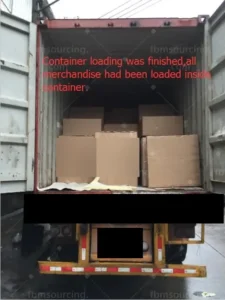
On logistics, the pattern varies by project. Sometimes, on a large project, the toilet partitions alone fill full containers; sometimes the toilet partitions share containers with the other product categories of the same project; and sometimes, in one batch, we combine a dozen or more product categories from several projects of the same client into a few containers — always full containers, and for us this is routine, well-practised work.
Pricing a commercial washroom partition package from China?
Send us the washroom drawings or the schedule and we will hold the board, coating, hardware and anchorage specification in one document across every factory that quotes. FBM Sourcing manages the package from specification through inspection and shipping.
Frequently Asked Questions
Which of compact laminate, powder-coated steel and HDPE has a verifiable product standard?
Only compact laminate: BSI records BS EN 438-4:2016 as current for compact laminate of thickness 2 mm or greater produced by a high pressure process for interior use, and GB/T 7911-2024 is the current Chinese national standard for high-pressure decorative laminates with effect from 1 October 2024, while for powder-coated steel and HDPE we could not verify an equivalent product standard for cubicle panels.
Is there a Chinese national product standard for finished toilet partitions?
We could not verify one: title searches of the Chinese national standards system on 24 September 2026 for toilet partitions, washroom partition panels and polyethylene sheet material all returned no results, and that system states that national standards in the construction engineering field are not included in it, so this is an unverified point rather than a finding that no such document exists.
Which fire standard applies to a toilet partition, and can a classification be quoted for a material?
Surface burning characteristics are usually specified to ASTM E84, whose active designation is E84-26a, and reaction to fire in Europe is classified using BS EN 13501-1:2018, which BSI records as current; a classification belongs to one construction and thickness tested, so it cannot be quoted for compact laminate, steel or HDPE as a material family.
What should be checked on the coating of a powder-coated steel cubicle?
Ask for the substrate specification and thickness, the pretreatment, the coating system with its cure schedule and adhesion evidence against ASTM D3359, whose active designation is D3359-23, and corrosion exposure data stated against the environment the washroom sits in, using the classification in BS EN ISO 12944-2:2017 as the reference point.
How does the ADA affect which partition material can be used?
The 2010 ADA Standards do not name materials, but clause 609.8 requires that allowable stresses not be exceeded when a force of 250 pounds (1112 N) is applied at any point on a grab bar, fastener, mounting device or supporting structure, and clause 604.8.2.3 requires a side-wall grab bar on both sides of an ambulatory accessible compartment, so wherever a grab bar is carried by a partition the panel and its anchorage become the supporting structure.
About FBM Sourcing
FBM Sourcing manages the entire China procurement package for overseas construction projects. Since 2014 we have worked with developers, general contractors, builders, commercial project owners, interior design and construction companies and FF&E solution providers across more than 20 countries and over 1,000 containers, as their sourcing partner in China — from the schedule or BOQ through factory selection, sampling, inspection by our own team before shipment, consolidation and shipping. All quotations, invoices and shipping documents are issued by FBM Sourcing, and sea freight is quoted to you before shipment. If you have a toilet partition package to price, start at China building materials and FF&E procurement.