Commercial cinema seating in China is not made by one recognisable industry of named factories. It is made by five different kinds of plant — powered recliner assemblers, fixed rocker-back seat manufacturers, ranked-seating engineering shops, upholstery-led VIP seating workshops, and the component makers who supply them all. Identifying the right type for your screen mix matters more than finding a name, because a plant excellent at one of these products usually cannot quote the others.
This article is written for developers, general contractors, builders, commercial project owners, interior design and construction companies and FF&E solution providers pricing seating for a multiplex, a premium large-format hall, a recliner-only VIP screen or a cinema refresh. It deals only with commercial cinema seating. Auditorium and lecture theatre seating is a different family with different geometry, covered in our guide to auditorium and lecture theatre seating manufacturers in China; the wider package around the seats is covered in our overview of FF&E sourcing from China for cinema and entertainment venue projects.
Why We Have Not Published a List of Named Factories Here
We checked whether any Chinese listed company can be named as a commercial cinema seating manufacturer on primary documents, and none passed. The test was narrow: currently listed on a Chinese exchange, and the category visible inside the annual report’s product-segment revenue table — the table headed “principal business by product” — not merely mentioned in a business description.
The venue-equipment groups that surface here report revenue in broad segments such as cultural, sports and tourism technology equipment, rail transit equipment and venue operation services. Seating appears in the narrative description of what they supply, alongside stage machinery, lighting and grandstands, but it is not a separate revenue line in the product-segment table, and in the two most recent annual reports we read the word for cinema does not appear at all. That is not evidence of a weak business; the published accounts do not support calling any of them a cinema seating manufacturer.
Several listed Chinese furniture companies do make recliner sofas for home theatre rooms sold through retail channels, but those are a different product: not ranked, not floor-fixed to a riser, not specified against assembly-occupancy requirements. So this article describes the manufacturer types and what document to ask for from each. There is no scoring column and no ranking, because we have no checkable basis for one.
What Counts as Commercial Cinema Seating, and What Does Not
Scope has to be split before an enquiry goes out: Chinese plants organise around these divisions and quote only the lines they run.
- Fixed rocker-back or push-back seats. The volume product in standard halls: steel frame anchored to the riser, moulded foam, gravity or spring return, fold-up pan, shared armrests with cup holders.
- Powered recliners. Electrically actuated seat and back, usually with a footrest, an armrest control and a low-voltage supply run to each seat or pair — an assembly product with an electrical bill of materials.
- Manual recliners and gliders. Mechanical mechanism, no power run, chosen where riser design or electrical scope rules out actuators.
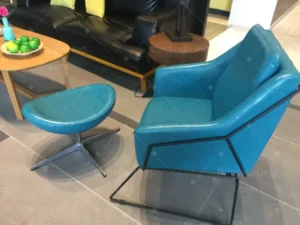
- VIP and premium-hall loose seating. Two-seat units, day-bed styles, loose recliners with side tables — often not ranked, and often built by an upholstery workshop rather than a seating plant.
- Riser trim, step lighting, aisle marking and seat numbering. Small-value items that sit on the critical path, because they are installed with the seats.
Retractable and telescopic seating belongs to multi-purpose halls, and bowl seating is another family — see our notes on stadium and arena seating manufacturers in China.
Which Types of Chinese Manufacturer Actually Build Commercial Cinema Seating?
Each type is described by what has to be inside the plant. The last field is the evidence to request — a product document, not a questionnaire.
1. Powered recliner assemblers
Part furniture maker, part light electromechanical assembler. Frame, foam and cover work is conventional; the difference is a sub-assembly line for actuators, control boxes, harnesses and power supplies, plus a cycle-testing rig. Most buy the actuator in as a module, so the electrical evidence belongs to that supplier and has to be passed through.
Evidence to request: actuator and power supply datasheets with model numbers; the electrical safety test report for actuator, control box and supply, showing the standard, edition and test date; the voltage, frequency and plug configuration for your country; the mechanism cycle test report with the cycles actually run; and the fire performance of cover and foam as a composite.
2. Fixed rocker-back seat plants
The highest-volume cinema product. Strength comes from a welded steel standard and a pressed or cast seat mechanism; consistency comes from tooling rather than sewing skill.
Evidence to request: a ranked-seating strength and durability report naming the model tested; the fixing detail for your riser, with anchor type and edge distance; a dimensioned drawing giving seat width, pan depth, back height and folded and unfolded depth; and the foam specification by density and grade, worth reading against our note on upholstery foam for contract seating.
3. Ranked-seating engineering shops that also serve cinemas
Venue-equipment businesses whose core work is theatres, cultural centres and grandstands. Engineering-led, comfortable with stepped substrates and raked sightlines, and often the only type willing to own the setting-out drawings. Their weakness for a multiplex is unit economics: bespoke project quantities, not a repeat seat produced to fixed tooling.
Evidence to request: a completed setting-out drawing for a comparable raked hall; the ranked-seating strength and durability report; written confirmation of whether setting out, supervision or installation is included; and what they need from the approved drawings before issuing a layout.
4. Contract upholstery workshops for VIP and premium halls
Loose recliners, two-seat units and lounge furniture for premium screens usually come from upholstery-led workshops. Craft quality can be excellent, but the mechanical and electrical discipline of a recliner plant is often absent, and ranked floor-fixed products are outside their scope.
Evidence to request: a non-domestic seating fire performance statement for the exact cover and filling combination, not a generic fabric certificate; a cleaning specification; frame material and joint construction; and, if the unit reclines, the mechanism supplier and its test report.
5. Component and sub-assembly suppliers
Actuators, tip-up mechanisms, cup holders, seat numbering plates, step lighting and riser nosing come from specialists selling into all of the plants above. On a large order it is sometimes better to buy a component line separately and have it delivered to the seating plant.
Evidence to request: the component datasheet and model number; the test report belonging to the component itself; written confirmation of compatibility with the seat model from both sides; and a spare parts statement, because an operator will need these again in year three.
Pricing a commercial cinema seating package from China?
Send us the approved seating layout, the riser section and the cover and fire requirement, and we will take the package through factory selection, sampling, inspection before shipment and shipping.
The One Piece of Geography We Can Actually Evidence
China has a current national industry product standard written for this category. The record on the national standards information service platform shows QB/T 2602-2013, titled in Chinese as public seating for cinemas and theatres, in the light industry series, status recorded as current, issued on 2013-08-12 and in force from 2013-12-01, revising and replacing QB/T 2602-2003. The record gives ICS 97.140, the technical custodian as the National Furniture Standardization Center and the approving department as the Ministry of Industry and Information Technology.
The same record names the drafting units, and the first is a provincial furniture and hardware research institute in Zhejiang. That is the one supply-base fact we will state, because it comes from an official record rather than a market summary. We have not tried to quantify how production is spread across provinces, having found no official source for it.
Which Standards Can Be Named and Checked on a Cinema Seating Submittal?
The table lists only references whose status we checked against the publisher’s own record. We have not quoted numeric thresholds, because those belong to the standard text and the project specification.
| Reference | What it covers | Status we verified |
|---|---|---|
| QB/T 2602-2013 | Public seating for cinemas and theatres, China light industry standard | Recorded as current; in force from 2013-12-01 |
| BS EN 12727:2016 | Furniture. Ranked seating. Requirements for safety, strength and durability | Listed as current by the publisher |
| BS EN 1021-1:2014 | Ignitability of upholstered furniture, ignition source smouldering cigarette | Listed as current by the publisher |
| BS EN 1021-2:2014 | Ignitability of upholstered furniture, ignition source match flame equivalent | Listed as current by the publisher |
| BS 5852:2006 | Ignitability of upholstered seating by smouldering and flaming ignition sources | Listed as current by the publisher |
| BS 7176:2007+A1:2011 | Resistance to ignition of upholstered furniture for non-domestic seating, by testing composites | Listed as current by the publisher |
| ASTM E84-26a | Standard Test Method for Surface Burning Characteristics of Building Materials | Shown as active by the publisher |
Two things follow. A non-domestic seating ignition specification is written around cover and filling tested together, so a fabric certificate alone does not answer it; and the fire route is set by the jurisdiction, so the specification, not the factory, names which reference applies. If the cover is open, our comparison of fabric and vinyl upholstery for commercial seating sets out the trade-offs that show up in a cinema.
What Do the ADA Standards Fix About Seat Layout in a United States Cinema?
For projects in the United States the 2010 ADA Standards for Accessible Design settle several things the seating manufacturer must build to. The provisions below are quoted from that text.
- Number of wheelchair spaces, Table 221.2.1.1. For 4 to 25 seats, 1 space; 26 to 50 seats, 2; 51 to 150 seats, 4; 151 to 300 seats, 5; 301 to 500 seats, 6; and for 501 to 5000 seats, “6, plus 1 for each 150, or fraction thereof, between 501 through 5000”.
- Width, 802.1.2. “A single wheelchair space shall be 36 inches (915 mm) wide minimum. Where two adjacent wheelchair spaces are provided, each wheelchair space shall be 33 inches (840 mm) wide minimum.”
- Depth, 802.1.3. “Where a wheelchair space can be entered from the front or rear, the wheelchair space shall be 48 inches (1220 mm) deep minimum. Where a wheelchair space can be entered only from the side, the wheelchair space shall be 60 inches (1525 mm) deep minimum.”
- Companion seats, 221.3 and 802.3. At least one companion seat for each wheelchair space required, giving shoulder alignment with the adjacent space, that point measured 36 inches (915 mm) from its front. Companion seats “shall be equivalent in size, quality, comfort, and amenities to the seating in the immediate area”.
- Designated aisle seats, 221.4 and 802.4. “At least 5 percent of the total number of aisle seats provided shall comply with 802.4 and shall be the aisle seats located closest to accessible routes.” Where armrests are provided on seating in the immediate area, folding or retractable armrests are required on the aisle side, and each designated aisle seat must be identified by a sign or marker.
As a manufacturing brief that means folding or retractable armrests on nominated seats, a companion seat matching the surrounding product rather than a filler chair, and a layout drawing showing wheelchair space dimensions — all quotation items, routinely missed when a layout reaches a plant as a bare seat count.
Row Spacing, Risers and the Recline Envelope
The most common cause of a cinema seating order going wrong is that the recline envelope was never reconciled with the riser depth. That envelope is a product dimension, not a design assumption: ask in writing for folded depth, reclined depth, footrest projection and the clearance required behind the seat back.
Row spacing itself is set by the building code adopted in the jurisdiction and by the approved drawings, so it belongs in the specification rather than being proposed by the factory. To quote accurately the factory needs riser height and tread depth for every row, substrate at the fixing points, the position of every step light and floor box, aisle positions, and the seat count row by row with wheelchair spaces and companion seats already located. A plan coordinated with the acoustic treatment also avoids a late clash at the side walls; our list of acoustic panel manufacturers in China for commercial interiors covers the products that usually sit immediately behind the end seats.
How the Package Ships, and What That Means for Programme
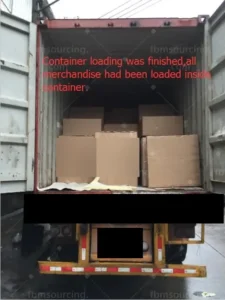
Cinema seats ship as frames, cushions, armrests, standards and fixings, with an extra electrical carton set on a recliner order. Cushions are volumetric rather than heavy, so a screen count converts into container volume faster than teams expect.
Sometimes, on a large project, the cinema seats alone fill full containers; sometimes the cinema seats share containers with the other product categories of the same project; and sometimes, in one batch, we combine a dozen or more product categories from several projects of the same client into a few containers — always full containers, and for us this is routine, well-practised work.
On our own orders one inspection is carried out by our own team at the factory after bulk production is finished, before shipment, with photo and video records, and the report goes to the client before the balance is paid. As sourcing partner on a recliner order we ask that it covers powered function on sampled units and the correct power supply variant for the destination country.
Pricing a commercial cinema seating package from China?
Send us the approved seating layout, the riser section and the cover and fire requirement, and we will take the package through factory selection, sampling, inspection before shipment and shipping.
Frequently Asked Questions
Can one Chinese factory supply both standard hall seats and VIP recliners?
Some can, but confirm it rather than assume it: ask for a dimensioned drawing and a test report for each product separately, because plants holding tooling for a fixed rocker-back seat often subcontract the recliner, and recliner plants often have no ranked-seating line.
What is the difference between cinema seating and auditorium seating in procurement terms?
Auditorium and lecture theatre seating is specified around writing surfaces, tight row spacing and high seat counts per hall, while commercial cinema seating is specified around recline, seat width and cup holders across far fewer seats per screen, so the two come from different lines.
Which document proves that a cinema seat meets a fire requirement?
A composite test report for the exact cover and filling combination used on your order, issued by an accredited laboratory, showing the standard reference, the edition and the test date, plus a written statement from the factory that production will use that same combination.
Do Chinese cinema seating manufacturers provide the installation?
Practice varies and must be settled in the quotation: some ranked-seating engineering shops supply setting-out drawings and supervision, many volume seat plants supply product only, and responsibility for setting out on site should be written down before the order is placed.
What should be ready before asking for a cinema seating price?
The approved seating layout with row-by-row counts, the riser section showing heights, tread depths and substrate, the specified row spacing, the cover and fire requirement, the wheelchair space and companion seat positions, the voltage for any powered seats, and the destination port.
About FBM Sourcing
FBM Sourcing manages the entire China procurement package for overseas construction projects. Since 2014 we have worked with developers, general contractors, builders, commercial project owners, interior design and construction companies and FF&E solution providers across more than 20 countries and over 1,000 containers, as their sourcing partner in China — from the schedule or BOQ through factory selection, sampling, inspection by our own team before shipment, consolidation and shipping. All quotations, invoices and shipping documents are issued by FBM Sourcing, and sea freight is quoted to you before shipment. If you have a cinema seating package to price, start at China building materials and FF&E procurement.