The Chinese sanitary ware manufacturers that matter for a US commercial or multifamily project fall into two groups: a handful of stock-exchange-listed makers whose product lines are on the public record (Huida, Arrow and Dongpeng for ceramics; Seagull, Runner and Solex for tapware), and the private plants of the Chaozhou, Kaiping and Nan’an clusters. For a US job the deciding evidence is the same for both: a current listing for the exact model to the ASME/CSA product standard, the WaterSense label where the specification asks for it, lead free certification for anything that carries drinking water, and dimensions that meet the 2010 ADA Standards.
This guide is written for developers, general contractors, builders, commercial project owners, interior design and construction companies and FF&E solution providers pricing a sanitary ware package from China for apartments, hotels, student housing, senior living or commercial washrooms in the United States.
Why This Shortlist Is Organised Around US Listing Evidence
A Chinese ceramic plant can be large and long-established and still have no model that a US plumbing inspector will accept. Two features of the US system explain why, and a cUPC listing still leaves the WaterSense and lead free questions to be answered separately:
- The product standards are binational and model-specific. Ceramic fixtures are tested to ASME A112.19.2/CSA B45.1, and faucets and shower fittings to ASME A112.18.1/CSA B125.1. A listing covers named models, not a factory’s whole catalogue.
- The mark points to a public directory. The cUPC mark is a mark of conformity for the United States and Canada, and the certification body behind it publishes a product listing directory. Its published guidance says each manufacturing location is audited before a new listing and inspected at least once a year. A mark that cannot be found in the directory under the listee’s name and model number is not evidence.
How cUPC compares with WaterMark, WRAS and CE is covered in sanitary ware certifications explained. Australian projects follow a different scheme, set out in top sanitary ware manufacturers in China for Australian projects.
Which Standards and Labels Does a US Sanitary Ware Schedule Reference?
Figures are as published by the issuing body, checked on 21 September 2026.
| Reference | Issued by | Covers | Published figures |
|---|---|---|---|
| ASME A112.19.2/CSA B45.1 (2024 edition) | ASME and CSA | Vitreous and non-vitreous china fixtures, including lavatories, sinks, urinals, water closets, bidets, bathtubs and shower bases | Materials, construction, performance, testing and markings; performance tests apply to all water closets and urinals that discharge into gravity drainage systems |
| ASME A112.18.1/CSA B125.1 (2024 edition) | ASME and CSA | Supply fittings between the supply stop and the terminal fitting, including lavatory, kitchen, bath and shower fittings, metering and self-closing fittings, showerheads and supply stops | See the standard |
| Federal maximum water use, 10 CFR 430.32 | US Department of Energy | Water closets, urinals, faucets, showerheads | Gravity tank and flushometer valve water closets 1.6 gpf; urinals 1.0 gpf; lavatory faucets 2.2 gpm at 60 psi; showerheads 2.5 gpm at 80 psi |
| WaterSense label | US Environmental Protection Agency | Tank-type and flushometer-valve toilets, flushing urinals, private lavatory faucets, showerheads | Toilets 1.28 gpf maximum (flushometer-valve toilets also 1.0 gpf minimum); flushing urinals 0.5 gpf; private lavatory faucets 1.5 gpm; showerheads 2.0 gpm |
| Lead free, Safe Drinking Water Act section 1417 | US Environmental Protection Agency | Pipes, fittings and fixtures that carry drinking water | Weighted average of 0.25% lead across the wetted surfaces |
Four details in these sources change how a package is specified:
- Editions. ASME lists 2024 as the current edition of both standards. Which edition governs a building depends on the plumbing code the jurisdiction has adopted, so the schedule should name the edition.
- WaterSense versions. EPA released Version 2.0 of its tank-type toilet specification in May 2024, then paused its effective date; EPA states that Version 1.2 remains in effect until further notice.
- Public washroom faucets. EPA has labelling criteria only for private lavatory faucets, the kind installed in apartments and hotel guest rooms, and bar sink faucets, not for public lavatory, metering or kitchen faucets; EPA’s guidance is that public lavatory faucets should have a flow rate of 0.5 gpm or less to be considered efficient and meet plumbing code requirements.
- Lead free certification. EPA states that, as of 1 September 2023, lead free certification is required for manufacturers and importers who introduce regulated plumbing products into commerce. The Act exempts toilets, bidets, urinals, fill valves, flushometer valves, tub fillers and shower valves, so the question lands on lavatory and kitchen faucets and supply stops, not on the ceramics.
State or local rules may set tighter limits; the project’s plumbing engineer confirms which apply before pricing.
What Do the 2010 ADA Standards Fix on the Fixture Schedule?
Several dimensions in the 2010 ADA Standards for Accessible Design depend on the fixture that arrives in the container:
- Water closet seat height (604.4): 17 inches (430 mm) minimum and 19 inches (485 mm) maximum above the finish floor, measured to the top of the seat. In residential dwelling units 15 inches (380 mm) minimum and 19 inches (485 mm) maximum is permitted. The bowl and its seat are therefore considered together.
- Urinals (605.2): stall-type or wall-hung, rim 17 inches (430 mm) maximum above the finish floor, and 13 1/2 inches (345 mm) deep minimum.
- Lavatories (606.3 and 606.5): front of the higher of the rim or counter surface 34 inches (865 mm) maximum above the finish floor, with supply and drain pipes underneath insulated or otherwise configured to protect against contact.
Multifamily projects carry a second layer. Under the Fair Housing Act, covered multifamily dwellings, meaning buildings with four or more dwelling units built for first occupancy after 13 March 1991, must meet seven design and construction requirements, including reinforced walls for grab bars and usable kitchens and bathrooms (joint statement of the Department of Housing and Urban Development and the Department of Justice, 30 April 2013). Which units follow which standard is for the project’s design and code consultants; the procurement consequence is that accessible-unit fixtures are a separate unit type with their own model numbers.
Pricing a sanitary ware package for a US multifamily or commercial project?
Send us the fixture schedule and we will match each toilet, lavatory, urinal and faucet to factories that can show listing, WaterSense and lead free evidence for the exact model.
Listed Chinese Sanitary Ware Manufacturers Relevant to US Projects
Most Chinese sanitary ware factories are private and publish no filings, so we name only companies whose exchange listing and 2025 annual report we have read. None is ranked, and naming a company does not mean any model holds a cUPC listing or a WaterSense label.
Integrated bathroom groups: Huida, Arrow and Dongpeng
Who they are: Huida Sanitary Ware (Shanghai Stock Exchange, 603385) is registered in Tangshan, Hebei. Its 2025 annual report breaks revenue into sanitary ceramics, bathtubs and shower enclosures, wall and floor tiles and bathroom hardware, and states that its products have been sold to the United States, Canada, the United Kingdom, Australia and more than 100 countries and regions. Arrow Home Group (Shenzhen Stock Exchange, 001322), with its head office in Foshan, reports sanitary ceramics as its largest line, followed by faucet hardware and bathroom furniture, under the ARROW, FAENZA and ANNWA brands; almost all of its 2025 revenue came from the domestic market. Guangdong Dongpeng Holdings (Shenzhen Stock Exchange, 003012), also headquartered in Foshan, is primarily a tile maker, with sanitary ceramics and other bathroom products as smaller lines.
Where they fit: large apartment, hotel and institutional projects that want one coordinated range. A group that sells mainly at home may have only part of its range tested to ASME/CSA.
Evidence to request: listing file and model numbers for every toilet, lavatory and urinal, matched in the public directory; the edition of ASME A112.19.2/CSA B45.1 on the listing; WaterSense listing per model where specified; bowl height and seat drawings for accessible units.
Tapware and shower makers: Seagull, Runner and Solex
Who they are: Guangzhou Seagull Kitchen and Bath Products (Shenzhen Stock Exchange, 002084) reports faucet and hardware products as its largest line in 2025, with more revenue from outside China than inside. Runner (Xiamen) Corp. (Shanghai Stock Exchange, 603408) reports kitchen and bath products as its largest segment and most of its revenue from overseas; its annual report describes a production base in Thailand and brand customers in North America. Xiamen Solex High-Tech Industries (Shanghai Stock Exchange, 603992) describes its kitchen and bath business as shower systems, faucets and smart toilets made for international brands and large retailers, and states that it sells none of them under a brand of its own.
Evidence to request: listing to ASME A112.18.1/CSA B125.1 for the exact model; lead free certification for every faucet and supply stop; WaterSense listing for private lavatory faucets and showerheads where specified; the flow rate marked on the product.
Private Sanitary Ware Manufacturer Types by Cluster
Vitreous china plants: Chaozhou
Who they are: the Chao’an district ceramic belt in Chaozhou, eastern Guangdong. The Chaozhou municipal government describes it as one of the largest sanitary ceramic production bases in China, with output of about one third of the national total (March 2025). We name no individual plants because they publish no filings that we can check.
Where they fit: the ceramic lines of apartment and hotel packages. The point to settle early is whose name the listing is in: a plant may hold its own file, or its bowl may be listed under a US brand’s file. The tank trim may be bought in from another maker, and the listed toilet is the complete assembly that was tested.
Evidence to request: listing file and model numbers under the name that will appear on the carton; WaterSense listing for the same model number; the make of the tank trim in the listed assembly; rough-in and bowl height drawings.
Brass tapware factories: Kaiping and Nan’an
Who they are: Shuikou town in Kaiping, Guangdong, is described by its town government as one of China’s three major plumbing and sanitary ware production bases, with 157 above-scale enterprises in the industry in 2025. Nan’an in Quanzhou, Fujian, is described by its municipal government as the country’s largest plumbing, kitchen and bath industry base. A provincial industry association quoted by the Quanzhou government in June 2025 said Nan’an’s trade is still mainly domestic.
Where they fit: the lines where lead free certification and flow rate decide acceptance. A factory that mainly sells at home may cast in an alloy that does not meet the US lead free definition, so the alloy is agreed before samples are made.
Evidence to request: lead free certification naming the model; body alloy specification; listing to ASME A112.18.1/CSA B125.1; cartridge maker; marked flow rate.
Vanities are a separate package with their own rules, covered in top bathroom vanity manufacturers in China for US multifamily projects.
For the brand landscape see commercial sanitary ware brands for hotel projects, and for production and trade figures see China sanitary ware market and export data 2026.
How Does Multifamily Repetition Change the Order?
A multifamily building repeats a few bathroom types many times, so one wrong detail is multiplied across every unit.
- One model per unit type. The schedule is reduced to the fewest toilet, lavatory and faucet models that satisfy the standard units, the accessible units and the common-area washrooms, since every model needs its own listing check.
- Rough-in fixed from the drawings. Toilet rough-in, faucet centres and wall-hung carrier type are taken from the plumbing drawings and confirmed on the factory’s dimension sheet before the sample is ordered.
- The sample is the listed model. The model number on the sample, the listing and the carton label must be the same string. A near-identical bowl with a different trim is a different product.
- Spares in the same shipment. Seats, fill valves, cartridges and aerators for maintenance stock are ordered with the main package so that they match the installed models.
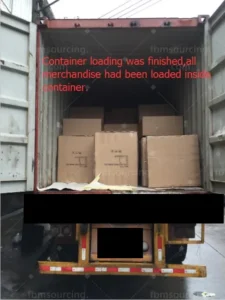
Sometimes, on a large project, the sanitary fixtures and faucets alone fill full containers; sometimes the sanitary fixtures and faucets share containers with the other product categories of the same project; and sometimes, in one batch, we combine a dozen or more product categories from several projects of the same client into a few containers — always full containers, and for us this is routine, well-practised work.
US import duties on China-made goods are a separate subject and are not covered here; see the US import duty structure for furniture and building materials from China.
Where FBM Sourcing Fits
FBM Sourcing works as the China sourcing partner for project companies building in the United States. On a sanitary ware package we turn the fixture schedule into model-by-model enquiries, match each line to a factory that makes it, and ask each factory for the listing, WaterSense and lead free evidence for the exact model before samples are approved. After bulk production is finished we carry out one inspection by our own team at the factory before shipment, with photo and video records, checking model numbers, markings and carton labels, and an inspection report goes to the client before the balance is paid. We do not issue listings or certifications, and we do not install.
Pricing a sanitary ware package for a US multifamily or commercial project?
Send us the fixture schedule and we will match each toilet, lavatory, urinal and faucet to factories that can show listing, WaterSense and lead free evidence for the exact model.
Frequently Asked Questions
Do Chinese sanitary ware manufacturers hold cUPC listings themselves?
Some do, and others make fixtures that are listed under a US brand’s name. The reliable check is to search the certification body’s public product listing directory for the listee name and the exact model number on your order; a certificate copy that cannot be matched there is not evidence.
Is the WaterSense label mandatory for toilets on a US project?
WaterSense is a voluntary EPA label; the federal maximum of 1.6 gallons per flush in 10 CFR 430.32 is mandatory. WaterSense labelled toilets use no more than 1.28 gallons per flush. State or local rules or the owner’s specification may require the label, so the project’s plumbing engineer confirms it before pricing.
Which edition of ASME A112.19.2/CSA B45.1 should a listing show?
ASME lists 2024 as the current edition. The edition that applies to a building is the one referenced by the plumbing code adopted in that jurisdiction, so name the edition in the fixture schedule and ask the factory which edition its listing shows.
Does the US lead free rule apply to toilets and urinals?
No. The Safe Drinking Water Act defines lead free as a weighted average of 0.25% lead across wetted surfaces and exempts toilets, bidets, urinals, fill valves, flushometer valves, tub fillers and shower valves. It does apply to lavatory and kitchen faucets and supply stops, and EPA states that certification has been required of manufacturers and importers since 1 September 2023.
What toilet seat height do the 2010 ADA Standards require?
Section 604.4 requires 17 inches (430 mm) minimum and 19 inches (485 mm) maximum above the finish floor, measured to the top of the seat; in residential dwelling units 15 inches (380 mm) minimum is permitted. Order accessible-unit toilets as a separate model with the seat that will be installed.
About FBM Sourcing
FBM Sourcing manages the entire China procurement package for overseas construction projects. Since 2014 we have worked with developers, general contractors, builders, commercial project owners, interior design and construction companies and FF&E solution providers across more than 20 countries and over 1,000 containers, as their sourcing partner in China — from the schedule or BOQ through factory selection, sampling, inspection by our own team before shipment, consolidation and shipping. All quotations, invoices and shipping documents are issued by FBM Sourcing, and sea freight is quoted to you before shipment. If you have a sanitary ware package to price, start at China building materials and FF&E procurement.