NCC 2025 was published by the Australian Building Codes Board on 1 May 2026, and it does not switch on everywhere at once. Victoria, Western Australia and the Australian Capital Territory adopted it on 1 May 2026; New South Wales, Queensland, South Australia (for the Building Code of Australia) and Tasmania take it up on 1 May 2027; the Northern Territory has not adopted it. The heaviest changes land on commercial work: energy efficiency including installed on-site solar photovoltaic systems, a rebuilt water management part, and tightened condensation mitigation provisions.
This page is for developers, general contractors, builders, commercial project owners, interior design and construction companies and FF&E solution providers running Australian projects. Two projects in two states can be assessed against different editions in the same month, and the referenced standard editions move with them. See also our overview of NCC and BCA compliance for building materials from China on Australian projects.
What Is NCC 2025, and Which Publication Date Applies?
The National Construction Code comprises the Building Code of Australia (NCC Volumes One and Two) and the Plumbing Code of Australia (Volume Three); Volume One covers Class 2 to Class 9 buildings. Two official dates are in circulation for the publication of NCC 2025, and they do not match. The Building Ministers’ Meeting communique of 22 October 2025 states that NCC 2025 would be published by 1 February 2026, and that states and territories could consider adoption from 1 May 2026. The ABCB, which publishes the code, states on its NCC 2025 pages that the edition was released and published on 1 May 2026. Both are recorded here deliberately. Work from the ABCB date: the ABCB is the publisher of record, and its adoption table is what each jurisdiction links back to.
When Does NCC 2025 Take Effect in Each State and Territory?
Adoption is a matter for each jurisdiction. The table reproduces ABCB adoption information for NCC 2025 as at 18 September 2026.
| State or territory | NCC 2025 adoption | Transition period |
|---|---|---|
| Australian Capital Territory | 1 May 2026 | 12 months |
| New South Wales | 1 May 2027 | N/A |
| Northern Territory | Not adopted | N/A |
| Queensland | 1 May 2027 | N/A |
| South Australia | BCA: 1 May 2027; PCA: 1 May 2026 | N/A |
| Tasmania | 1 May 2027 (temporarily adopted 1 May to 4 June 2026) | 5 June 2026 to 1 May 2027 |
| Victoria | 1 May 2026 | N/A |
| Western Australia | 1 May 2026 | 12 months |
South Australia has split the edition, so one project there can sit on NCC 2025 for plumbing products and NCC 2022 for the building fabric. Tasmania temporarily adopted NCC 2025 from 1 May to 4 June 2026, then set a transition to 1 May 2027. The ABCB also warns that some requirements may apply at different times, or not at all, because of state and territory variations.
What Changed in Commercial Energy Efficiency?
These changes apply to Class 3 and Class 5 to 9 buildings: hotels, offices, retail, hospitals and schools. At performance level, J1P1(e) roughly halves the regulated energy allowance and now quantifies greenhouse gas emissions.
The change with the largest physical footprint is J9D5. In NCC 2022 the requirement was to leave space for future solar; in NCC 2025 it was amended to require installation of on-site solar photovoltaic systems, or equivalent renewable energy generation systems. Two deemed-to-satisfy routes size it. Under J9D5(2)(a) the array covers 100 per cent of the available roof space, with exclusions at J9D5(2)(a)(i) to (xi) for roof area needed for other purposes or unsuitable because of shading, orientation or geometry. Under J9D5(2)(b) it is sized from the area of conditioned space using Table J9D5a, which permits the array to sit on the ground within the site or on another building in the same development. Battery storage is not mandated, but switchboard space for one is.
J6D10 and Section J8 add electrical system readiness where gas space heating or gas heated water is installed, and the gas heater minimum gross thermal efficiencies in J8D4 and J8D5 were replaced with a single value of 90 per cent. On verification, J1V1 raises the NABERS star rating targets and J1V3 adopts new weather files and a 3 per cent performance margin between the proposed and reference buildings.
What Does NCC 2025 Mean for Commercial Glazing and Facades?
Glazing is touched in three places, in different parts of the code. First, Section J4. Clause J4D6 sets the deemed-to-satisfy requirements for walls and glazing, and the NCC 2025 list of amendments records that its total system U-Values, solar admittance values and wall R-Values were all updated. Both are calculated under NCC Specification 37; U-Value is capped by Table J4D6a and solar admittance by Tables J4D6c and J4D6d, which vary by building class and orientation. Where the opaque wall component is less than 80 per cent of the total wall-glazing area the minimum Total R-Value is R1.0. NCC 2022 clause J3D6 was deleted because thermal bridging control is inherent in the wall-glazing U-Value requirements. Because these are whole-system figures covering frame and glass together, factory thermal data has to be system data, not centre-of-glass data; our comparison of double glazing, low-E and triple glazing for commercial windows covers how those build-ups differ.
Second, Part J5, building sealing. Clause J5D5 requires a door or openable window to be sealed, and exempts a window complying with AS 2047. In NCC 2025 the J5D5(1) concession for climate zones 1 to 3 was removed, as it was at J5D4, J5D6 and J5D7, so tropical and subtropical projects that sat outside several sealing provisions no longer do.
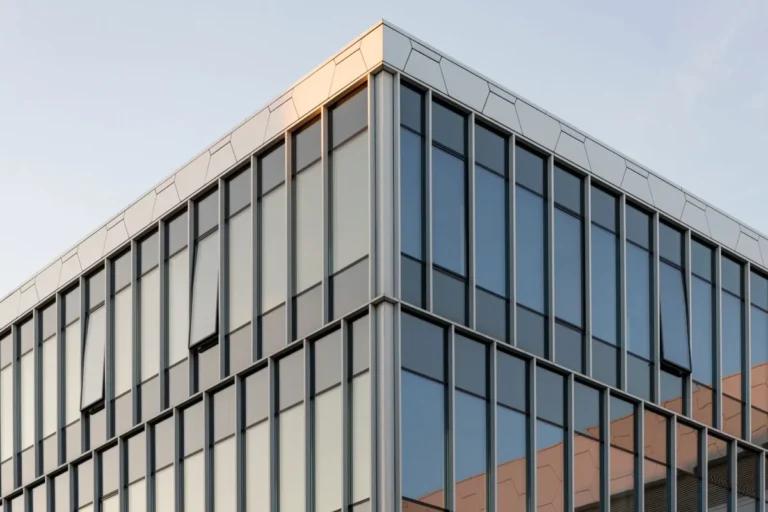
Third, the split between AS 2047 and AS 1288, set by Volume One clause B1D4 and repeated for weatherproofing at F1D14. Windows, framed sliding and swinging glazed doors including framed french and bi-fold doors, adjustable louvres, shopfronts and window walls with one-piece framing in an external wall must comply with AS 2047. Everything else falls to AS 1288: assemblies not in an external wall, revolving doors, fixed louvres, roof lights, unframed glazed doors, and balustrade and sloping overhead glazing. Schedule 2 of NCC 2025 Volume One references AS 2047—2014 (incorporating amendments 1 and 2), AS 1288—2021 Glass in buildings — Selection and installation, and AS/NZS 4284—2008 Testing of building facades at F1V1. On high-rise work a window wall with one-piece framing is an AS 2047 product, while the facade test route runs through AS/NZS 4284 — the distinction set out in our piece on curtain wall versus window wall on high-rise buildings. For what an AS 2047 package contains, see AS 2047 windows from China: testing and certification.
Pricing a window or glazing package for an Australian project?
Send the window and door schedule with the state the project sits in, and we will come back with the product evidence each factory can supply against the code edition your certifier is assessing.
What Changed in Waterproofing and Water Management?
This is the largest structural rewrite in Volume One. Part F3 has been deleted and its requirements folded into Part F1; Performance Requirement F1P1 was re-written and absorbs the former F1P2 and F1P3, and F3V1 became F1V1. The ABCB gives the reason plainly: its research showed most water-related defects come from sub-surface water, which affects buildings from below ground level or beneath finished surfaces such as balconies, podiums and concrete roofs, passing through tiled systems, pavers, screeds or degraded membranes. New defined terms of sub-surface water, structural substrate and surface finish were added.
The deemed-to-satisfy consequences are specific. New clause F1D4 requires a concrete roof, balcony, podium or similar part of a building to have a drainage system with sufficient overflow provision, a structural substrate graded to a minimum fall of 1:80, a minimum 70 mm step down from the internal floor structural substrate to the adjacent external one, and a monolithic hob integral with the substrate at least 70 mm high at the outer perimeter, except where that perimeter drains directly to a gutter. A tile bed, screed or topping is not a structural substrate, and new clause F1D5 requires that concrete to comply with AS 3600. F1D7 requires external waterproofing membranes made of materials complying with AS 4654.1 and designed and installed to AS 4654.2, and new clause F1D10 requires the flooring or surface finish of a roof, balcony, terrace or podium to be self-draining or directly fixed to an F1D7 membrane. That is a materials question as much as a detailing one, which is why our list of waterproofing membrane manufacturers in China is organised around what the membrane is tested to.
Two shifts matter for industrial work. The concessions that exempted certain Class 7 and Class 8 storage and factory buildings from waterproofing and weatherproofing provisions were removed at F1D8, F1D14 and F1D15. And Verification Method F1V1 runs on a prototype specimen of at least 2.4 m by 2.4 m, with static pressure of either 300 Pa or 30 per cent of the serviceability wind pressure, whichever is higher, per clause 8.5.2 of AS/NZS 4284 and cyclic pressure per clause 8.6.2. F1V1 also requires that the wall include only windows complying with AS 2047.
What Changed in Condensation Mitigation?
Condensation provisions sit in Volume One Part F8 and in Part 10.8 of the ABCB Housing Provisions. Read the application clause first: F8D2 states that the Part F8 deemed-to-satisfy provisions apply only to a sole-occupancy unit of a Class 2 building and a Class 4 part of a building — apartments and the residential parts of mixed-use buildings, not offices or retail.
Within that scope the requirements tighten. The ABCB lists the inclusion of climate zones 1 and 3 for the first time, expanded wall membrane vapour permeance requirements, mandatory wall cavities in climate zones 6, 7 and 8, and new exemptions for insulated sandwich panels and for walls outside the building envelope or below ground level. In the code, F8D3 requires any pliable building membrane or sarking-type material used as a control layer in an external wall to comply with AS 4200.1 and be installed to AS 4200.2; requires control layers between the cladding and the exterior side of the primary insulation layer to achieve the vapour permeance in Table F8D3; and requires a drained and ventilated cavity where neither occupies that position. A required cavity must be formed from battens or spacers at least 12 mm deep, drain to the exterior, and have openings with a free area of not less than 1,000 mm2 per metre of wall. Table F8D3 notes that a cavity must be provided in climate zones 6, 7 and 8. Roof ventilation was split: F8D5 now applies only where the primary insulation layer is not parallel to the roof plane, and new F8D6 covers the parallel case.
What Does the Residential Freeze to Mid-2029 Actually Mean?
At the Building Ministers’ Meeting of 22 October 2025, ministers agreed to pause further residential changes to the NCC, following the Commonwealth announcement of 24 August 2025 that no further residential changes, other than essential quality and safety measures, will be made until mid-2029. The same communique confirmed that voluntary embodied carbon provisions would be issued as ABCB guidance rather than code, and that electric vehicle charging and residential energy efficiency changes would not be introduced at this time. The NCC 2022 settings stay, including 7-star.
That policy is visible inside the code. A note in Section J of NCC 2025 Volume One states that for Class 2 buildings, Section J is replaced with Section J of NCC 2022 Amendment 2, and references to Class 2 buildings were removed throughout Section J. For an apartment project, energy efficiency requirements therefore do not move with the new edition even where it has been adopted, while the water management and condensation provisions do.
Which Product Evidence Files Should Be Requested from Chinese Factories?
This is a document question: each product submittal has to name the right standard, edition and scope. As your sourcing partner in China, FBM Sourcing collects these in the form a certifier reads.
- Windows and external glazed doors. Design test reports or product certification against AS 2047, with the schedule showing which product types, configurations and tested sizes are covered. Schedule 2 notes that tests under earlier editions remain valid, but that reports for tests carried out after the NCC reference date for AS 2047—2014 Amendment 2 must relate to the amended Standard, so the test date and the edition tested to must both appear.
- Glass. For assemblies falling to AS 1288 rather than AS 2047, glass type, thickness and safety glass documentation referenced to AS 1288—2021.
- Facade and window wall systems. Test reports to AS/NZS 4284—2008 stating which clauses the water penetration procedure was run under and at what pressures, so the report reads against F1V1.
- Thermal data. Total system U-Value and solar admittance inputs for the complete frame and glass assembly, on the basis set out in NCC Specification 37; a centre-of-glass figure is a different number.
- Waterproofing membranes. Material compliance to AS 4654.1 and an installation specification to AS 4654.2.
- Pliable building membranes and sarking. Compliance with AS 4200.1, installation instructions to AS 4200.2, and the measured vapour permeance value, because Table F8D3 is read against that number, not a product name.
Reports should come from an accredited laboratory or a conformity assessment body whose accreditation scope covers the test performed; that scope document matters as much as the certificate number. Our list of aluminium window and door manufacturers in China for Australian projects is built around which factories already hold these documents.
Pricing a window or glazing package for an Australian project?
Send the window and door schedule with the state the project sits in, and we will come back with the product evidence each factory can supply against the code edition your certifier is assessing.
Frequently Asked Questions
When was NCC 2025 published?
Two official dates exist: the Building Ministers’ Meeting communique of 22 October 2025 said NCC 2025 would be published by 1 February 2026, while the Australian Building Codes Board states it was released and published on 1 May 2026. Work from the ABCB date.
Which states have adopted NCC 2025 already?
Victoria, Western Australia and the Australian Capital Territory adopted it on 1 May 2026; South Australia adopted the Plumbing Code of Australia on 1 May 2026 but the Building Code of Australia only from 1 May 2027; New South Wales, Queensland and Tasmania move on 1 May 2027; and the Northern Territory has not adopted it.
Does NCC 2025 make rooftop solar mandatory on commercial buildings?
Clause J9D5 was amended to require installation of on-site solar photovoltaic systems, or equivalent renewable energy generation systems, for Class 3 and Class 5 to 9 buildings, replacing the earlier requirement to only leave space for a future installation.
Do the NCC 2025 energy efficiency changes apply to apartment buildings?
No: a note in Section J of NCC 2025 Volume One states that for Class 2 buildings Section J is replaced with Section J of NCC 2022 Amendment 2, so apartment energy efficiency requirements stay where they were, while the Part F1 water management and Part F8 condensation provisions do change.
Which glazing standard applies to a shopfront or a window wall under NCC 2025?
Under Volume One clauses B1D4 and F1D14, windows, framed sliding and swinging glazed doors, adjustable louvres, shopfronts and window walls with one-piece framing in an external wall must comply with AS 2047; assemblies outside that list comply with AS 1288.
About FBM Sourcing
FBM Sourcing manages the entire China procurement package for overseas construction projects. Since 2014 we have worked with developers, general contractors, builders, commercial project owners, interior design and construction companies and FF&E solution providers across more than 20 countries and over 1,000 containers, as their sourcing partner in China — from the schedule or BOQ through factory selection, sampling, inspection by our own team before shipment, consolidation and shipping. All quotations, invoices and shipping documents are issued by FBM Sourcing, and sea freight is quoted to you before shipment. If you have a windows and glazing package to price, start at China building materials and FF&E procurement.