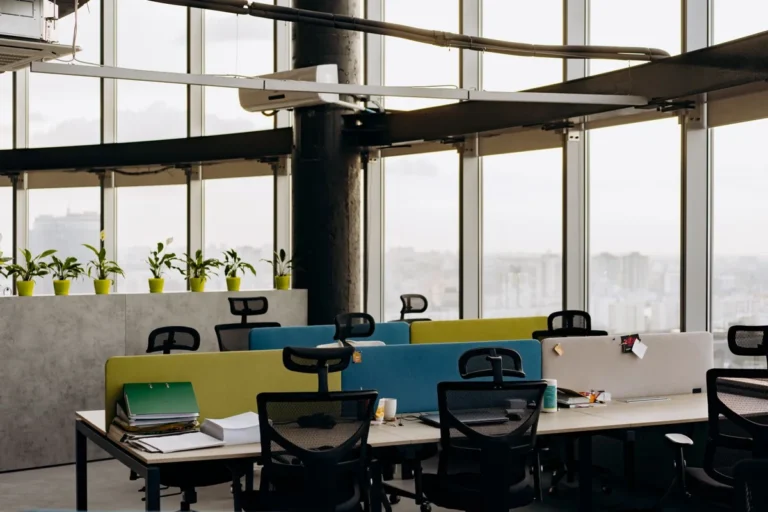
China’s office workstation supply is not one industry but several that meet on the same floor plate. One Shanghai-listed company, Henglin Home Furnishings Co.,Ltd. (SSE: 603661), reports systems office furniture as a core product line; the rest of a workstation package comes from specialist factories that each own one part of it — panel and screen systems, benching frames, worktops, pedestals and the metal hardware that joins them. A workstation is quoted as a system, not a row of desks: change the module pitch, the screen height or the cable route and you change which factory can make it.
This page is written for developers, general contractors, builders, commercial project owners, interior design and construction companies and FF&E solution providers pricing an office floor out of China: benching runs, panel-based cubicles, screen-based workstations and call-centre clusters, with the storage and hardware that ship with them.
What Counts as a Workstation System, and What Does Not?
Four configurations cover almost every commercial office package sourced from China, and they come off different production lines.
- Panel-based cubicles. A self-supporting panel frame carries the worktop, the storage and the power and data path. The panel is the structure and the long-lead item.
- Benching runs. A shared steel or aluminium beam runs the length of the cluster, legs sit at intervals and tops bridge between them, with a low screen on the beam. Tops and screens are replaceable; the beam pitch is not.
- Screen-based workstations. Free-standing desks with clamp-on or top-mounted screens, usually acoustic. The screen is a separate product with its own test regime, and is frequently the item that fails a submittal.
- Call-centre clusters. Tight-pitch benching with full-height dividing screens, high cable capacity and often a specified acoustic treatment.
Several neighbours of the workstation are separate product families and separate factories. Task seating is one, covered in our list of office seating and ergonomic chair manufacturers in China. Electric sit-stand desks are another, with their own drive systems and electrical documents; treat them as a separate line and start from our list of height-adjustable desk and workstation manufacturers in China. Room dividers sit in office partition sourcing from China, and the complete floor package is in our broader list of Chinese office furniture makers for corporate projects.
The boundary is not arbitrary. EN 527-1:2011 states its scope as dimensions for office tasks undertaken seated, sit-stand or standing, and explicitly excludes storage units, other tables in the office area, and reception desks. A schedule that lumps those into one row asks several different factories to quote the same line.
Listed Chinese Companies in the Office Workstation Supply Chain
Henglin Home Furnishings Co.,Ltd. (Shanghai Stock Exchange: 603661)
Henglin is the one Chinese listed company we could verify as reporting a systems office line rather than a single office product. The Shanghai Stock Exchange listed-company register shows A-share code 603661 under the abbreviation Henglin, main board, listing date 21 November 2017, with no risk-warning prefix. Its 2025 annual report gives the registered English name as Henglin Home Furnishings Co.,Ltd., states the company was established in 1998, and places its office address in Anji County, Huzhou, Zhejiang province, where the business started as an office chair factory.
What matters here is the line the report calls systems office: an integrated office environment offering built from standardised configuration, modular design and customisation, covering office, meeting and training tables and chairs, intelligent storage and movable partition systems, lounge furniture, and professional lighting and acoustic equipment. It sits alongside ergonomic seating, upholstered furniture and new-material flooring. From the product-line revenue table in the same report, office furniture accounted for roughly 24 per cent of main-business revenue in 2025; that line fell about 20 per cent year on year while total main-business revenue rose about 6 per cent. Products are sold in more than 80 countries and regions.
Country of origin is the point to get right here. The report describes a manufacturing footprint across China, Vietnam and Switzerland, and its definitions table identifies LO as Lista Office Group AG, a Swiss subsidiary, with Swiss land ownership in the fixed-asset notes. A group name on a quotation therefore tells you nothing about where a line item is made: it does not make a Chinese-made workstation Swiss, and it does not make an LO-branded product Chinese. Fix country of origin per line item in writing before the order, because it drives duty treatment, documentation and, on some public projects, eligibility.
Evidence to request: test reports naming the exact model and configuration supplied, not a family name; a separate report for the panel or screen system rather than a desk report used to cover both; the emissions report for the board and finish quoted; and a written country-of-origin declaration per line item.
Why Only One Company Is Named Here
Several of the best-known office workstation names in China are privately held, with no listing to check, and others on English-language lists are foreign-invested operations manufacturing in China, which is not the same as a Chinese manufacturer. Two Chinese listed companies in the wider office field are single-product businesses, one in seating and one in lifting desks. Rather than pad a list with unverifiable names, the sections below describe manufacturer types and what to ask each for. There are no scores and no rank order here.
Which Manufacturer Types Supply the Panels, Screens and Frames?
- Panel and screen system factories. They build the frame, the acoustic core, the fabric or felt wrap and the hang-on rail system. Tooling is committed to a panel thickness and connector geometry, so a system change is a re-quote, not a variation. Evidence to request: the panel system’s own strength and stability report, the fabric or felt specification with fire performance documentation for the destination market, and a connector sample.
- Benching and beam frame factories. Steel or aluminium spines, legs, modesty panels and levelling feet. These are metalworking plants, and finish is a coating-line question. Evidence to request: the coating specification and film thickness record, a corrosion report where called for, and the beam load test at the quoted span.
- Acoustic pod and movable partition makers. Full-height dividers, phone booths and meeting pods increasingly ship with a workstation package, and they are a glazing and acoustic assembly rather than a furniture one. Evidence to request: the acoustic performance report for the assembly as built, the glass specification and thickness, and whether electrical fittings are included and to which country’s standard.
Pricing a workstation and cubicle package for an office floor?
Send the schedule or BOQ and FBM Sourcing will match each item type to the right factory type in China and come back with quotations that compare on the same basis. Developers, general contractors, builders and FF&E solution providers work with us this way on commercial office projects.
Which Manufacturer Types Supply the Tops, Storage and Hardware?
- Panel furniture factories. Melamine-faced and laminate worktops, credenzas and pedestal carcasses, cut on panel saws and edge-banded. Board grade and edge treatment change both price and durability. Evidence to request: the emissions class certificate for the board actually quoted, the edge-band material and thickness, and a production sample with the real edge profile.
- Metal office storage factories. Steel pedestals, tambour units, lockers and filing — usually different plants from the benching frame makers. Evidence to request: the storage unit test report, the interlock or anti-tilt specification where required, and the lock and key system detail, including master keying.
- Hardware and component makers. Cable spines and trays, grommets, monitor arms, castors, levellers and locks, bought in by the furniture factory, whose report may not cover them. Evidence to request: a component list naming each bought-in item and its maker, plus test documentation for load-bearing components.
Treating all of these as one supplier is the commonest reason a workstation package arrives incomplete. A benching run with the right beam and the wrong grommet is still a snag list.
What Should the Workstation Specification Fix Before Factories Quote?
Chinese factories quote fast from a complete schedule and slowly from an incomplete one: every missing field is a question that must be asked before a number exists. These fields change the price or the supplier:
- Configuration: positions per run, back-to-back or single-sided, and module pitch in millimetres.
- Structure: panel-supported, beam benching, or free-standing desks with applied screens.
- Screen type and height above the worktop, and whether acoustics are specified by performance or material.
- Worktop material, thickness, edge profile and finish, and whether tops are per position or shared.
- Cable management: spine capacity, riser type, grommet positions, and who supplies the outlets.
- Storage: pedestal type, mobile or fixed, lock and key system, under-top or end-of-run.
- Finish system and colour references for metal and board, given as a physical reference.
- Fixing: free-standing, floor-fixed or wall-fixed, and who supplies the fixings.
- Standards and the edition to be tested against, per item type.
- Destination, so packing, labelling and documentation are priced once.
A schedule with those ten fields filled in can be priced without a clarification round. Our page on office workstation sourcing from China sets out how it becomes factory quotations.
Which Standards Should an Office Workstation Specification Name?
Name the standard and the edition per item type, not once for the whole package. Statuses were checked on 18 September 2026.
| Standard | What it covers | Where checked |
|---|---|---|
| EN 527-1:2011 | Work tables and desks, dimensions for seated, sit-stand and standing tasks; excludes storage units, other office-area tables and reception desks. Valid. | Swedish Institute for Standards catalogue |
| EN 527-2:2016+A1:2019 | Work tables, safety, strength and durability requirements. The 2016 edition replaced the earlier Part 2 and the former Part 3 test-method standard, and carries a 2019 amendment. | Swedish Institute for Standards catalogue |
| EN 1023-1, EN 1023-2, EN 1023-3 | Office screens: dimensions, mechanical safety requirements, test methods. All three valid. | Swedish Institute for Standards catalogue |
| ANSI/BIFMA X5.5 Desk Products | Commercial desks and tables, including height-adjustable tables, with tests for monitor arms. | BIFMA specification-language document |
| ANSI/BIFMA X5.6 Panel Systems | Performance requirements for panel systems, screens, panel-supported systems and hang-on components. | BIFMA specification-language document |
| ANSI/BIFMA X5.9 Storage | Test methods for freestanding, mobile and wall-mounted storage units. | BIFMA specification-language document |
| ANSI/BIFMA X7.1 | Formaldehyde and TVOC emissions requirements for low-emitting seating and office furniture. | BIFMA specification-language document |
| ANSI/BIFMA e3 | Furniture sustainability standard; LEVEL is its conformance mark for independently certified products. | BIFMA specification-language document |
| GB/T 38607-2020 | Chinese national standard: office tables and desks, test methods for stability, strength and durability. In force, voluntary. | China’s national standards full-text public system |
| GB/T 22792.1-2009 and GB/T 22792.3-2008 | Office screens: dimensions and test methods. Both in force, both voluntary. | China’s national standards full-text public system |
| GB 22792.2-2008 | Office screens, safety requirements: the mandatory member of the Chinese screen series. Listed as abolished. | China’s national standards full-text public system |
Two points follow. First, the parts of the Chinese screen series still in force are voluntary, so a factory can be compliant at home and hold nothing that answers a European or North American screen specification; ask for the EN or BIFMA report by name. Second, BIFMA’s own published specification language says a product test report, or another form of conformance verification such as a signed affidavit, is acceptable conformance documentation, and that where the current edition is under three years old the prior edition is acceptable. Any report produced for a destination market should come from an accredited laboratory whose scope covers the test reported.
How Do Panel-Based Cubicles and Benching Differ Once They Are Quoted?
In where cost and risk sit. In a panel-based package most of the value and most of the schedule risk are in the panel system, while tops and storage can change late. In a benching package the beam and its pitch are fixed at order, but tops, screens and pedestals are items several factories can supply.
How Are Workstations Packed and Shipped?
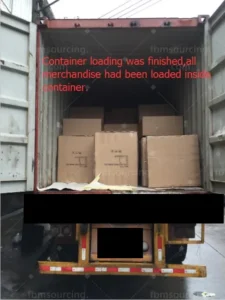
Workstation packages are volumetric rather than heavy, so the constraint is cubic capacity and edge protection. Sometimes, on a large project, the workstations alone fill full containers; sometimes the workstations share containers with the other product categories of the same project; and sometimes, in one batch, we combine a dozen or more product categories from several projects of the same client into a few containers — always full containers, and for us this is routine, well-practised work. Carton marking that matches the schedule item codes matters more here than in almost any other category, because a benching run cannot be built from cartons that arrive out of order. Our page on office furniture container loading from China covers how the loading plan is built.
What Gets Checked Before Workstations Ship?
FBM Sourcing carries out inspection by our own team at the factory before shipment, with photo and video records. On workstations that means dimensional conformity against the approved sample and the schedule, panel and screen flatness and fabric consistency across the run, beam and leg finish, connector completeness against the packing list, pedestal drawer action and lock function, carton marking against item codes, and the presence of assembly instructions and fixings.
Where FBM Sourcing Fits
FBM Sourcing works as the sourcing partner on the client’s side of the table. On a workstation package that means reading the schedule or BOQ, matching item types to factory types, putting one specification in front of several factories so quotations compare on the same basis, running sample approval, holding documentation requirements against what the factory can produce, inspecting before shipment, consolidating and shipping.
Pricing a workstation and cubicle package for an office floor?
Send the schedule or BOQ and FBM Sourcing will match each item type to the right factory type in China and come back with quotations that compare on the same basis. Developers, general contractors, builders and FF&E solution providers work with us this way on commercial office projects.
Frequently Asked Questions
Are there publicly listed office workstation manufacturers in China?
One that we could verify: Henglin Home Furnishings Co.,Ltd., A-share code 603661 on the Shanghai Stock Exchange main board, listed on 21 November 2017, which reports a systems office line covering office, meeting and training tables and chairs, intelligent storage and movable partition systems. Most other significant Chinese workstation makers are privately held.
Does one factory make a complete workstation package?
Rarely, and almost never every component. Panel and screen systems, benching frames, worktops, metal storage and hardware such as cable spines and monitor arms come from different plants, and the assembling factory buys several of them in, so its test report may not cover the bought-in parts. Request the component list and its documents separately.
Which standard should an office workstation specification name for screens?
For Europe, EN 1023-1, EN 1023-2 and EN 1023-3 cover screen dimensions, mechanical safety requirements and test methods, all three listed as valid when checked on 18 September 2026. For North America, ANSI/BIFMA X5.6 covers panel systems, screens, panel-supported systems and hang-on components. A desk report under EN 527-2 or ANSI/BIFMA X5.5 does not cover the screen.
Do Chinese national standards cover office workstations?
Partly. GB/T 38607-2020 covers stability, strength and durability test methods for office tables and desks, and GB/T 22792.1-2009 and GB/T 22792.3-2008 cover screen dimensions and test methods; all three are in force and voluntary. The mandatory safety part of the series, GB 22792.2-2008, is listed as abolished, so domestic compliance alone will not answer an EN or BIFMA specification.
Should sit-stand desks be quoted with the workstation package?
Quote them as a separate line. Electric height-adjustable desks bring a drive system, control electronics and destination-specific electrical documentation that a panel or benching factory may not hold, and the supplier base is different.
About FBM Sourcing
FBM Sourcing manages the entire China procurement package for overseas construction projects. Since 2014 we have worked with developers, general contractors, builders, commercial project owners, interior design and construction companies and FF&E solution providers across more than 20 countries and over 1,000 containers, as their sourcing partner in China — from the schedule or BOQ through factory selection, sampling, inspection by our own team before shipment, consolidation and shipping. All quotations, invoices and shipping documents are issued by FBM Sourcing, and sea freight is quoted to you before shipment. If you have a workstation and cubicle package to price, start at China building materials and FF&E procurement.