Door-to-site delivery means the container leaves the port and is delivered to the construction site itself rather than to a warehouse or a distribution centre — and on a live building site that last 40 kilometres is the segment that fails most often. The goods are not the problem; access is. A standard 40’ container on a trailer is roughly 16.5 m long overall, needs about 30 m of straight run to reverse in, and cannot be tipped, so it has to be unloaded by hand or by forklift through the doors while the driver waits. Getting that right is a question of four decisions taken before the vessel sails: who unloads, what equipment is on site that day, how many free hours the haulier allows, and where the goods go the moment they come off the truck. As your China sourcing partner, FBM Sourcing manages this end-to-end.
What Does “Door-to-Site” Actually Include?
Door delivery is an Incoterms and haulage arrangement, not a service level. Under DAP or DDP the seller arranges carriage to the named place; under FOB or CIF the buyer’s own forwarder does. Either way the standard scope of the trucking leg is narrower than most site teams expect.
- Included: collection of the container from the terminal or depot, road haulage to the address, and a defined period of free time on site — typically 2 hours for a live unload, sometimes 3.
- Not included: unloading labour, forklifts, telehandlers, cranes, pallet trucks, or anyone to sign for and count the goods.
- Charged separately: waiting time beyond the free period (billed by the hour or part hour), a failed delivery attempt, and any return to depot.
- Two physically different operations: a live unload, where the trailer waits and leaves the same visit, and a drop-and-swap, where the container is left on site on a trailer or grounded and collected later, which needs space, a hard standing and the haulier’s agreement.
- Detention and demurrage run in parallel: shipping lines allow a limited number of free days for the container itself, and those days run from discharge, not from the day the site is ready. Detention charges are the single most common surprise on a site delivery.
The distinction that matters commercially is between the ocean leg and the land leg. FOB, CIF and DDP decide who books what, and port and local charges beyond ocean freight are where the land-side costs actually appear.
Can a Construction Site Take a 40ft Container?
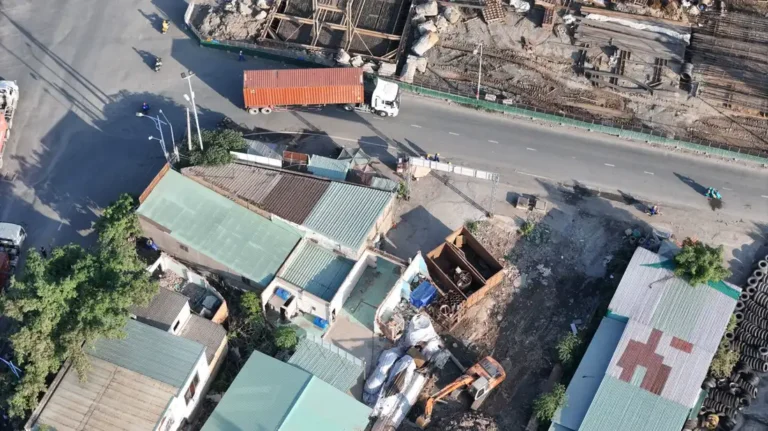
Often, but not always — and the honest check is a site survey, not an assumption. Six constraints decide it.
The approach
An articulated vehicle needs a carriageway wide enough to swing in, and low bridges, weight-restricted roads, weekend lorry bans and urban delivery windows all bite before the gate. In tight city-centre projects the answer is frequently a transhipment to a rigid truck at a local depot, which adds a handling step and a cost line but avoids a failed delivery.
The gate and the yard
Gate width, overhead cables, scaffold, site huts and stacked material all reduce the turning circle. A trailer that cannot turn cannot reverse to the unloading point, and a container that cannot be positioned cannot be unloaded.
The ground
A loaded 40’ container plus trailer can approach 30–34 tonnes gross. On a partially built site, soft ground, buried services and fresh slabs decide where a trailer may stand.
The equipment and the labour
Unloading 60–70 m³ of boxed furniture by hand takes a team of four several hours; the same container with palletised goods and a forklift takes well under an hour. The choice between hand-loaded and palletised is made at the factory, months earlier, and it is worth deciding deliberately — see how a 40ft container is loaded.
Sourcing this for a commercial project?
FBM Sourcing works with project owners, developers, main contractors and FF&E contractors on hotel, apartment, school, office and other commercial building projects. Send us your BOQ, drawings or product list — our team will review it and get back to you.
Direct to Site or Through a Warehouse?
Both are legitimate; they suit different projects, and the decision belongs to the programme rather than to the freight budget.
Direct to site works when the building is weathertight, the floor is ready to receive goods, there is secure storage, and the installation team is already mobilised. It removes a handling step and the associated damage risk, and it is the cheaper route when the timing lines up.
Through a local warehouse or a consolidation facility works when the site is not ready, when goods have to be released floor by floor, or when the FF&E install runs behind the base build — the normal condition on hotels and student accommodation. It costs storage and a second delivery leg, and it buys schedule tolerance. The division of responsibility between the supplier, the freight forwarder, the main contractor and the installer is set out in who handles FF&E delivery, warehousing and installation.
Where a project is genuinely phased, a third route often beats both: ask the factory to hold finished goods and release them against the handover programme, which is covered in can Chinese factories hold stock or stagger deliveries. Goods held in China cost nothing in demurrage and nothing in local storage.
What Happens on the Day, and Who Signs?
The delivery is a documented handover, not just an arrival. The sequence that avoids arguments looks like this.
- Book the slot against the site’s delivery management system and confirm the free time allowance in writing.
- Check the seal number against the packing list and the bill of lading before it is cut, and photograph it intact.
- Count as it comes off against the carton numbering. Room-by-room labelling makes this a matter of minutes rather than an afternoon — see hotel FF&E labelling for room-by-room delivery.
- Annotate the POD. Damage or shortage noted on the proof of delivery at the moment of unloading is the evidence that supports a claim; a clean signature closes the door on it. Cargo claim notice periods are short — typically 3 days for visible damage under most carriage regimes.
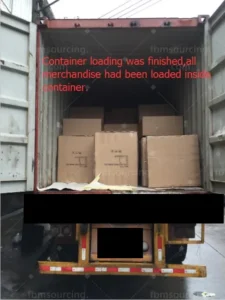
- Photograph everything before the truck leaves: the doorway view of the load, any crushed cartons, and the seal.
The paperwork that has to be in place beforehand — bill of lading, packing list, commercial invoice, certificates — is listed in what shipping and customs documents come with a China project order. Customs clearance must be complete before the container moves inland, which is why the clearance question is settled long before the delivery slot is booked.
How FBM Sourcing Handles Delivery to Site
FBM Sourcing manages the entire China procurement package for overseas construction projects. On a hotel, apartment, school, office or retail package we plan the arrival end at the loading plan stage: cartons are numbered and labelled by room, zone or phase so the site can check them off the packing list as they come off the trailer; the loading sequence is set so that first-fix items come out first; and the packing method is chosen against what the site can actually handle on the day. Our own FBM Sourcing QC team inspects the goods on the factory floor with a full inspection before shipment and records the loading with photographs and video, so that anything noted on arrival can be traced back to the condition in which the container was sealed. All quotations, invoices and shipping documents are issued by FBM Sourcing — you deal with us, and we carry the responsibility. For suppliers you nominate, we charge a 5% commission; for products we source for you, we quote a direct price. Sometimes, on a large project, the joinery alone fill full containers; sometimes the joinery share containers with the other product categories of the same project; and sometimes, in one batch, we combine a dozen or more product categories from several projects of the same client into a few containers — always full containers, and for us this is routine, well-practised work.
If you have a site with awkward access, a phased handover, or a delivery date you cannot move, send us the site address, the destination port, the required-on-site dates and any access restrictions. Our team will review it and set out a loading and delivery plan — use the quote button above or WhatsApp +86 135 6007 5057.