The FOB price of custom furniture from China is driven first by raw materials, which typically account for 45–60% of the factory quote — timber and panel, foam, fabric or leather, hardware, and glass or stone tops. Direct labor usually adds 15–25%, finishing and spray-line time another 8–15%, export packing 3–5%, and factory overhead plus margin makes up the balance. Because materials dominate, the specification you write — not the factory’s hourly rate — is what moves the price most on a container-quantity custom furniture order.
This article breaks down the custom furniture cost structure the way a factory estimator builds a quotation: line by line through the bill of materials (BOM), then labor, finishing, packing, and overhead. It is written for project buyers — hotel casegoods packages, apartment furniture packages, restaurant seating programs — ordering at container scale, and it uses structural ranges rather than quotes. No two projects price identically, but the proportions below hold across most mid-market Chinese furniture factories.
The Typical Cost Structure Inside a Factory Quotation
When a Chinese factory prices a custom casegood or upholstered piece, the estimator costs the BOM first, applies labor and finishing time, adds packing, then loads overhead and margin on top. A typical FOB factory price for custom project furniture splits roughly as follows:
- Raw materials: 45–60% — timber, plywood/MDF panel, veneer, foam, fabric or leather, metal frames, hardware, glass and stone tops, lacquer and glue.
- Direct labor: 15–25% — machining, assembly, upholstery, sanding between coats.
- Finishing: 8–15% — spray-line time; each additional lacquer coat adds a spray-and-dry cycle.
- Export packing: 3–5% — foam corners, honeycomb board or 5-ply cartons, wooden crates for stone and glass.
- Factory overhead + margin: the remainder — typically 10–20% combined, covering rent, utilities, tooling depreciation, management, and profit.
Two practical consequences follow. First, negotiating hard on a quote without touching the spec rarely moves the number more than a few percent, because most of the price is material the factory buys at market rates. Second, a small spec change — veneer instead of solid timber on wardrobe carcasses, domestic soft-close runners instead of imported — can move the price 10–20% without changing how the piece looks in a finished room. That is where real value engineering happens.
Raw Materials: Why 45–60% of the Price Is Decided Before Labor Starts
Material selection is the single biggest price lever on custom furniture. On a typical hotel casegoods package, the substrate decision alone — solid timber versus veneered panel versus laminate — can swing the material line by 20–40% for the same drawing. Solid wood costs more in raw stock, generates more machining waste, and needs more careful drying; veneered MDF or plywood delivers a near-identical face at a fraction of the timber content; high-pressure laminate is the most economical face for high-abrasion surfaces such as desk tops and wardrobe interiors. The trade-offs between panel cores are covered in detail in our guide to plywood vs MDF vs particleboard for project casegoods.
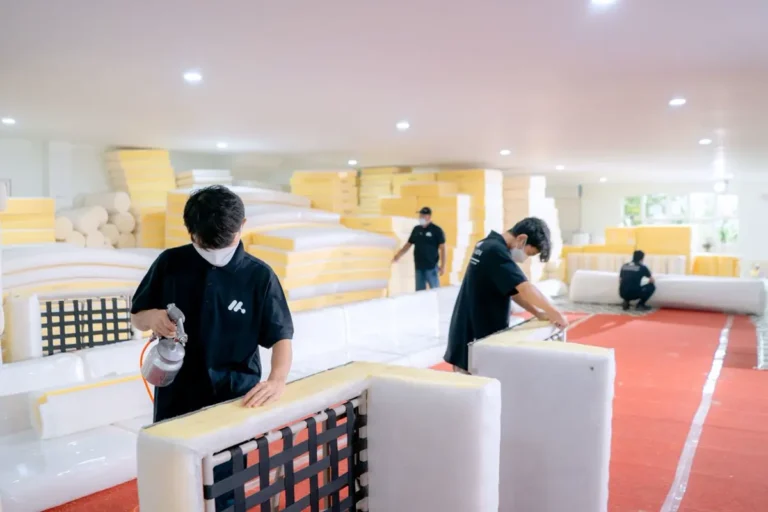
Upholstery follows the same logic. Foam is priced by density and grade: a commercial seat cushion typically uses 28–35 kg/m³ high-resilience foam, and moving up a density band raises the foam line noticeably while extending cushion life in heavy-use restaurant and lobby seating. If your market requires flammability compliance — California TB 117-2013 (commonly written CAL 117) for the US, or Crib 5 for UK contract use — compliant foam and barrier fabrics carry a premium over untested stock, and that premium belongs in the quote from day one, not as a surprise later.
Fabric is the other big upholstery variable. Factory-supplied contract fabric is quoted inside the FOB price; customer’s own material (COM) shifts the fabric cost to your side but adds freight, import handling into China, and coordination time, and factories still charge for the extra cutting care COM usually demands. Hardware rounds out the BOM: imported soft-close hinges and runners from European brands can cost several times their domestic Chinese equivalents per set, and on a 200-room casegoods package with 8–12 hinges and runners per room, that multiplier is visible in the total.
Labor, Finishing and Packing: The 25–40% You Can See on the Factory Floor
Direct labor typically represents 15–25% of the FOB price, and it scales with joinery complexity rather than product size — a plain wardrobe carcass machines quickly on CNC lines, while curved rails, mitred waterfall edges, and hand-applied details add hours per unit. Batch size matters here: once a line is set up for a run, the setup time amortizes across every identical unit, which is one reason container-quantity orders of repeated room types price better per unit than short mixed runs.
Finishing is the most underestimated line. A standard commercial finish is a 3–5 coat system — stain, sealer, and two or three topcoats — and every additional coat is another pass through the spray line plus drying time. Open-pore matte finishes, high-gloss polished lacquer (which can require 6+ coats with sanding and polishing between them), and two-tone schemes all add spray-line hours directly to the price. Sheen level is a genuine cost decision, not just an aesthetic one.
Export packing runs 3–5% of FOB on most furniture, and it is money well spent: foam-wrapped, honeycomb-boarded, five-ply-cartoned furniture routinely crosses the ocean with damage rates under 1–2%, while under-packed goods can arrive with claim-level damage on a meaningful share of pieces. Stone tops and mirrors add wooden crating. Packing also affects freight indirectly — knock-down (flat-pack) packing can cut cubic volume by 30–50% versus fully assembled pieces, which matters when a 40HQ container holds about 68 CBM.
Sourcing this for a commercial project?
FBM Sourcing works with project owners, developers, main contractors and FF&E contractors on hotel, apartment, school, office and other commercial building projects. Send us your BOQ, drawings or product list — our team will review it and get back to you.
Why Do Two Factory Quotes for the “Same” Item Differ by 30–40%?
Project buyers regularly receive two quotes for what looks like the same nightstand or dining chair that sit 30–40% apart, and the instinct is to suspect the higher factory of padding — or the lower one of cutting corners. In most cases neither is true: the gap lives in the BOM, in spec differences the drawing never pinned down. One factory quoted E1 particleboard carcass with PVC edging; the other quoted E0 plywood with 2mm ABS edging and solid-timber drawer boxes. One assumed 25 kg/m³ foam and domestic hinges; the other assumed 32 kg/m³ HR foam and imported soft-close hardware. Same photo, different furniture.
This is a spec-alignment problem, not a scam. The fix is a line-item BOM comparison: force every quote onto the same substrate, foam density, fabric grade, hardware brand, finish system, and packing method before comparing totals. When quotes are normalized this way, the genuine factory-to-factory spread on identical spec usually narrows to 5–15%, which reflects real differences in efficiency, overhead, and hunger for the order. We cover the working method in how to compare China factory quotes like-for-like.
Which Spec Decisions Move the Price Most?
Not all specification choices carry equal weight. The table below summarizes the levers with the largest typical impact on a custom furniture FOB price, in rough order of magnitude:
| Spec decision | Typical FOB impact | What drives it |
|---|---|---|
| Solid wood vs veneer vs laminate | 20–40% on the material line | Timber content, waste rate, drying and machining time |
| Foam density + fire rating (e.g. CAL 117, Crib 5) | 10–25% on upholstered pieces | HR foam grade, compliant foam and barrier fabric premium |
| Hardware brand (imported vs domestic soft-close) | 5–15% on casegoods | Per-set price multiplied across 8–12 sets per hotel room |
| Finish system and sheen | 5–15% | Number of coats; high-gloss can need 6+ spray-and-sand cycles |
| COM vs factory fabric | Shifts cost off FOB, adds logistics | Buyer-side fabric purchase, freight into China, cutting surcharge |
| Batch size / MOQ per item | Setup amortization per unit | Repeated room types spread line setup across more units |
| Molds and tooling for non-standard pieces | One-time charge, amortizable | Curved shells, cast metal bases, custom extrusions |
Two of these deserve special attention on custom programs. First, sampling: a full pre-production sample of a custom piece typically takes 7–15 days to build, and each revision round repeats most of that cycle — a hotel mock-up room with one of every casegood and seat is standard practice on branded projects and should be budgeted as a line item, not absorbed as a surprise. Second, tooling: genuinely non-standard pieces — a curved banquette shell, a custom cast-aluminum table base — carry one-time mold or tooling charges that factories quote separately and often partially credit back at volume. Both are covered in our guide to sample, mold and tooling costs in China sourcing.
From FOB Price to Landed Cost: What the Buyer Adds on Top
The FOB price is where the factory’s responsibility ends — goods loaded at the Chinese port — and it is typically only 60–80% of what the furniture actually costs standing in your building. On top of FOB, the buyer side adds ocean freight (roughly 30–40 sailing days to the US East Coast, UK, or Caribbean; 14–20 days to the Middle East or Australia from South China), marine insurance, destination port and handling charges, import duty and taxes in your jurisdiction, inland delivery, and any installation. Freight is quoted per container, so how efficiently your furniture fills a 28 CBM 20GP or 68 CBM 40HQ directly affects the landed number per unit.
None of these downstream costs change the factory quote, but they change which spec decisions are rational. Knock-down packing that saves half a container of volume can matter more to the final number than a modest FOB discount. For the full build-up from factory price to delivered cost, see our breakdown of landed cost on a China project order.
Where a Furniture Sourcing Agent Fits in Cost Control
Everything above points to the same conclusion: on custom project furniture, cost control is specification work. That is precisely where a furniture sourcing agent earns its keep — building a complete BOM-level spec before quoting, normalizing multiple factory quotations onto identical spec so a 30–40% paper gap becomes a real 5–15% comparison, and value-engineering the spec itself: veneer where solid wood adds nothing, domestic hardware where the brand standard permits it, one fewer lacquer coat where the sheen spec allows.
FBM Sourcing manages the entire China procurement package for overseas construction projects. Our fee is a confirmed 5–8% agency commission on the order value — what that covers, from factory shortlisting through our own team’s full pre-shipment inspection with photo and video records, is detailed in what a China sourcing agent fee covers. Because the fee is a percentage, our incentive aligns with getting the spec right the first time: fewer sample rounds, fewer surprises in the BOM, and quotes you can actually compare. If you are pricing a hotel, apartment, or restaurant furniture package, start with our China furniture and FF&E sourcing agent service for commercial projects.
Get a China Procurement Quote for Your Project
If you have a container-quantity custom furniture package to price — hotel casegoods, an apartment building’s unit furniture, restaurant seating — send us your drawings, BOQ or product list, quantities and room counts, destination port, and project timeline. We will build the specification to BOM level, obtain and normalize factory quotations, and return a like-for-like cost picture you can take to your project team.
Use the Get a Project Quote button above or message us on WhatsApp at +86 135 6007 5057. The more spec detail you share up front — substrates, foam densities, fire-rating requirements, hardware standards, finish sheens — the more accurate the first factory quotation will be.
Written by Spring Dan · Founder, FBM Sourcing
Sourcing building materials and FF&E in China for commercial construction projects since 2008. About Spring · LinkedIn