Landed cost for a China project order = FOB goods value + ocean freight + marine insurance + import duty and tariffs + port and terminal charges + customs brokerage + inland delivery to your site, plus the agency fee if you buy through a china sourcing agent and sourcing partner. Every line in that formula is charged on one of three bases: a percentage of the goods value, a rate per container or cubic metre, or a flat document and handling fee. Once you know which basis applies to each item, the landed cost of a China order stops being a mystery and becomes a spreadsheet you can build before you sign anything.
This guide walks through each component the way we cost it for hotel, apartment and commercial fit-out orders: what drives the number, who invoices it, and where project buyers most often leave a line out.
What Goes Into the Landed Cost Formula?
The full stack, in the order the charges occur:
- FOB goods value — factory price including export packing and delivery to the Chinese port, cleared for export
- Ocean freight — port-to-port carriage, priced per container on a full container load
- Marine insurance — a small percentage of the insured cargo value
- Import duty and tariffs — ad valorem percentages set by your destination country per HS code
- Port, terminal and government fees — terminal handling, processing fees, security filings
- Customs brokerage — the fee for lodging your import entry
- Inland delivery — drayage from the destination port to your project site or warehouse
- Agency fee — if applicable: for suppliers you nominate, we charge a 5% commission; for products we source for you, we quote a direct price
Which items sit on your side of the ledger depends on the shipping term you buy on. Under FOB you pay everything from ocean freight onward; under CIF the factory has bundled freight and insurance into its price; under DDP almost the entire formula is hidden inside one number. Our breakdown of FOB vs CIF vs DDP for building material orders explains the trade terms.
FOB Goods Value: The Base Everything Else Is Built On
The FOB value is the factory’s price for goods packed for export and delivered onto the vessel at the Chinese port. For furniture and building material packages it is normally the largest single block in the formula, which is why the rest of the calculation uses it as a reference: agency fees, insurance and (in many countries) duty are all expressed as a percentage of FOB value.
Two things matter when you pin this number down for a project order. First, confirm what the packing specification includes — export cartons, corner protection, crating for stone and glass — because packing for a long sea voyage is not the same as domestic packing, and a quote that excludes it will grow later. Second, confirm the price is genuinely FOB and not EXW; the difference is the inland haulage and export clearance inside China, which on an EXW quote becomes your problem to arrange and pay.
Ocean Freight: Volume Cargo vs Weight Cargo
Ocean freight is priced on space, not value. A 40ft high-cube container gives you roughly 76 cubic metres of internal volume, and for furniture and joinery — which are volume cargo, light for their size — the constraint is almost always cubic metres, not tonnage. Tiles, stone and sanitaryware are the opposite: they hit the container’s payload weight limit long before the walls are full.
The practical consequences for a landed cost model:
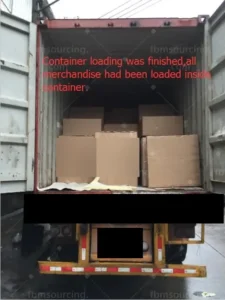
FCL (full container load): you pay a flat rate per container regardless of how well you fill it. Freight cost per unit therefore depends directly on load planning — a container packed to 90% utilisation carries the same freight bill as one packed to 60%, spread over far more product. This is where mixed-material consolidation earns its keep on project orders; our guide to estimating container counts for hotel FF&E orders shows how loose-loaded case goods and flat-packed items change the math.
Loose freight, by contrast, is priced per revenue ton — one cubic metre or 1,000 kg, whichever yields more — and carries origin and destination handling charges that a full container never sees. Those charges are the reason project orders are planned around full containers from the start: where one category does not fill a box on its own, it is consolidated with the other categories of the same project, or with categories from several projects of the same client, until the container is full. How that consolidation is planned is covered in our full container consolidation guide for building material projects.
Import Duty and Tariffs: Check the Duty Base First
Duty is an ad valorem charge — a percentage of a declared customs value — but countries disagree on what that value includes, and the difference moves real money on a project order:
- United States: duty is assessed on the FOB value of the goods alone. Freight and insurance are excluded from the duty base.
- European Union and Australia: duty is assessed on the CIF value — goods plus freight plus insurance. When freight rates spike, your duty bill rises with them even though the product price never moved.
The rate itself is set by the HS classification of each product, and a mixed project order — furniture, lighting, tiles, doors, sanitaryware — will span many HS codes with different rates. Costing the whole container at one blended guess is the most common duty error we see in buyer spreadsheets. On top of base rates, additional tariff measures apply to specific origin-and-product combinations and change with trade policy; our note on how tariff and lead-time changes affect China sourcing covers how we track this for live projects. For US-bound orders in particular, a headline tariff rate is not a landed cost — the duty base, the classification line by line and the exemptions in force all move the final number, which is why we run a landed-cost assessment on the actual product list before a client makes any go or no-go decision.
Two US-specific ad valorem fees belong in the same section of your model because they are calculated the same way: the Merchandise Processing Fee at 0.3464% of the goods value (19 CFR 24.23), and the Harbor Maintenance Fee at 0.125% of value on sea freight arrivals (19 CFR 24.24). Small percentages, but they are real lines on the entry summary and they compound across a multi-container program. Whether a preference is available at all is a separate question — see can a certificate of origin reduce import duty.
Sourcing this for a commercial project?
FBM Sourcing works with project owners, developers, main contractors and FF&E contractors on hotel, apartment, school, office and other commercial building projects. Send us your BOQ, drawings or product list — our team will review it and get back to you.
Insurance, Port Charges, Brokerage and Final Delivery
Marine insurance is one of the cheapest lines in the whole formula and the worst one to skip. Standard practice is to insure on the CIF value plus a margin agreed in the policy, and the premium is a small percentage of that insured value. For a container of custom-made joinery with a long production lead time, the premium is trivial against the replacement lead time. For a related decision, see the port and local charges that apply beyond ocean freight.
Port and terminal charges are mostly flat fees per container or per shipment: terminal handling at both ends, destination port infrastructure or facility fees, and in the US the ISF (Importer Security Filing), which under 19 CFR 149.2 must be lodged at least 24 hours before your cargo is laden aboard the vessel in China — late or missing filings attract penalties.
Customs brokerage is a flat professional fee per entry, sometimes with small add-ons per additional HS line. It is minor on a single container and worth negotiating on a program of ten.
Inland delivery (drayage) from destination port to site is quoted per container per trip, driven by distance and whether the site can turn a container around inside the free unloading window. A site that needs the container dropped and collected later pays extra chassis and trip charges — a real consideration for fit-out sites with no forklift on hand.
All of these charges travel on a defined set of paperwork, and errors there create their own costs; see our checklist of shipping and customs documents for China project orders for what must match across the invoice, packing list and bill of lading.
Why Is Landed Cost More Useful Than Unit Price?
Because unit price ranks quotes, while landed cost ranks outcomes — and the two orderings are frequently different. Three structural reasons:
Duty applies to value, freight applies to volume. A product that is 10% cheaper but packs 20% less efficiently consumes more of your fixed container cost per unit. Volume cargo like furniture lives and dies on cube utilisation: with a 40HQ holding about 76 cubic metres either way, the freight bill per chair is set by the packing engineer, not the price list.
Classification can outweigh price. Two comparable products can fall under different HS codes with materially different duty rates. The higher-priced item under the lower-duty classification can land cheaper — a comparison no unit-price spreadsheet will ever surface.
Freight is the line most often mis-budgeted, because it is calculated on chargeable weight rather than on the weight of the goods — the difference between gross, net and volumetric weight is explained separately.
The cheap quote often has the thin scope. The lowest FOB number on a tender is frequently the one that quietly excludes export packing, assumes cartons too light for project handling, or prices a lighter specification. Landed cost forces every quote onto the same scope before you compare, which is most of the reason to build the model at all. On the packages we run, the goods themselves typically account for only part of the final delivered number once freight, duty and destination charges stack up — meaning a few percent saved on FOB can be wiped out by a single structural miss further down the formula.
Cost Item, Charging Basis and Who Invoices It
| Cost item | Charging basis | Who charges it |
|---|---|---|
| FOB goods value | Per product, incl. export packing & delivery to Chinese port | Factory |
| Agency fee | A direct price for products it sources; 5% commission for suppliers you nominate | Sourcing agent |
| Ocean freight | Per container, on a full container load | Carrier / freight forwarder |
| Marine insurance | % of insured value (CIF value plus an agreed margin) | Insurer, via forwarder or agent |
| Import duty & tariffs | % of FOB (US) or CIF (EU/AU) value, per HS code | Destination customs authority |
| MPF / HMF (US only) | 0.3464% / 0.125% of goods value | US Customs & Border Protection |
| Terminal handling & port fees | Flat per container, both ends | Terminals, via forwarder |
| Customs brokerage | Flat per entry (+ per extra HS line) | Customs broker |
| Inland delivery / drayage | Per container per trip, by distance | Trucking company |
What Do Buyers Most Often Forget to Include?
When a landed cost model misses, it is rarely the big lines — it is these:
- ISF filing (US): a mandatory security filing due at least 24 hours before the cargo is laden aboard the vessel (19 CFR 149.2), with penalty exposure if missed
- Documentation fees: bill of lading issuance, telex release, certificates of origin — small flat fees that appear on every shipment
- Customs examination fees: if your container is selected for X-ray or physical inspection, the handling and storage costs are yours even when the cargo is fully compliant
- Demurrage and detention: destination ports typically allow 4-7 free days before storage charges start; a slow customs release or an unready site burns through them fast
- Destination surcharges: chassis fees, congestion surcharges, peak season surcharges — announced by carriers, not negotiable at delivery time
- Currency movement: project orders quoted in USD, with around four months between deposit and balance payment on custom orders, carry real exchange-rate exposure in your home currency
None of these change the formula — they are all inside “port charges” and “delivery” if you cost them honestly. They only become surprises when the model was built from a price list instead of from a shipment.
Duty is only one line of that landed figure, and it is itself a stack rather than a rate: see how US import duties are structured on furniture and building materials from China for the classification, Section 301 and AD/CVD layers behind it.
For US projects, check with your customs broker whether any line in the package falls under a Section 232 action as well as the ordinary duty. Our summary of the Section 232 kitchen cabinets tariff, which also covers vanities and upholstered wooden seating, sets out what applies now and what is scheduled to change on 1 January 2027, with the Federal Register citations.
Get a China Procurement Quote for Your Project
If you are costing a hotel, apartment, office or other commercial building project, we can build this landed cost picture for you against your actual BOQ — line-by-line HS classification, container planning and destination charges for your port, with every assumption stated. FBM Sourcing acts as a china sourcing agent for building materials and FF&E, working for project owners, developers, main contractors and FF&E contractors. Submit your drawings, quantities, destination port and timeline, and our team will review the package and come back to you with a structured procurement proposal.