On a project import from China, customs clearance in the destination country is the legal responsibility of the importer of record (IOR) — normally the buying entity that owns the goods on arrival, not the factory and not the sourcing agent and sourcing partner. The IOR almost always appoints a licensed customs broker to file the entry, classify the goods and pay duties and taxes on its behalf, but the liability stays with the IOR. The sourcing agent in China handles export clearance and produces the document pack that the broker needs; it does not become the importer unless the contract is written DDP and the seller has explicitly accepted import responsibility.
- Importer of record — legally answerable for declaration accuracy, classification, valuation and payment of duties and taxes; the party customs audits after release.
- Customs broker — licensed agent in the destination country who files the entry, applies HS codes, calculates and remits duties, and clears other agency requirements.
- Sourcing agent in China — export declaration, commercial invoice, packing list, bill of lading, certificate of origin, applicable test reports, and ISPM 15 treatment marking on wood packaging.
- Incoterms 2020 — the contract term decides who arranges and pays for import clearance; only DDP puts it on the seller.
- Common trap — CIF and CFR cover ocean freight to the destination port, but import clearance and duties still belong to the buyer.
Who Is the Importer of Record?
The importer of record is the legal person or company that presents goods to customs in the destination country and takes responsibility for the declaration. In practice that is the entity named as consignee or as importer on the customs entry — the developer, the main contractor, the FF&E contractor, or a project company set up for the build. It must have a valid tax and importer registration in that country: an EORI number in the UK and EU, an ABN with a customs client identifier in Australia, an IRS number or importer number in the United States, and equivalent registrations across Caribbean and Middle East markets.
Three duties sit with the IOR and cannot be delegated away, even when a broker does all the typing. First, declaration accuracy: descriptions, quantities and marks must match what is physically in the container. Second, classification: the correct HS code must be applied, and although the first six digits of the Harmonized System are internationally aligned, countries extend the code to eight, ten or more digits under their own tariff schedules. Third, valuation: the declared value must reflect the real transaction value under the customs valuation rules.
This is why post-clearance audits land on the importer, not on the broker or the factory. Customs authorities in most developed markets can reassess an entry years after release, and if a code was wrong or a value understated, the demand goes to the IOR. FBM Sourcing declares export shipments truthfully and will not issue an invoice showing a value other than the value actually paid.
How Do Incoterms Decide Who Clears Customs?
Incoterms 2020 are the contractual switch that decides where the seller’s obligation stops. On a building project the choice is made once, at PO stage, and then governs everything that happens at the arrival port weeks later. The rules that matter for a China project import:
| Incoterm 2020 | Who arranges import clearance | Who pays import duties and taxes |
|---|---|---|
| EXW | Buyer | Buyer |
| FCA | Buyer | Buyer |
| FOB | Buyer | Buyer |
| CFR | Buyer | Buyer |
| CIF | Buyer | Buyer |
| DAP | Buyer | Buyer |
| DDP | Seller | Seller |
FOB is by far the most common term on container-load orders out of China, because the buyer or its forwarder controls the ocean leg and the arrival-side handling. The persistent misunderstanding is around CIF and CFR: those terms move freight cost (and, under CIF, minimum cargo insurance) to the seller, but they are still shipment terms — risk transfers when the goods are loaded on board, and import clearance remains the buyer’s job. A CIF price is not a delivered-to-site price.
DAP confuses buyers for the opposite reason. The seller carries the goods all the way to a named place, which can be the site gate, but DAP explicitly excludes import clearance and import duties. If nobody has arranged an IOR and a broker, a DAP container sits at the terminal accruing charges while the parties argue.
DDP is the only term where the seller owns import clearance and the duty and tax bill. Large project shipments rarely use it in practice, for two reasons. The seller needs a usable importer identity and tax registration in the destination country, which a Chinese exporter normally does not have, and in several markets a non-resident cannot act as IOR at all without appointing a local fiscal representative. Just as important, under DDP the buyer loses visibility of how its goods were classified and valued — and if the entry is later challenged, the project still has to explain the paperwork. A full comparison sits in our guide to FOB vs CIF vs DDP for building materials from China.
What Does a Customs Broker Actually Do?
The broker is the operator. Once the arrival notice is issued, the broker takes the document pack and turns it into a customs entry. The work breaks down into five tasks:
- Classification. Assigning the national tariff code to every line. On a mixed FF&E container this is real work: upholstered seating, case goods, lighting, sanitaryware and tile all fall under different chapters of the tariff.
- Entry filing. Lodging the declaration with the customs authority, including advance filings where required. US imports need an Importer Security Filing (the 10+2 ISF) transmitted at least 24 hours before the container is loaded onto the vessel in China, which means the data has to exist before departure, not on arrival.
- Duty and tax calculation and remittance. Computing what is owed on the declared value and paying it, usually against the importer’s account or the broker’s bond.
- Other government agencies. Timber and wood-packaging controls, biosecurity and quarantine declarations in Australia and New Zealand, market-access requirements for electrical goods, and product-specific documentation for items such as sanitary ware or glazing.
- Release and delivery. Arranging container pickup after release, and booking the delivery slot to site.
A broker acts under a power of attorney. It gives classification advice, but it files on the importer’s instructions and against the importer’s declaration — which is why the IOR question has to be settled before the order ships, not after.
Once the container lands, port free time starts running whether or not clearance is ready — see our guide to demurrage and detention charges and how to avoid them.
Sourcing this for a commercial project?
FBM Sourcing works with project owners, developers, main contractors and FF&E contractors on hotel, apartment, school, office and other commercial building projects. Send us your BOQ, drawings or product list — our team will review it and get back to you.
What Does the Sourcing Agent Handle on the China Side?
A china sourcing agent sits on the export side of the transaction. FBM Sourcing files the export declaration in China and assembles the document pack that travels with the goods, so that the broker at the other end has a complete and internally consistent set to work from. That pack normally contains the commercial invoice, the packing list with carton counts and gross and net weights, the bill of lading, the certificate of origin, and any test reports or declarations of conformity that apply to the product category. What each document is for is covered in detail in our breakdown of the shipping and customs documents that come with a China project order; this article is about who is accountable for each step.
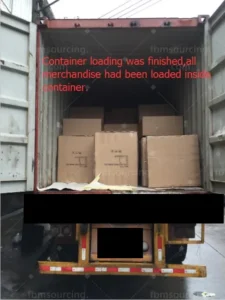
Two agent-side jobs matter more than buyers expect. The first is document-to-cargo consistency. When six factories feed one 40HQ container of roughly 67–68 m³ loading volume, the packing list, the carton shipping marks and the physical load have to reconcile line by line. Our team inspects goods before shipment at the factory with photo and video records, and the loading record is matched against the packing list before the container is sealed. How this works across multiple vendors is set out in our guide to consolidating products from multiple Chinese factories into one container.
The second is wood packaging. Any solid-wood crating, pallet or bracing used in export packing must be heat treated or fumigated and carry the IPPC mark under ISPM 15 — the wheat symbol plus the two-letter country code, the treatment facility code and the treatment code (HT for heat treatment, MB for methyl bromide). Missing or illegible marks are one of the fastest ways to have a container detained on arrival.
On classification, a building material sourcing agent can and should offer HS code suggestions, because the agent knows the exact material composition and construction of each item. But the suggestion is input, not a decision: the final classification responsibility rests with the importer and its broker under the destination country’s tariff. Any agent that promises to “guarantee” a tariff outcome is describing something it has no legal standing to deliver.
Why Do Project Shipments Get Held at Customs?
Across project cargo, holds cluster into four causes. Each has a preventable mechanism on the China side.
- Documents do not match the cargo. Carton counts, product descriptions or shipping marks differ from the packing list. Prevention: reconcile the loading photos and carton tally against the packing list before sealing, and re-issue documents if a factory ships a partial quantity.
- Classification dispute. Customs disagrees with the declared HS code, usually because the description is too generic (“furniture”, “building material”). Prevention: line-level descriptions stating material, construction and function, agreed with the broker before the vessel sails.
- Origin documentation. A certificate of origin is missing, or a preferential rate is claimed on a form that does not support it. Prevention: decide early whether a preference is being claimed and issue the correct certificate type; where no preference applies, a plain certificate of origin is still requested by many customs authorities.
- Wood packaging non-compliance. Untreated or unmarked timber crating. Prevention: ISPM 15 treated and stamped material specified in the packing standard for every vendor in the consolidation.
Project cargo carries extra exposure that a single-SKU import does not. One fit-out package is a multi-category, multi-container shipment, so there is no single HS code — there are dozens of tariff lines on one entry. Phased deliveries mean every arrival is a separate clearance with its own broker fee and its own chance of a query. And once a container lands, the clocks start: demurrage runs on containers left inside the terminal past the allotted free period, and detention runs on equipment kept outside the terminal past the return deadline. A customs hold pauses nothing — the charges accrue while the entry is being resolved, which is why clearance readiness has to be checked before the vessel arrives, not after.
How to Set This Up Before You Place the Order
Settle six points at PO stage and the arrival becomes an administrative event rather than a crisis:
- Name the importer of record in the contract, with its tax and importer registration confirmed as active in the destination country.
- Fix the Incoterm using an Incoterms 2020 rule and the named port or place, written out in full on the PO — for example “FOB Shenzhen, Incoterms 2020”.
- Appoint the customs broker and issue its power of attorney early enough for advance filings such as the ISF to be transmitted before loading.
- Agree the HS codes line by line between the broker and the agent, so the export declaration and the import entry describe the same goods.
- Specify the packing standard, including ISPM 15 treated timber and the shipping mark format, in the PO to every factory.
- Plan the site delivery: access, unloading equipment and booking windows, so containers are returned before detention starts.
Sequencing matters as much as content. Ocean transit plus clearance plus inland delivery has to be built backwards from the site programme — our China sourcing and shipping timeline by project type gives realistic planning windows, and if you are still deciding how the goods travel, full container consolidation for building material projects covers how a project package is grouped into full container loads. It is also worth being clear on who is doing what on the logistics side, which we unpack in 3PL vs freight forwarder vs sourcing agent.
Get a China Procurement Quote for Your Project Shipment
FBM Sourcing is a building material and furniture sourcing agent based in Guangzhou, one hour from Foshan, working with project owners, developers, main contractors and FF&E contractors on hotel, apartment, school, hospital, office, government, chain restaurant and fuel station projects across the USA, Australia, the UK and Europe, the Caribbean and the Middle East. We handle factory selection, production management, inspection before shipment with photo and video records, export declaration and the full document pack your broker needs to clear the goods — while your importer of record and broker keep control of the entry, as they should. Send your BOQ, drawings or product list with quantities, destination port and target programme dates, and our team will review it. More detail on scope is on our project procurement page. Customs responsibility and cargo risk are separate questions — for the insurance side, see what marine cargo insurance a China project shipment needs.