
ANSI/BIFMA standards are the American commercial-furniture performance benchmarks — laboratory test protocols for strength, durability and stability that US projects routinely require for office and institutional furniture. “BIFMA certified” is shorthand with a catch: BIFMA itself publishes the standards but does not certify products; compliance is demonstrated by a test report from a laboratory that has tested your specific product model against the specific standard, such as ANSI/BIFMA X5.1 for office seating. Major Chinese export factories serving the US contract market routinely hold current test reports for their commercial lines — the buyer’s job is to require the report, match it to the exact model being ordered, and check its edition and date. FBM Sourcing is your sourcing partner in China: it holds no inventory and has no product range of its own.
The standards project buyers meet most often:
- ANSI/BIFMA X5.1 — office seating: task and desk chairs; includes cyclic durability tests such as 100,000-cycle seat impact.
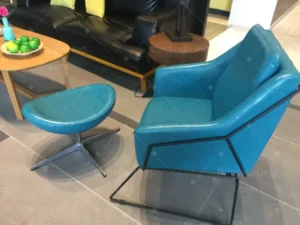
- ANSI/BIFMA X5.4 — lounge and public seating: lobby, reception and soft seating.
- ANSI/BIFMA X5.5 — desk and table products, including height-adjustable desks.
- ANSI/BIFMA X5.9 — storage units: pedestals, filing and shelving.
- ANSI/BIFMA X7.1 / M7.1 — low-emission testing for furniture and seating (VOC emissions), often specified alongside performance standards on institutional work.
What Do BIFMA Standards Actually Test?
Each standard is a battery of laboratory procedures simulating years of commercial use. X5.1, the office seating standard most often cited on US projects, includes static load tests on seat and back, cyclic seat impact testing (dropping a load onto the seat 100,000 times), backrest durability cycling, armrest strength, base and caster durability, and stability tests against tipping. The pass thresholds are set for eight-hour daily commercial use — which is precisely the difference between contract-grade and consumer-grade furniture. A chair that passes X5.1 has demonstrated, in a laboratory, the service life a corporate fit-out or institutional buyer is paying for.
This is why US specifiers write BIFMA references into furniture schedules for offices, universities, healthcare and government projects: the standard converts “good quality” from an opinion into a testable claim. For hotel and multifamily FF&E, BIFMA references appear selectively — task chairs in guest rooms, public-area seating, casegoods on some brand standards — alongside the fire and materials compliance covered elsewhere in a project specification.
Do Chinese Factories Have BIFMA Test Reports?
The export contract-furniture sector in China is well adapted to BIFMA requirements: factories supplying US office furniture programmes maintain current test reports on their core commercial lines as a condition of market access, and the large seating and desk manufacturers — including those in our guide to top office furniture manufacturers in China for corporate fit-outs — treat X5.1 and X5.5 testing as routine. Testing is performed at accredited furniture-testing laboratories against the standard’s current edition, and a single report covers a specific model as tested.
The practical gaps appear at the edges, and they are exactly where project buyers get caught. A report may cover the factory’s standard model but not your customised version — a different base, gas lift or seat foam can invalidate the reference. A report may cite a superseded edition of the standard where your specification requires the current one. Or the report may simply be old: laboratories date reports, and specifiers commonly expect recent testing rather than a report from many years ago. None of these are exotic problems — they are checklist items, which is the point of the next section.
Sourcing this for a commercial project?
FBM Sourcing works with project owners, developers, main contractors and FF&E contractors on hotel, apartment, school, office and other commercial building projects. Send us your BOQ, drawings or product list — our team will review it and get back to you.
What Should Your RFQ Require for BIFMA Compliance?
Write the requirement into the enquiry, not the post-order correspondence. Four lines cover it:
- Name the standard and edition per product type: e.g. “task chairs: ANSI/BIFMA X5.1, current edition” — and require the test report number in the quotation.
- Match the model: the report must correspond to the model and configuration being ordered; any customisation must be declared against the tested configuration.
- Require the full report, not a certificate page: the report identifies the laboratory, the test date, the standard edition and the tested sample — the single-page “certificate” often circulated omits most of that.
- State the consequence: goods are to match the tested specification, and pre-shipment inspection will check construction against it.
Handled this way, BIFMA documentation becomes part of quote comparison: a factory quoting without a report on the specified line is quoting a different product, whatever the photos look like — the same like-for-like discipline covered in our guide to an effective RFQ package for China sourcing.
Is BIFMA the Same as Fire or Emissions Compliance?
No — and mixing them up is a common specification error. BIFMA X5-series standards test mechanical performance: strength, durability, stability. Fire performance of upholstered furniture is governed by separate regimes such as California TB 117-2013 for the US market. Chemical emissions have their own tracks: ANSI/BIFMA X7.1 for furniture VOC emissions, and CARB Phase 2 / TSCA Title VI for the composite wood inside casegoods, as covered in our guide to CARB and TSCA compliance for furniture from China. A complete US institutional specification typically stacks all three: BIFMA for performance, TB 117-2013 for upholstery fire behaviour, CARB/TSCA for board emissions. Each has its own document, and the shipment file should carry all of them.
How Do You Read a BIFMA Test Report?
When the report arrives, five fields tell you whether it protects your project. The standard and edition — the report must cite the exact standard your specification names, and editions change: a report against a superseded edition may not satisfy a current-edition specification. The tested model and configuration — model number, base type, mechanism, foam and upholstery build should match the product on your schedule; “similar model” is not a match. The issuing laboratory — identified by name and accreditation on the report itself. The test date — recent enough that the tested construction is still what the factory builds today. And the results table — a proper report records each test in the battery with its outcome, not a single summary line.
Reports failing on model match are the most common finding in practice: the factory’s report is genuine, but it covers the standard chair, and your project ordered it with a different base and a higher-density seat foam. The fix is procedural and cheap when caught at quotation stage — align the order to the tested configuration, or have the varied configuration tested — and expensive when caught by a specification reviewer after delivery.
How Does a Sourcing Agent Verify BIFMA Documentation?
On a multi-line furniture package, document verification is a workflow, not a favour. FBM Sourcing collects the test reports at quotation stage, checks report-to-model match and standard editions before any order is placed, writes the tested specification into the purchase order, and then verifies at the factory that production goods match the tested construction — frame material, foam grades, mechanism and base — during pre-shipment inspection by our own team, with photo and video records delivered to the client. Factory-issued laboratory reports are documentation we verify as part of the paper trail for your destination market, alongside the fire and emissions files. For US corporate, education and healthcare fit-outs, that document pack is what lets your furniture schedule clear specification review without substitution arguments on site — the same discipline we apply across hotel furniture programmes from China.
BIFMA covers structure; emissions are certified separately. See GREENGUARD and low-VOC furniture certification for US commercial projects for what Gold requires and how to verify a Chinese factory’s listing.
For UK projects the equivalent evidence comes from the BS EN family rather than BIFMA: see what FIRA testing means for furniture on UK projects and how Chinese factories pass it.
Height-adjustable desks add motors, lifting columns and a control box to the X5.5 question, so the report has to name the frame, drive system and top that will actually ship. Our guide to height adjustable desk manufacturers in China sets out who makes each part and the product evidence to request.
Get a China Procurement Quote for BIFMA-Compliant Furniture
FBM Sourcing is a furniture sourcing agent for commercial building projects — offices, schools, healthcare, hotels and government work across the US, Australia, Europe and the Caribbean. We source BIFMA-tested lines from proven Chinese factories, verify the documentation against your specification, and inspect production before shipment. Send your furniture schedule, quantities and destination port through our project procurement page and our team will confirm the compliance pack your project needs. Frame performance is only half the specification — the cover material carries its own fire and abrasion requirements, covered in fabric vs vinyl upholstery for commercial seating.