For most hotel projects the answer splits cleanly by area: specify woven Axminster in corridors, ballrooms and other patterned public areas of upscale and luxury properties; machine-tufted broadloom in guestrooms and in midscale properties throughout; and carpet tile in meeting rooms, back-of-house offices and corridors where facilities teams want tile-by-tile replacement. The three hotel carpet types differ in construction, not just price — Axminster weaves the pattern into the carpet on an 80/20 wool–nylon blend, tufting stitches yarn into a backing at three to four times the production speed, and carpet tile bonds a tufted face to a dimensionally stable modular backing. Which one you specify decides your fire-test route, your lead time and your replacement economics for the next seven years. FBM Sourcing acts as your sourcing partner from specification through to shipment.
Quick summary for specifiers:
| Decision | Verdict | Action |
|---|---|---|
| Luxury / upper-upscale public areas | Woven Axminster, 80/20 wool–nylon | Lock design 12+ weeks before floor-laying date |
| Guestrooms (most flags) | Machine-tufted broadloom, solution-dyed nylon or wool blend | Specify 900–1,100 g/m² pile weight; order room-sequenced rolls |
| Meeting rooms, offices, select-service corridors | Carpet tile, 50 × 50 cm | Hold 2–3% attic stock on site for swap-outs |
| Fire compliance | Set by destination market, not by China | Name ASTM E648 / EN 13501-1 / AS ISO 9239.1 class in the BOQ |
Facts that anchor the decision:
- Custom Axminster: 8–12 weeks production after design approval; tufted broadloom: 3–5 weeks; standard-range carpet tile: 2–3 weeks ex-works.
- US corridors and exitways require ASTM E648 Class I (critical radiant flux ≥ 0.45 W/cm²); Class II (≥ 0.22 W/cm²) is the floor for many other areas.
- Hospitality Axminster pile weights run roughly 1,100–1,350 g/m² in guest corridors and 1,350–1,500 g/m² in ballrooms; tufted guestroom carpet runs 900–1,100 g/m².
- A 20 ft container carries roughly 2,500–3,000 m² of 50 × 50 cm carpet tile; broadloom ships as 4 m wide rolls (100–120 m² each), normally in 40 ft high-cubes.
- Working overage norm: 5% extra on patterned Axminster for repeat-matching waste, plus 2–3% attic stock woven in the original dye lot.
What Actually Separates the Three Hotel Carpet Types?
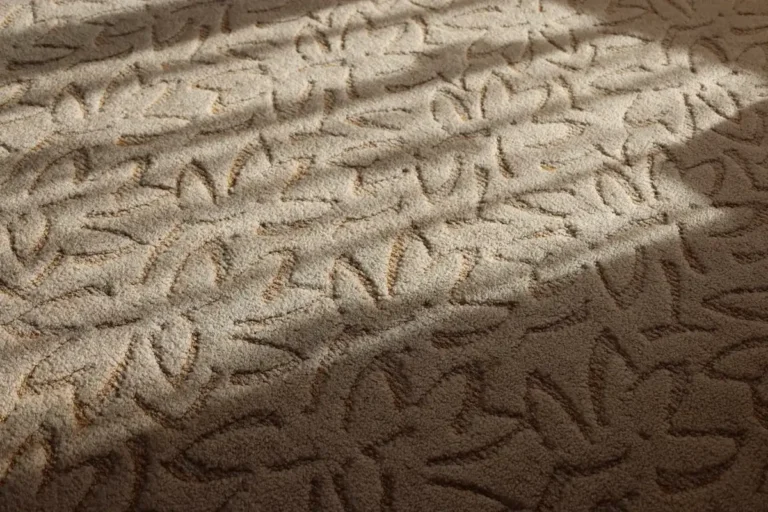
Axminster is a woven construction: pile yarns and backing are produced in one weaving operation, so the pattern goes through the carpet rather than sitting on top of it. That is why Axminster holds crisp, multi-colour patterns over 12-colour palettes, keeps its face under castor traffic, and is the default in luxury-flag brand standards. The standard hospitality blend is 80% wool, 20% nylon — wool for appearance retention and inherent flame resistance, nylon for tensile strength.
Machine tufting stitches yarn into a pre-made primary backing, then locks it with a secondary backing. It is three to four times faster to produce than weaving, which is exactly why it costs less and ships sooner. Modern solution-dyed nylon tufted carpet resists bleach and sunlight fading better than piece-dyed product — a real consideration for coastal and high-UV markets like Australia and the Caribbean.
Carpet tile is a tufted face bonded to a heavy modular backing — PVC or bitumen — engineered for dimensional stability (European product is tested to EN 986). The unit of purchase, installation and replacement is the 50 × 50 cm tile, and that single fact drives its whole business case: a wine spill in a meeting room is a four-tile swap from attic stock, not a re-carpeting job.
Where Should You Specify Axminster?
Corridors, ballrooms, pre-function areas, signature restaurants and casino floors in upscale, upper-upscale and luxury properties. Guest corridors are the classic case: long sightlines reward large-repeat patterns, and patterns hide the soiling track that solid-colour carpet shows within months. At 1,100–1,350 g/m² pile weight, corridor Axminster on a proper cushion typically runs a 5–7 year replacement cycle under full occupancy.
| At a glance | Best appearance retention and pattern definition · highest cost of the three · 8–12 week custom lead time · 80/20 wool–nylon standard · strongest fit: luxury and upper-upscale public areas |
The trap on Axminster is programme, not price. The 8–12 week weaving window starts only after the design, colour poms and quality sample are signed off, so a late design freeze pushes carpet straight onto the critical path. Which mills can actually weave hospitality Axminster at project volume — and how they differ — is covered in our review of the hotel carpet manufacturers in China.
When Does Machine-Tufted Broadloom Make Sense?
Guestrooms almost everywhere, and whole-property use in midscale and extended-stay flags. Guestrooms take a fraction of corridor traffic, and the room door conceals the transition, so paying Axminster money inside the room rarely survives value engineering. A 900–1,100 g/m² solution-dyed tufted carpet delivers a 6–8 year guestroom cycle — aligned with typical soft-goods refurbishment — at a cost structure that can run 40–60% of an equivalent woven product, depending on fibre.
| At a glance | Best cost-to-performance in guestrooms · 3–5 week lead time · solution-dyed nylon resists fading and cleaning chemicals · pattern capability limited vs weaving · strongest fit: guestrooms and midscale properties |
Sourcing this for a commercial project?
FBM Sourcing works with project owners, developers, main contractors and FF&E contractors on hotel, apartment, school, office and other commercial building projects. Send us your BOQ, drawings or product list — our team will review it and get back to you.
Where Do Carpet Tiles Win?
Meeting rooms, boardrooms, business centres, back-of-house offices — and increasingly select-service corridors. The argument is lifecycle maths: broadloom is replaced wall-to-wall, while tile floors are maintained tile-by-tile from a 2–3% attic stock held on site. Tile also installs over raised-access floors and fits out phased areas without seams waiting on adjoining zones. Logistics are cleaner too: tiles pack flat in boxes of roughly 5 m², load about 2,500–3,000 m² per 20 ft container, and need no long-roll handling on site.
| At a glance | Lowest lifecycle cost in meeting and office areas · 2–3 week lead time on standard ranges · modular replacement from attic stock · visible joints rule it out of luxury public areas · strongest fit: meeting rooms, offices, select-service corridors |
Where carpet tile loses is anywhere the design intent calls for seamless, large-repeat patterning — a ballroom in 50 cm modules never quite reads as one floor. And in wet-adjacent or hard-use zones, carpet of any construction gives way to hard flooring: our comparisons of vinyl vs SPC flooring for commercial projects and slip resistance ratings for commercial tiles cover those areas of the same schedule.
What Fire and Performance Standards Apply to Hotel Carpet?
Fire compliance is set by the destination market and must be written into the BOQ before quoting — not discovered at customs. For the USA, the flooring radiant panel test ASTM E648 (NFPA 253) governs: Class I (critical radiant flux ≥ 0.45 W/cm²) for corridors and exitways in unsprinklered buildings, Class II (≥ 0.22 W/cm²) as the general floor elsewhere, plus the CPSC pill test (16 CFR 1630) on all carpet. European projects specify EN 13501-1 reaction-to-fire classes — Cfl-s1 is the common corridor requirement — tested to EN ISO 9239-1. Australian and New Zealand projects reference AS ISO 9239.1 critical radiant flux values under the NCC, with common thresholds of 2.2 and 4.5 kW/m² depending on building class and sprinkler protection. UK hospitality work still commonly cites BS 5287 assessment to the hot metal nut test (BS 4790).
Beyond fire, the specification lines that keep a carpet looking acceptable at year five are pile weight, density and fibre. Wool blends self-extinguish more readily and hold appearance in pattern-critical areas; solution-dyed nylon wins on stain and fade resistance. Reputable Chinese mills test to all the standards above through accredited laboratories and supply type-test certificates with shipment documents — the same certification logic that applies across an FF&E package, as set out in our guide to fire safety certificates for hotel FF&E sourced from China.
How Do the Three Constructions Compare on Cost Structure?
Without quoting absolute prices — which move with wool, nylon and freight markets — the relative structure is stable. Taking a mid-spec tufted guestroom carpet as the baseline, woven Axminster of hospitality grade typically lands at roughly two to three times the baseline per square metre once the wool content and weaving time are priced in, while standard-range carpet tile usually sits near the tufted baseline on first cost but below it on lifecycle cost in meeting and office areas, because replacement happens per tile rather than per room. Two structural points matter more than the headline rate. First, fibre is the biggest single cost driver inside any construction: moving from an 80/20 wool–nylon blend to solution-dyed nylon changes the material cost more than switching mills does. Second, installation accessories are part of the real comparison — Axminster and tufted broadloom want a proper underlay (felt or PU foam cushion adds material cost but roughly doubles perceived quality underfoot and extends face life), while carpet tile installs direct-stick with no cushion line at all. On a full package bought through an agent, carpet follows the same commercial logic as the rest of the FF&E schedule: mill-direct pricing plus a 5% commission for suppliers you nominate (products we source for you are quoted at a direct price), rather than a trader margin hidden inside the unit rate.
Which Carpet Should You Use in Each Hotel Area?
| Area | Specify | Typical spec anchor |
|---|---|---|
| Guest corridors (upscale/luxury) | Axminster 80/20 | 1,100–1,350 g/m², ASTM E648 Class I or EN Cfl-s1 |
| Ballroom / pre-function | Axminster 80/20 | 1,350–1,500 g/m², large custom repeat |
| Guestrooms | Tufted broadloom | 900–1,100 g/m², solution-dyed nylon or wool blend |
| Meeting rooms / boardrooms | Carpet tile 50 × 50 | EN 986 dimensional stability, 2–3% attic stock |
| Back-of-house offices | Carpet tile 50 × 50 | Standard range for fastest lead time |
| Select-service corridors | Carpet tile or tufted | Driven by brand standard and lifecycle budget |
| Lobby feature / suites (5-star) | Hand-tufted custom | Statement piece, paired with volume mill for the rest |
How Do You Buy Hotel Carpet from China as Part of a Project Package?
Carpet is rarely a standalone purchase — it lands inside a consolidated hotel FF&E package from China with casegoods, seating and lighting, and the carpet decisions above set the package’s critical path. A workable sequence for a project buyer: freeze carpet constructions per area at design development; issue the BOQ with fire classes and pile weights named per line; approve strike-offs (woven samples of your actual pattern) before releasing production; and schedule the 8–12 week Axminster window against your floor-laying dates, letting the 2–3 week tile order trail behind. Sequencing deliveries by floor, in installation order, saves real site labour on a 200-room fit-out.
As a china sourcing agent, FBM Sourcing manages that sequence across mills: matching each construction to the right factory, running the sample and strike-off loop, and carrying out every inspection with our own in-house QC team at the mill — pile weight and density checks, shade-batch continuity across rolls, backing adhesion and metre marking — documented in photo and video records at the pre-shipment inspection, before anything is released for loading. Consolidation then puts carpet, underlay and accessories into the same containers as the rest of the FF&E schedule with one set of shipping documents.
We recommend: Axminster for the public-area floors your guests will judge, tufted broadloom behind every guestroom door, and carpet tile wherever a facilities manager will one day thank you for attic stock. Freeze the design early, name the fire class in the BOQ, and buy the overage in the original dye lot.
Get a China Procurement Quote for Your Hotel Carpet Schedule
FBM Sourcing is a building material sourcing agent and furniture sourcing agent for commercial construction projects — hotels, apartment buildings, offices, schools and government work across the USA, Australia, Europe and the Caribbean. Send us your carpet schedule or full FF&E BOQ — drawings, room counts, fire-class requirements, destination port and timeline — and our team will review your requirements and get back to you.