China windows door systems — the sliding, folding and glazed entrance products that come out of the same aluminum fabrication clusters — sit on almost every hospitality and commercial fit-out schedule we price: the restaurant opening onto a terrace, the apartment balcony line, the meeting rooms that must disappear on demand. Sliding and folding are the two systems buyers most often weigh against each other, and they carry very different cost structures, hardware risks and maintenance profiles. As a china sourcing agent and sourcing partner pricing both weekly, here is the selection logic we walk clients through before a single quote is issued.
Where Each System Wins
Sliding Doors: The Default for Repetitive Openings
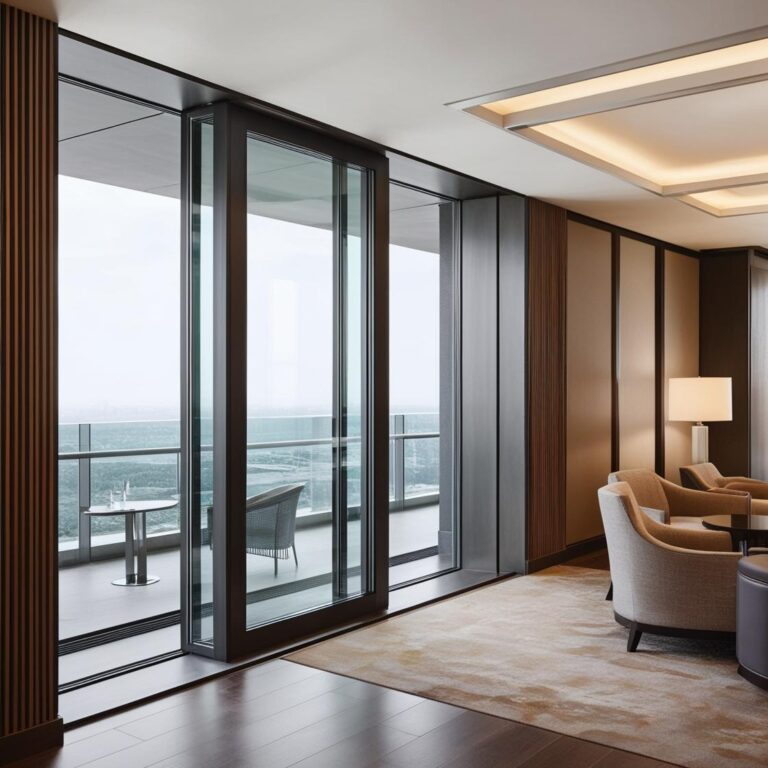
Sliding systems win on repetition and simplicity. For a 200-unit apartment balcony line or hotel guest rooms opening to terraces, sliding doors deliver the lowest cost per opening, the fewest moving parts and the easiest installation for local crews. Panels run on two or three tracks, hardware is confined to rollers, locks and handles, and replacement parts are commodity items. Our sliding door sourcing from China page covers the frame series, glass options and track configurations we typically specify for hotel and apartment projects.
Folding Doors: Paying for the Full Opening
Folding (bi-fold) systems buy you something sliding doors cannot: a fully clear opening. A six-panel folding wall turns a restaurant into an open-air venue; a sliding system always leaves at least one panel width closed. That capability is noticeably more expensive per square meter than an equivalent sliding system, largely because of hardware — top rollers, intermediate hinges, drop bolts and the head track that carries the full stacked weight. Where the opening is the product — restaurants, bars, function rooms, retail frontage — the premium is justified. We break down configurations on our folding door sourcing from China page.
The Five Selection Questions That Settle It
1. Does the Space Earn Revenue from the Opening?
A terrace restaurant that seats 30 more covers when fully open justifies folding hardware. A guest room balcony does not — nobody pays more for a room because the balcony door folds.
2. How Many Openings, and How Identical Are They?
Volume favors sliding. Fifty identical sliding openings drive tooling and production efficiencies. Folding systems rarely repeat at that scale, so their unit economics improve less with quantity.
3. Who Maintains It?
Folding hardware needs periodic adjustment — hinge tension, drop bolt alignment, track cleaning. A hotel with an engineering team handles that; a strata apartment building often does not. We steer residential developers toward sliding systems for exactly this reason.
4. What Is the Wind and Water Exposure?
Coastal and high-rise projects push both systems into heavier frame series and tested weather ratings — the same performance logic that governs Chinese doors and windows generally. Sliding systems usually achieve higher water-penetration ratings at lower cost because interlocks and sill drainage are simpler. For cyclone- and hurricane-rated openings, confirm the tested assembly certificate before quoting either system. We cover this in more detail in our case study on hotel construction materials Florida sourcing, where window and door systems were specified against Florida Building Code hurricane-zone provisions.
5. What Does the Floor Detail Allow?
Flush thresholds — the detail every designer wants — are harder to weatherproof on folding systems. If the spec demands a level transition with real weather exposure, price the sill detail before committing, not after.
Sourcing this for a commercial project?
FBM Sourcing works with project owners, developers, main contractors and FF&E contractors on hotel, apartment, school, office and other commercial building projects. Send us your BOQ, drawings or product list — our team will review it and get back to you.
Cost Benchmarks from Recent Quotations
Folding and sliding systems price differently, and freight favors sliding slightly — flat panels crate more densely. On a larger scope the system decision alone can move the package significantly, which is why we price both options on borderline spaces before the client commits.
Sourcing Either System Well
Whichever direction the fit-out goes, the sourcing discipline is the same: lock the frame series and hardware brand in the submittal, approve a corner sample showing joinery and finish, and inspect rollers, hinges and weather seals before packing — hardware substitution is the single most common defect we catch in this category. Both systems sit within our broader door sourcing from China scope and frequently ship in the same containers as the project’s other joinery. For scheduling either system inside a full project program, see our guide to the hotel project procurement timeline.
Hardware: Where Both Systems Live or Die
On aluminum sliding and folding systems, hardware is not an accessory — it is the product. Rollers, top carriers, intermediate hinges and drop bolts determine whether a folding wall still operates smoothly in year five, and whether a sliding panel still glides after two hundred thousand cycles of hotel use. This is also where quotations diverge invisibly: two quotes for the same frame series can differ significantly purely on hardware brand, and the cheaper one will not disclose it. We specify hardware brands or defined load and cycle-test ratings in the submittal, and our pre-shipment inspections test-cycle assembled panels rather than checking boxes of parts — hardware substitution is the single most frequent defect finding across this entire category. For folding systems specifically, insist on the head track and carrier assembly from the same system supplier as the hinges; mixed hardware sets are the root cause of most post-installation adjustment problems.
Installation and Site Coordination
Neither system forgives poor openings. Folding systems need a dead-level head beam — the track carries the full stacked panel weight, and a few millimeters of deflection shows up as panels that bind at one end of their travel. Sliding systems tolerate more structural variance but depend on sill drainage being installed exactly as detailed. The practical protocol: final measured openings before production release, an installation drawing set in English with the shipment, and hardware adjustment tools plus spare rollers packed with the order. For overseas projects we also recommend the factory produce a short installation video against your actual system configuration — a short job in China that saves trial and error for site crews who have never assembled that series before.
Lead Times and Container Planning
For both systems the production lead time is confirmed by the factory in writing for each order from approved shop drawings, with glass — not aluminum — usually setting the pace: insulated, laminated or performance-coated units take longer than standard tempered glass. Packing differs more than production: sliding panels crate flat and dense, while folding systems ship with more crate volume per opening because of pre-hung hardware and protective packing around projecting fittings. As planning numbers, a 40HQ container carries roughly 55–75 square meters of crated folding system or 80–110 square meters of sliding system, mixed loads landing in between. On multi-system projects we consolidate window-door systems with the wider joinery package so partial-container space is never shipped empty — one more reason the system decision should be made before, not after, the container plan is drawn.
Get a China Procurement Quote for Your Door Package
FBM Sourcing manages door and window procurement from factory shortlist to container loading for hotels, apartments, schools and commercial buildings in the USA, Australia, Europe and the Caribbean. Send us your door schedule, drawings, quantities, destination port and project timeline, and our team will review your requirements and get back to you. Submit your project requirements here.
Related reading