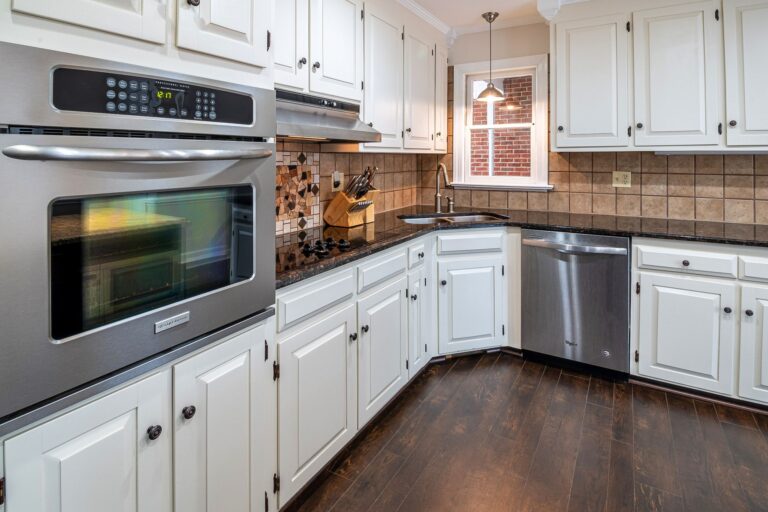
Chinese kitchen cabinets are the default procurement route for apartment towers, hotel projects and multifamily developments because the production ecosystem delivers three things local supply rarely matches at volume: millimetre-level customisation, 30–45 day production runs, and ex-factory pricing far below equivalent local supply for the same specification tier. What the route does not forgive is a loose brief — cabinet orders succeed or fail on the specification tier, the drawings, the formaldehyde certification and the QC plan, all fixed before production starts. This guide covers each of those decisions for developers and project managers buying at 20+ unit volume; for the product configurations and how to brief us directly, see our kitchen cabinet sourcing page. On projects like this, FBM Sourcing works as your dedicated sourcing partner.
Most export cabinet production concentrates in Guangdong, where cabinet factories, hardware distributors, finishing plants and stone countertop fabricators operate within a short radius of each other — which is why one coordinated order can cover carcases, doors, benchtops and hardware without extended lead times. For a market-level view, our China kitchen cabinet industry 2026 sourcing guide maps the industry; for named production sources serving US multifamily work, see the top kitchen cabinet manufacturers in China for US multifamily.
Which Specification Tier Fits Your Project?
Cabinet quotations only become comparable once the tier is fixed, because visually identical kitchens can be built to three different standards. The tiers are defined by materials and hardware, and the cost difference between them tracks four lines: carcase board grade, door face system, hardware brand and countertop material.
Entry tier (export-grade basic): 16mm E1 particleboard carcase, PVC-wrapped MDF doors, standard soft-close hinges, melamine interior. Appropriate for rental apartments and budget residential where the longevity requirement is 5–10 years.
Mid tier (commercial grade): 18mm E1 moisture-resistant particleboard or MDF carcase, lacquer or acrylic door faces, Blum or Hettich hardware, ABS edge banding, quartz countertop option. The most common tier for hotel kitchenettes, serviced apartments and mid-range multifamily — and the safe default when in doubt.
Upper tier (premium commercial): 18mm E0 board or solid wood carcase, veneer or solid wood doors, full Blum hardware package, integrated lighting channels, stone countertop. Specified for luxury suites, branded residences and high-end residential.
The most common sourcing mistake in the category is a tier mismatch — under-specifying a premium project (which surfaces as warranty claims and early hardware failure) or over-specifying budget housing (which burns margin the pro forma never recovers). Match the tier to the asset’s hold period and tenant profile, then hold every quotation to that tier line by line.
What Must Be Locked Down Before Production Starts?
Four items decide the outcome of a cabinet order, and all four belong in writing before any deposit:
Dimensioned drawings. Factories quote and build from what you send. Hand sketches and room lists produce assumed standard sizes that do not match the site; supply CAD files or dimensioned elevations for every kitchen type, and confirm site-measured dimensions before production release wherever the programme allows.
A physical finish sample. Lacquer colour and sheen level cannot be judged from a photograph. Approve a physical sample door or finish panel — checked under both natural and artificial light — and keep it as the reference standard for inspection. Reject any sample with lifting edge banding, visible orange peel or play in the hinge cups.
Formaldehyde certification. For Australia, Europe, the UAE and especially the US, confirm current E1/E0 board certification — and for US-bound projects, TSCA Title VI / CARB compliance — as a test certificate on file, not a verbal assurance. The standards and which markets require them are explained in our guide to formaldehyde standards for cabinets from China (E1, E0, CARB, TSCA Title VI).
Hardware by brand and model. “Soft-close hinges” is not a specification; “Blum Clip Top” is. Generic substitution is the easiest place for a low quote to hide, and hinges and runners are the components guests and tenants touch 20 times a day — contract-grade drawer runners are rated for 40,000+ cycles.
One structural note: factories quoting unusually fast lead times at volume often subcontract part of the production, which introduces finish and dimension inconsistency between batches. Confirm where your order will physically be produced and keep a single project’s cabinets in one factory — finish consistency across factories is nearly impossible to hold.
Sourcing this for a commercial project?
FBM Sourcing works with project owners, developers, main contractors and FF&E contractors on hotel, apartment, school, office and other commercial building projects. Send us your BOQ, drawings or product list — our team will review it and get back to you.
How Does QC Work on a Kitchen Cabinet Order?
For orders above roughly 20 kitchen sets, quality control before shipment is not optional — a systematic defect in one door profile repeats across every unit in the tower. On FBM Sourcing projects, inspection is carried out by our own QC team inside the factory and delivered to the client as photo and video records. What is checked:
- Material verification: board grade, edge banding and finish materials checked against the approved sample, since a systematic substitution repeats across every unit
- Dimension check: random carcase units measured against drawings to a tolerance of ±2mm on width, height and depth
- Finish inspection: doors and panels under raking light for orange peel, pinholes, dust inclusions and batch-to-batch colour drift against the approved sample panel
- Hardware function: hinges, drawer runners and lift mechanisms cycled for smooth operation and correct soft-close damping
- Joint and panel integrity: dowel joints, cam locks and glued panels checked for security and alignment
- Packing inspection: foam protection, corner guards and carton grade confirmed against the destination’s handling chain
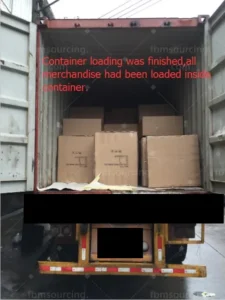
Defects found at inspection are rectified before container loading — shipping defective cabinets and pursuing credit notes afterwards is not a workable model, so a correction window sits in the schedule between final inspection and the vessel booking.
What Are Realistic Lead Times and Container Numbers?
A standard commercial kitchen cabinet order runs on this programme:
- Quotation and factory matching: once complete drawings are received
- Sample production and approval: 15–25 days
- Production: 30–45 days from deposit for standard configurations; 45–60 days for custom door profiles
- Inspection and container loading: 3–5 days
- Ocean freight: 18–25 days to Australia, 20–28 days to the Middle East, 28–35 days to Europe, plus clearance and delivery
End to end, plan 12–18 weeks from brief to site for standard specification and 18–24 weeks for premium tiers with custom profiles and stone countertops. On freight, a 40HQ container typically carries 25–40 complete flat-packed kitchen sets depending on unit sizes and packing density, and per-unit freight drops further when kitchens share containers with bathroom vanities and wardrobes from the same programme — standard practice on apartment and hotel projects. For the matching wardrobe scope, see our wardrobe cabinet sourcing page.
Which Mistakes Cost Kitchen Cabinet Buyers the Most?
Across project orders, the same four failures account for most of the money lost in this category:
- Quoting from inadequate drawings — the factory assumes standard sizes, the site is not standard, and the discovery happens at installation
- Approving finish from a screen — sheen and colour shift between photo and product; only a physical panel protects you
- Approving from a drawing instead of a sample — without a signed-off physical sample as the reference, there is nothing objective to inspect the run against
- Splitting one project across factories — finish consistency between factories does not hold; keep the project in one factory even at a modest lead-time cost
Every one of these is a process failure, which is the argument for running the category through a coordinated procurement programme rather than a purchasing transaction.
Get a Kitchen Cabinet Quote for Your Project
Send kitchen layouts or CAD drawings, unit counts by kitchen type, finish references, destination port and target delivery window. As a China building materials and FF&E procurement agent working on a 5% commission for suppliers you nominate (products we source for you are quoted at a direct price), FBM Sourcing manages factory matching, sampling, QC before shipment with photo and video records, and consolidated container loading — and comes back with tier recommendations and comparable quotations once the brief is complete.