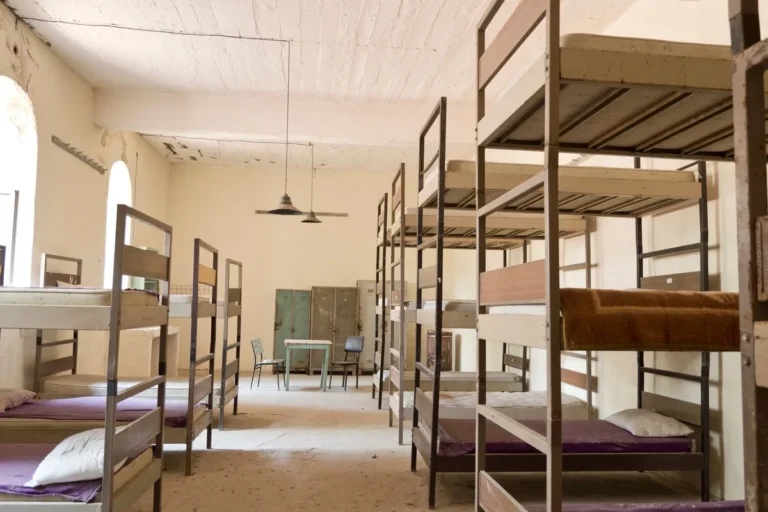
Worker accommodation furniture has to survive what hotel and hostel furniture rarely meets: rooms used by rotating shifts, hundreds of residents sharing washrooms and a dining hall, and years of operation far from replacement stock. What holds up is steel beds with locking fasteners, moisture-proof mattresses with fire evidence for the destination market, lockable steel or compact laminate storage, heavy-frame canteen seating, vandal-resistant washroom fittings, washable slip-rated floors and doors on durable hardware. The specification comes partly from the destination’s official accommodation rules and partly from how the operator will maintain the site.
This guide is for general contractors building staff housing for large Gulf projects, camp and staff accommodation operators and the commercial project owners behind them, developers, and FF&E solution providers. It covers what goes inside sleeping rooms, washrooms and canteens, not modular building systems, and it treats worker housing as its own category rather than as a budget hotel or school dormitory.
Why Is Worker Accommodation Harder on Furniture Than a Hotel or Hostel?
- Occupancy rarely stops. Shift rosters keep rooms, washrooms and dining halls in use day and night, so there is no quiet season for maintenance and every weak joint is loaded every day.
- Residents neither choose nor own the furniture. Bunks are climbed without ladders, lockers are forced when keys are lost, and chairs are dragged and stacked.
- Operation runs for years, often remotely. A replacement part may be a sea shipment away, so anything that cannot be repaired on site with ordinary tools becomes a permanent defect.
The procurement consequence: specify for the weakest point of each item (joints, locks, hinges, edges) and for repair on site, not for appearance in a sample room.
What Do Official Worker Accommodation Rules Say About Beds, Storage and Washrooms?
Requirements are set country by country. We summarise only requirements we have read in official documents; for a live project, the current edition and any permit conditions should come from the project’s consultant or the approving authority. For UAE projects in particular, obtain the current labour accommodation requirements that way, as we could not read the current official text while preparing this guide.
Qatar: Worker Accommodation Planning Regulations
The Worker Accommodation Planning Regulations published by Qatar’s Ministry of Municipality and Environment, dated 3 March 2016, apply to temporary and permanent worker accommodation in two categories: small-scale single residential facilities for 50 to 500 residents and large-scale facilities for 501 to 5,000 residents. Construction standards and materials are regulated separately through the building permit process. The living-amenity tables include these requirements:
| Item | Requirement stated in the Regulations |
|---|---|
| Sleeping area | 6.0 square metres per bed space; 1.5 m between adjacent beds, separated by a privacy screen or curtain |
| Bed tiers | Not to exceed two tiers |
| Bed standard | Solid, durable and fire resistant construction; minimum 1.0 m x 2.0 m; minimum 300 mm from the bottom of the mattress to the floor |
| Mattress | Durable and impervious to moisture |
| Personal storage | One lockable unit per person, minimum 2.0 m high x 800 mm wide x 600 mm deep, plus 1 linear metre of open shelf space per person |
| Room fittings | One task light for each person; blackout curtains or blinds; fixed lighting ceiling mounted, suspended lighting prohibited |
| Communal washrooms | Bathing separated from toilets; minimum one toilet per 6 persons, one urinal per 10, one basin unit per 3 with aerated hot and cold taps and a liquid soap dispenser, one shower per 6 |
| Canteen | Floors, walls and ceilings washable, using non-absorbent, fire proof, light coloured and non-toxic materials; hand washing with non-hand operated taps |
| Laundry | A fully catered laundry service, through a centralised laundry on site or a commercial laundry provider |
Saudi Arabia: Collective Housing for Individuals
Saudi Arabia’s municipal and housing ministry has issued, by ministerial decision dated 1445 AH (2024), a guide to the health, technical and safety conditions required in collective housing for individuals. It classifies collective housing as a residential building, a residential complex or mobile cabins, with separate chapters on technical requirements, fire prevention and protection, and operational requirements. The detailed tables in the published file are not machine-readable text, so we do not restate figures from it.
Australia: Remote Workers’ Quarters Under the NCC
NCC Volume One defines a Class 3 building as a residential building providing long-term or transient accommodation for a number of unrelated persons, and its explanatory information lists workers’ quarters, including shearers’ or fruit pickers’ accommodation, or hotel workers’ accommodation, among Class 3 buildings. A boarding house, guest house, hostel or the like that would ordinarily accommodate not more than 12 people, with a total area of all floors not more than 300 square metres, is Class 1b. The building certifier settles the classification for a particular camp, and it determines which NCC provisions apply, so confirm it before finishes are selected.
Steel Bunks and Single Beds: Structure, Anti-Loosening and Guardrails
The bed is the most heavily loaded item in the building. Steel frames are the default for hard use because they can be repaired in place and do not swell or trap moisture; the wider trade-offs are in our comparison of steel and wood frame furniture for institutional projects. The points that decide whether a steel bed lasts:
- Joint design. Welded end frames with side rails bolted into welded brackets hold their geometry; screws driven into thin tube and push-fit connectors loosen first. Put the joint type on the drawing.
- Anti-loosening fasteners. Specify nylon-insert lock nuts or thread-locking compound at every structural joint, plus a spare fixing kit per bed. Daily climbing and turning over gradually works plain nuts loose.
- Guardrails and ladders. Bolt them to the frame, ideally onto welded mounting plates, rather than clipping them on. Heights and gaps should follow the bunk bed standard the specification names; EN 747-1:2024, for example, specifies requirements for the safety, strength and durability of bunk beds and high beds for domestic and non-domestic use.
- Bed base. A steel mesh or perforated deck has fewer crevices to clean than timber slats and does not warp in humid rooms. Draw size and height to the destination rule, which in Qatar means at least 1.0 m by 2.0 m and 300 mm from mattress bottom to floor.
- Tube ends and coating. Capped tube ends keep dust and pests out; a powder coat specified by colour code and film thickness keeps thousands of beds from different batches consistent.
Furnishing staff housing or a worker camp from China?
FBM Sourcing works with general contractors, accommodation operators and developers on worker housing projects. Send the room schedule, drawings or BOQ and our team will review the package with you.
Mattresses and Upholstered Items: Which Fire Evidence Applies?
Fire performance requirements for mattresses and upholstery differ by country and sometimes by building type, so the order starts by confirming which test the destination authority and the project’s fire consultant require. For the Gulf, see our guide to fire safety approvals for Gulf projects.
- Name the test, not a description. Almost any foam can be called fire retardant; only a report against a named test method carries weight.
- Match the report to what is supplied. It should come from an accredited laboratory and cover the same cover fabric, filling and foam as the production mattress.
- Specify the cover for hygiene. A wipeable moisture-proof cover, or a washable cover over a waterproof protector, usually matters more to mattress life in shared rooms than extra foam thickness.
- Treat canteen and recreation upholstery the same way. Moulded or vinyl-covered canteen seating avoids much of the question.
Lockers and Wardrobes: Which Construction Survives Daily Use?
Personal storage is a security item as much as furniture: a locker that can be forced, or whose keys cannot be managed, generates complaints faster than anything else. Where Qatar’s full-height requirement applies, the locker is in effect a narrow steel wardrobe.
| Construction | Where it fits | Watch points |
|---|---|---|
| Powder-coated cold-rolled steel, knocked down | Dry sleeping rooms, large quantities | Panel thickness and door stiffening on the drawing; flat packing adds site assembly |
| Welded steel, supplied assembled | Sites short of assembly labour | Much larger shipping volume; check door access into rooms |
| Compact laminate (solid HPL) | Washrooms, changing areas, humid coastal sites | Stainless steel hinges and fixings |
| Melamine-faced board | Supervisor rooms with lighter use | Edge banding and hinge screws fail first |
Lock choice follows the operator’s key management: a padlock hasp is simplest across hundreds of residents, cam locks need a master key plan and spare cylinders, electronic locks need a battery and code plan. Specify ventilation louvres, legs so floors can be washed underneath, and anti-tip fixing, and number each locker to match its bed.
Canteen Tables and Seating for Shift Dining
The dining hall takes the heaviest furniture use on site. Qatar’s regulations size the dining and servery area on the basis of seating no more than half of residents at any one sitting, a useful reference for seat counts, though the operator’s meal rota sets the final number.
- Fixed bench-table sets on a steel frame cannot be dragged away, and floors are cleaned around a clear base. They suit high-turnover canteens.
- Loose tables with stacking chairs suit multi-use halls, but need replacement glides and spare chairs.
- Tops in compact laminate, high-pressure laminate on moisture-resistant board, or stainless steel, with sealed or radiused edges.
- Seats in moulded polypropylene or vinyl rather than fabric.
Washroom and Laundry Fittings That Stand Up to Hundreds of Users
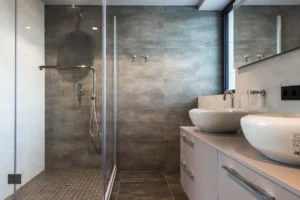
Because washroom quantities follow headcount, a large camp orders toilets, basins and showers in the hundreds, and small differences in robustness multiply.
- Toilets: vitreous china with dual-flush cisterns. Wall-hung pans are easier to clean around, floor-mounted pans simpler to replace; see wall-hung vs floor-mounted toilets for commercial bathrooms.
- Basins: stainless steel troughs or vitreous china basins on concealed brackets, with no vanity cabinets in communal areas.
- Taps and showers: metal-bodied self-closing or sensor taps with aerators, and fixed vandal-resistant shower heads, with flow rates confirmed against local water efficiency rules.
- Cubicles and accessories: compact laminate partitions on raised feet, stainless steel hardware, and accessories fixed with tamper-resistant screws.
- Laundry: if the operator runs a central laundry in-house, commercial washer-extractors and dryers join the package, with electrical certification for the destination.
Floors: Wear, Slip Resistance and Easy Cleaning
Floors are wet-cleaned daily and walked in work boots carrying sand and grit, so choose by zone.
| Zone | Typical finish | What to specify |
|---|---|---|
| Sleeping rooms, corridors | Homogeneous vinyl sheet with welded seams, or porcelain tile | Wear layer, coved skirting, a colour that hides grit |
| Washrooms, showers | Porcelain tile or slip-resistant vinyl | The slip test method used in the destination market |
| Canteen, servery | Porcelain tile or seamless resin | Non-absorbent, washable; in Qatar also fire proof, light coloured and non-toxic |
| Kitchen, laundry, plant rooms | Epoxy or other seamless resin | Chemical resistance and drainage falls |
The trade-offs are covered in which flooring to specify for back-of-house and service areas. Order attic stock from the same production batch; tiles replaced later from another batch show a shade difference down the whole corridor.
Doors and Door Hardware: Specifying for Durability, Not Appearance
- Door leaves: steel, or high-pressure laminate on a solid core, in steel frames; fire-rated door sets wherever the fire strategy requires them, with certification the destination authority accepts.
- Hinges and closers: heavy-duty ball-bearing hinges, stainless steel in washrooms and coastal sites; closers sized to door weight and to the durability class in the hardware standard the specification names.
- Locks: a master key system following the operator’s structure (building, floor, room), with spare cylinders ordered with the doors.
- Protection: kick plates, wall or floor stops, and through-fixed lever handles.
Hardware is quoted accurately only once a schedule exists; see what a door hardware schedule should contain before a China quote.
How Should the Package Be Packed, Numbered and Shipped Across Several Buildings?
- Group by room type. Define room types (a four-bed room, a supervisor room, a washroom block, the canteen) with a kit list each, and pack cartons by room-type kit.
- Number to the building. Labels carry building, floor, room type and room number in the languages the site team reads; see FF&E labelling for room-by-room delivery.
- Ship fixings and spares with the furniture. Fixing kits, spare lock nuts, locker locks, hinges and glides travel in the same shipment, marked separately.
- Load in handover sequence. Load building by building to match the contractor’s handover programme.
- Check before loading. Inspection by our own team at the factory before shipment, with photo and video records, against the approved samples and kit lists.
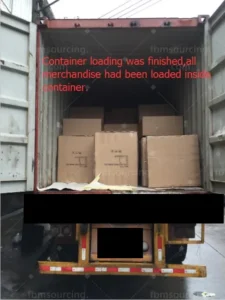
Sometimes, on a large project, the bunk beds and lockers alone fill full containers; sometimes the bunk beds and lockers share containers with the other product categories of the same project; and sometimes, in one batch, we combine a dozen or more product categories from several projects of the same client into a few containers — always full containers, and for us this is routine, well-practised work. As the contractor’s sourcing partner in China, we plan those loads around the handover programme rather than each factory’s finish date.
Furnishing staff housing or a worker camp from China?
FBM Sourcing works with general contractors, accommodation operators and developers on worker housing projects. Send the room schedule, drawings or BOQ and our team will review the package with you.
Frequently Asked Questions
Are three-tier bunk beds allowed in worker accommodation?
It depends on the destination. Qatar’s Worker Accommodation Planning Regulations state that beds are not to exceed two tiers and set a minimum bed size of 1.0 m by 2.0 m and 6.0 square metres per bed space. Elsewhere, confirm the rule with the project’s consultant before choosing a bed model.
Should beds in staff housing be steel or timber?
Steel is the usual choice for shared sleeping rooms because it can be repaired in place and does not swell in humid rooms; timber is more common in lighter-use supervisor rooms. Either way, joints and fasteners decide service life more than the material.
What personal storage do worker accommodation rules require?
It varies by country. Qatar’s regulations require one lockable unit per person, at least 2.0 m high, 800 mm wide and 600 mm deep, plus 1 linear metre of open shelf space per person, which means counting a full-height locker with every bed from the start.
How are remote workers’ quarters classified in Australia?
NCC Volume One’s explanatory information lists workers’ quarters, including shearers’ or fruit pickers’ accommodation, among Class 3 buildings, while small boarding houses, hostels or the like for not more than 12 people and not more than 300 square metres are Class 1b. The building certifier decides for each camp.
Should washroom lockers and cubicles be steel or compact laminate?
In wet and humid areas, compact laminate with stainless steel fixings is generally safer because it does not rust and can be washed down; powder-coated steel remains a good choice in dry sleeping rooms. Keep one lock system and numbering scheme across both.
About FBM Sourcing
FBM Sourcing manages the entire China procurement package for overseas construction projects. Since 2014 we have worked with developers, general contractors, builders, commercial project owners, interior design and construction companies and FF&E solution providers across more than 20 countries and over 1,000 containers, as their sourcing partner in China — from the schedule or BOQ through factory selection, sampling, inspection by our own team before shipment, consolidation and shipping. All quotations, invoices and shipping documents are issued by FBM Sourcing, and sea freight is quoted to you before shipment. If you have a worker accommodation furniture package to price, start at China building materials and FF&E procurement.