For back-of-house and service areas the honest answer is that epoxy is the wrong specification for a commercial kitchen, rubber is the wrong specification anywhere fats and oils are present, and vinyl is the wrong specification wherever there is a floor gully and a hot washdown regime. Each of the three is right somewhere, and the decision is made room by room rather than for the whole back-of-house at once. There is also a procurement difference that outranks all of the technical ones: vinyl and rubber are manufactured goods that ship in a container, while resin floors are an installed system in which the warranty belongs to the applicator and not to the manufacturer of the resin.
Which rooms are we actually specifying?
“Back-of-house” on a hotel, hospital or school covers at least five environments with incompatible requirements:
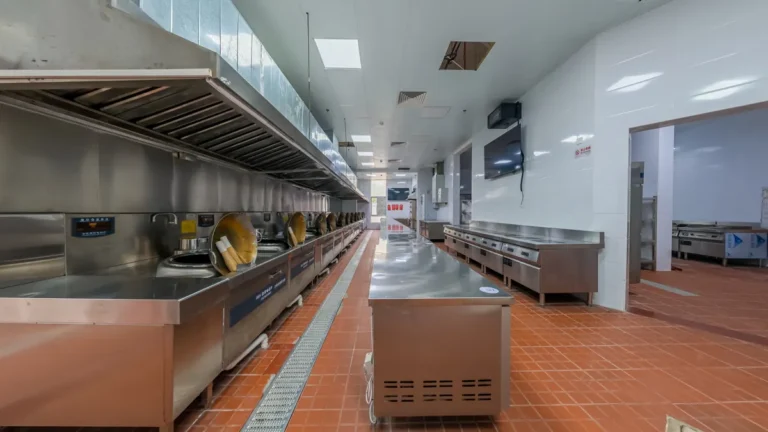
- Production kitchens, sculleries and wash-up. Hot water and steam, animal fats, food acids, heavy trolley traffic, floor gullies, and a cleaning regime that involves flooding the floor and scrubbing it.
- Cold rooms and freezers. Permanent low temperature, condensation at the threshold, and thermal movement at the door line.
- Laundries and housekeeping. Water, detergent, chemical spillage, very heavy wheeled loads, and long straight runs.
- Plant rooms, workshops and switchrooms. Dry, occasional oil and solvent, point loads from equipment, and a need for a floor that can be marked out and cleaned.
- Staff corridors, changing rooms and offices. Foot traffic, acoustics, comfort underfoot, and a finish that people have to spend a shift standing on.
Specifying one product across all five is the most common and most expensive error in a back-of-house package, and it usually surfaces within eighteen months as a failed kitchen floor.
The three families, and what each is actually for
Vinyl: sheet, homogeneous and safety grades
Commercial vinyl for wet or heavily trafficked areas is sheet, not tile, hot-welded at the seams and coved up the wall to form a continuous impervious surface. Homogeneous vinyl carries its wear characteristics through the full thickness, so it survives aggressive machine cleaning better than a printed heterogeneous product with a thin wear layer. Safety vinyl embeds abrasive particles — quartz, aluminium oxide, carborundum — to hold slip resistance when the floor is wet and contaminated.
Right for: laundries, housekeeping stores, staff areas, sculleries with moderate duty, hospital utility rooms. Wrong for: production kitchens with hot washdown and standing fat — the welds and the adhesive bond are the failure point. Luxury vinyl tile has no place in a wet back-of-house at all; the joints are not welded and water tracks under the tiles.
Rubber: sheet and tile
Rubber is the most resilient of the three underfoot, has excellent impact and indentation recovery, does not need a surface polish, and performs unusually well on stairs and in gyms and plant rooms. It handles cigarette burns and point loads better than vinyl.
Right for: plant rooms, workshops, stairs, staff corridors, gyms, back-of-house circulation. Wrong for: anywhere animal or vegetable fats are present. Rubber is attacked by oils and fats, and a kitchen will destroy it. It is also generally the most expensive of the three per square metre.
Resin: and the distinction that matters most
“Epoxy” and “resin floor” are not synonyms, and treating them as such is how kitchens get the wrong floor. Epoxy is rigid and has limited tolerance for thermal shock. Flood a cured epoxy floor with water at 80 °C, as a scullery does several times a day, and the differential movement between the coating and the slab breaks the bond — the floor delaminates in sheets, usually starting at the gully.
The correct specification for a commercial kitchen is polyurethane cement, also called urethane mortar or PU screed: a thick, heavy-duty, thermally tolerant resin screed designed for exactly the hot-washdown, fat-laden, thermal-cycling environment that destroys epoxy. It is laid at 6 to 9 mm, coved at the walls, and falls are formed to the gullies.
Epoxy is right for: plant rooms, workshops, dry stores, car park decks, laboratories, areas needing chemical resistance without thermal shock. Polyurethane cement is right for: production kitchens, sculleries, cold rooms, breweries, food preparation.
Sourcing this for a commercial project?
FBM Sourcing works with project owners, developers, main contractors and FF&E contractors on hotel, apartment, school, office and other commercial building projects. Send us your BOQ, drawings or product list — our team will review it and get back to you.
What decides the answer, room by room
| Room | Specify | Why | What would change the answer |
|---|---|---|---|
| Production kitchen, scullery, wash-up | Polyurethane cement screed with coved skirting and falls to gully | Only family that tolerates hot washdown, fats and thermal cycling | A fit-out with no wet cleaning regime at all, which is rare |
| Cold room and freezer | Polyurethane cement rated for the service temperature | Thermal movement and condensation at the threshold | A proprietary insulated panel floor supplied with the cold room |
| Laundry and housekeeping | Welded safety sheet vinyl, coved | Water and detergent without thermal shock; economical and repairable | Very heavy wheeled cage traffic, which may justify resin |
| Plant room, workshop, switchroom | Epoxy coating or screed, or rubber | Dry, chemical and point-load resistance, easy to mark out | Regular hot washdown, which moves it to polyurethane cement |
| Staff corridor, changing, office | Rubber or homogeneous vinyl | Comfort underfoot, acoustics, appearance retention | A budget that will not carry rubber, which sends it to vinyl |
| Stairs and landings back-of-house | Rubber with integral nosing | Slip resistance and impact recovery on the highest-risk surface | A fire strategy requiring a specific reaction-to-fire class |
Slip resistance: get the right test for the right jurisdiction
Back-of-house is where slip claims happen, and the three commonly quoted measures are not interchangeable:
- DIN 51130 R-ratings (R9 to R13) come from a ramp test with a person walking on an oiled surface, wearing boots. Kitchens are normally specified R11 or R12. This is the European convention and the one most Chinese factories will quote.
- DCOF under ANSI A326.3 measures dynamic coefficient of friction with a wet sensor. The commonly cited threshold for level interior floors expected to be walked on wet is 0.42. This is the US convention.
- AS 4586 P-ratings (P0 to P5) are the Australian and New Zealand pendulum classification, and the values do not map onto R-ratings arithmetically. Where the project sits in Australia, the P-rating is the one the certifier will ask for, as set out in AS 4586 slip ratings and how they differ from R-ratings.
Ask for the test that the destination jurisdiction actually recognises, and ask for it on the specific product and finish being quoted — not on a sibling product in the same range.
The procurement difference that outranks the technical one
This is the point that changes how a back-of-house floor is bought from China.
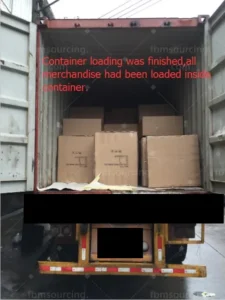
Vinyl and rubber are goods. They are manufactured, rolled, packed and shipped. You can inspect them before loading, they arrive as a countable quantity against a schedule, and the manufacturer’s warranty attaches to the material. Sourcing them from China is a normal product transaction, and they consolidate well with the rest of a project package.
Resin floors are not goods, they are a system installed on site. You can import the resin, the aggregate and the primer, but the performance depends almost entirely on the substrate preparation, the moisture content of the slab, the ambient conditions on the day and the skill of the applicator. Almost every resin manufacturer’s warranty is conditional on installation by an approved applicator following their method statement. Buying resin as a commodity and handing it to a general contractor to lay is the most reliable way to end up with no warranty from anyone.
The practical conclusion for a project team: buy vinyl and rubber as part of the China package; buy resin floors as an installed subcontract in the destination country, and use the China package for everything the resin contractor does not supply — gullies, channels, kerbs, stainless trims and the kitchen equipment itself. Where the whole package is being split into factory-level enquiries, this is exactly the kind of boundary that has to be drawn before RFQs go out, as described in how a sourcing agent splits a BOQ into factory-level RFQs.
What to obtain before ordering
- Reaction to fire classification to the destination standard — EN 13501-1 for Europe with the flooring subscript, ASTM E648 critical radiant flux in the United States, or the applicable national requirement. Escape routes normally carry a higher requirement than the rooms they serve.
- Slip resistance evidence on the exact product and finish, tested to the standard the destination recognises.
- Chemical and thermal resistance data matched to the actual cleaning regime, including the temperature of the washdown water and the cleaning chemicals in use.
- EN 14041 CE marking and Declaration of Performance for resilient, textile and laminate floor coverings destined for the European Union.
- Emissions and environmental documentation where the project is pursuing a rating — VOC emissions test data, EPDs and HPDs, as covered in what LEED and WELL documentation Chinese factories can provide.
- Batch and shade control. Sheet vinyl and rubber must be supplied from a single production batch per area, with roll numbers recorded, and enough attic stock retained for repairs.
- Adhesive compatibility confirmed in writing, including the moisture tolerance of the adhesive against the slab condition expected on site.
Where the wider flooring package spans front-of-house as well, the manufacturer landscape is set out in top flooring manufacturers in China for commercial projects, and the market and export picture in the China flooring market and export data.
About FBM Sourcing
FBM Sourcing manages the entire China procurement package for overseas construction projects. Sourcing since 2014, we have shipped 1,000+ containers to project sites in 20+ countries, working with project owners, developers, main contractors and FF&E contractors on hotels, apartment buildings, schools, offices and other commercial buildings. All quotations, invoices and shipping documents are issued by FBM Sourcing — you deal with us, and we carry the responsibility. For suppliers you nominate, we charge a 5% commission; for products we source for you, we quote a direct price.
If you have a back-of-house flooring package to price, send us the room schedule with the cleaning regime and the destination country at https://fbmsourcing.com/china-building-materials-ffe-procurement/.
Sourcing this for a commercial project?
FBM Sourcing works with project owners, developers, main contractors and FF&E contractors on hotel, apartment, school, office and other commercial building projects. Send us your BOQ, drawings or product list — our team will review it and get back to you.
Frequently asked questions
Can you use epoxy in a commercial kitchen?
It is not the right specification. Epoxy is rigid and has limited thermal shock tolerance, so repeated hot washdown causes differential movement between the coating and the slab and the floor delaminates, usually starting at the gully. The correct resin specification for a production kitchen is polyurethane cement, also called urethane mortar or PU screed, laid at 6 to 9 mm with coved skirtings and falls to the gullies.
Is rubber flooring suitable for a kitchen?
No. Rubber is attacked by animal and vegetable fats and oils, which are unavoidable in a production kitchen. Rubber performs very well in plant rooms, workshops, stairs, gyms and staff circulation, where its impact recovery and slip performance are its strengths.
What slip rating should a back-of-house kitchen floor have?
It depends on which standard the destination recognises. Under DIN 51130 kitchens are commonly specified R11 or R12. In the United States the ANSI A326.3 dynamic coefficient of friction is used, with 0.42 the commonly cited threshold for interior floors expected to be walked on wet. In Australia and New Zealand the AS 4586 pendulum P-rating applies, and it does not convert arithmetically from an R-rating.
Should resin flooring be bought from China?
Generally no, and not because of the material. A resin floor is an installed system whose performance depends on substrate preparation, slab moisture, site conditions and applicator skill, and manufacturer warranties are normally conditional on installation by an approved applicator. Buy resin floors as an installed subcontract in the destination country, and buy vinyl, rubber, gullies, channels, kerbs and trims as part of the China package.
What is the minimum order for flooring from China?
We do not handle loose freight. The practical minimum is a full container load consolidated for one client. Sheet vinyl and rubber are dense and consolidate well with bulkier categories such as furniture in the same container.