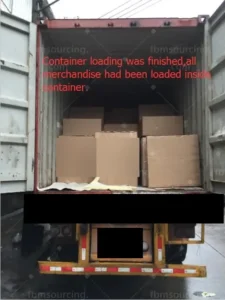

Before a TV cabinet is loaded into the container, check five things: surface finish and color match against the approved sample, squareness (the unit should sit flat with no rocking and doors/drawers close evenly), hardware function (soft-close hinges and drawer runners operate smoothly across every unit, not just a sample handful), the cable management cutout position against your electrical drawings, and packaging integrity (corner protection, moisture barrier, and no direct box-on-box pressure on finished surfaces). Skipping this check at the factory means any defect is only discovered after the unit has already crossed an ocean, when a fix costs far more in time and money than it would have at the point of loading. FBM Sourcing works as your sourcing agent and sourcing partner throughout this process.
The Pre-Shipment TV Cabinet QC Checklist
- Finish and color match — compare against the approved physical sample under natural daylight, not only factory fluorescent lighting, and check for consistency across the full production run, not just the first units off the line
- Structural squareness and joint integrity — the cabinet should sit flat on all contact points with no visible gap at joints or seams; rock the unit gently to check for looseness
- Hardware operation — test soft-close hinges and drawer runners on a sample percentage of the order (every unit on small orders, statistical sampling under AQL for larger runs), not just the demo unit shown by the sales team
- Cable cutout and cord grommet position — verify placement against the approved technical drawing and your actual electrical/MEP rough-in locations, since this is the detail most often mismatched between drawing and factory execution
- Dimensional check — confirm width, depth and height against your sizing schedule within the agreed tolerance (typically ±2mm for melamine casegoods), especially important when your order includes multiple room-type sizes in one container
- Packaging and protection — corner guards, edge protection, moisture-resistant wrap, and confirmation the packing plan avoids stacking heavy items directly on finished cabinet surfaces
What Happens If a Defect Is Found During Inspection?
If inspection catches a defect before container loading, the standard process is: the inspector documents the issue with photos and a written report, the factory is notified and given a defined window to rework or replace the affected units before the revised loading date. This adds days to the schedule, but it is dramatically cheaper than discovering the same defect after the ocean transit, when rework means either accepting the defect, shipping replacement parts, or absorbing the cost of a failed installation on-site.
Who Should Run the Inspection — the Factory or Your Sourcing Agent?
A factory’s own internal QC team has an incentive to pass its own production, so relying solely on factory self-inspection is a common mistake on first-time China orders. This is particularly important on TV cabinets because cable cutout position and hardware function are easy for a factory-side inspector to sign off on without cross-checking against the buyer’s actual room drawings.
Sourcing this for a commercial project?
FBM Sourcing works with project owners, developers, main contractors and FF&E contractors on hotel, apartment, school, office and other commercial building projects. Send us your BOQ, drawings or product list — our team will review it and get back to you.
How Does This Fit into the Broader Container Loading Process?
TV cabinet inspection is normally one line item within a full pre-shipment inspection covering every product category going into the same container — beds, wardrobes, desks, seating and casegoods all need their own inspection points, and TV cabinets specifically need the cable/hardware checks described above added to the standard finish and dimension checks every casegood receives. Buyers ordering a full guest room furniture package should request one consolidated inspection report covering all categories before any container is sealed, rather than separate reports from separate factories that are difficult to cross-reference against the master purchase order.
What Sampling Ratio Should Be Inspected on a Large TV Cabinet Order?
On small orders, many buyers check every unit for the critical items (cable cutout position, hardware function, visible finish defects) since the time cost is manageable and full coverage removes any ambiguity. For larger orders, statistical sampling under AQL (Acceptable Quality Limit) tables is standard — with a tighter AQL level for critical functional items than for general appearance defects like hardware and cable cutout accuracy, since a functional defect is more disruptive on-site than a minor cosmetic one. Whatever ratio is used, agree on it in writing with your inspection provider before the inspection date, not during the inspection itself, since disputes over sampling method after the fact are hard to resolve once the container is already loaded.
Should You Inspect Before or After the Cabinet Is Fully Packed?
Inspection should always happen before final packing, while units are still accessible for hands-on checks of drawer operation, hinge function and cutout position. Inspecting after packaging is complete only allows a visual exterior check of the carton and cannot catch the functional issues that matter most on a TV cabinet. If your inspection provider proposes checking sealed cartons only, this is a red flag — request the inspection be scheduled while units are unpacked or partially packed so functional items can still be tested by hand.
Common Defects Found on TV Cabinets During Pre-Shipment Inspection
Across project-scale orders, the most frequently flagged issues on TV cabinet inspections are: color variance between units produced in different batches (especially on stained or lacquered finishes exposed to different curing conditions), grommet holes cut in a slightly different position than the approved drawing when a factory reuses a jig from a previous project, drawer runners that bind or fail to close fully after transit vibration if under-specified for the drawer weight, and edge banding that lifts at corners if adhesive cure time was rushed to meet a shipping deadline. None of these are unusual or a sign of a bad factory — they are the standard failure points inspection exists to catch, which is why skipping inspection to save time is a false economy on any order over a handful of units.
Why Rushed Production Schedules Increase Defect Rates
Most of the defects above become more common when a factory is compressing its own production schedule to meet a buyer’s late-requested ship date — edge banding adhesive needs proper cure time, and finish coats need proper drying time between layers, and both get shortened under schedule pressure. Buyers who request expedited turnarounds should expect inspection to catch more issues, not fewer, and should build in the standard lead time wherever possible rather than treating inspection as a formality that can be skipped when the schedule is tight.
What Documentation Should You Receive After Inspection?
A complete pre-shipment inspection report for a TV cabinet order should include: photo documentation of the sampled units (finish, cutout, hardware), a pass/fail determination against each checklist item, any defect notes with photo evidence and corrective action taken, the AQL sampling method and sample size used, and sign-off confirming the units match the approved sample and specification sheet. Keep this report on file — it is the reference document if any dispute arises after installation about whether a defect existed before or after shipping.
Get a China Procurement Quote for Your TV Cabinet Order
To have your TV cabinet order inspected and consolidated correctly before container loading, submit your drawings, quantity, destination port and project timeline through FBM Sourcing’s China procurement inquiry page. As your sourcing agent, we run pre-shipment inspection against your approved sample and specification sheet before any container is authorized to load. See also our guide on TV cabinet materials, sizing and lead times and how factory QC and inspection works when sourcing from China.