The porcelain tile manufacturers in China that matter for a Middle East project fall into two groups: a small number of listed building-ceramics companies whose corporate details can be checked on a stock exchange, and a much larger tier of unlisted plants that produce most of the volume. Three listed companies are verifiable today as porcelain and ceramic tile producers registered in Guangdong: Guangdong Dongpeng Holdings, Monalisa Group and MarcoPolo Holdings. For a Gulf scheme, though, the decision is rarely settled by the name on the box. It is settled by whether a plant can hold one shade and one calibre across phased handovers, and whether the conformity paperwork Saudi Arabia and the wider GCC require can be produced before the goods reach the port.
This article is written for developers, general contractors, builders, commercial project owners, interior design and construction companies and FF&E solution providers delivering schemes in Saudi Arabia, the United Arab Emirates and the other GCC markets. It assumes a tile package measured in thousands of square metres across several buildings or phases, not a showroom order.
Why This List Only Covers Gulf Projects
FBM Sourcing already publishes a general shortlist of ceramic tile manufacturers in China for commercial projects, plus versions for the United States and Australia. Those pages cover what a tile manufacturer in China makes and how the industry is structured; this page does not repeat them.
What is different about the Gulf is not the tile; it is the route the tile travels before it is allowed to arrive. A Saudi or UAE project adds a conformity layer that does not exist in the same form elsewhere, a phased-handover pattern that puts shade and calibre consistency under unusual pressure, and documentation that must be in place before a container is booked. Everything below follows those three constraints.
What Does a Gulf Specification Ask a Tile Manufacturer to Prove?
Three layers sit above a Gulf tile package, and project teams often collapse them into one.
The first is regional. The GCC Standardization Organization (GSO) was established by resolution of the GCC Supreme Council at its 22nd Session in Muscat, Oman, on 30–31 December 2001, began operating in May 2004 and is headquartered in Riyadh. GSO does not clear a shipment; it is the body through which the member states’ national standards bodies align what a standard says.
The second is the national standards body in the destination country, and each is a distinct organisation with its own scheme: the Saudi Standards, Metrology and Quality Organization (SASO); the UAE’s Ministry of Industry and Advanced Technology (MOIAT), established in July 2020; the Qatar General Organization for Standardization, established in 2002; Kuwait’s Standards and Industrial Services Affairs, whose origins go back to 1967; Bahrain’s Standards and Metrology Directorate, established in 1988; and Oman’s Directorate General for Standards and Metrology, constituted under Royal Decree No. 1/78 of 3 January 1978. The consequence is that a document accepted in one GCC market is not automatically the document another asks for, and the detail for the smaller markets is in our page on conformity rules in Qatar, Kuwait, Oman and Bahrain.
The third is the clearance mechanism, and for Saudi Arabia this is where most tile packages get held up. SASO operates SABER, an electronic platform through which products and conformity certificates are registered and shipment certificates issued, so goods are checked before entering the Saudi market. A notice published on the platform is explicit about the consequence of skipping it: register the required conformity certificates and the shipment conformity certificate on SABER, or the shipment risks being re-exported. That is worth reading twice: a re-export decision on a mixed container of heavy freight is expensive. The mechanics are in our page on SASO and SABER certification for building materials to Saudi Arabia, and the UAE equivalent in our page on UAE conformity requirements for building materials from China.
A tile manufacturer in China cannot complete this for the project on its own, and one that says it can should be asked exactly which certificate it means. The plant supplies the evidence: test reports, the technical file and the product data a conformity assessment body needs. The registration belongs to the party importing into the market.
Which Chinese Tile Companies Can Be Verified on a Stock Exchange?
Three porcelain and ceramic tile producers are listed on the Shenzhen Stock Exchange and can be checked against the exchange’s own company record. Naming them is a statement about corporate verifiability and product range only, not about Gulf project history. Regional experience is a question to put to the company directly, with project references attached and verified.
Guangdong Dongpeng Holdings
Shenzhen Stock Exchange code 003012, admitted 19 October 2020, registered in the ceramics industrial zone of Qingyuan, Guangdong. The group’s own site organises the business around a tile brand, a porcelain slab line, a bathroom business, a building-materials arm and a separately presented project division for project-grade tile. For a Gulf package the relevant point is that project tile is its own line, not an overflow of the retail range.
Monalisa Group
Shenzhen Stock Exchange code 002918, admitted 19 December 2017, registered in Xiqiao, Nanhai District, Foshan, Guangdong. The company states that its products cover ceramic tiles together with ceramic thin panels, large panels and sintered slabs, and that the brand trademark was registered in 2000. That large-panel capability matters where a specification calls for continuous-looking surfaces on lobby walls and feature cladding rather than a conventional module.
MarcoPolo Holdings
Shenzhen Stock Exchange code 001386, admitted 22 October 2025, registered in Gaobu Town, Dongguan, Guangdong. It is the most recent listing of the three, so its published disclosure history is the shortest. Its own site presents tiles, large panels and sintered slabs alongside a project division with a project-case section.
| Company | Exchange and code | Admitted | Registered | Product range as published by the company |
|---|---|---|---|---|
| Guangdong Dongpeng Holdings | Shenzhen Stock Exchange, 003012 | 19 October 2020 | Qingyuan, Guangdong | Tiles, porcelain slabs, project tile line, bathroom products, building materials |
| Monalisa Group | Shenzhen Stock Exchange, 002918 | 19 December 2017 | Foshan, Guangdong | Ceramic tiles, ceramic thin panels, large panels, sintered slabs |
| MarcoPolo Holdings | Shenzhen Stock Exchange, 001386 | 22 October 2025 | Dongguan, Guangdong | Tiles, large panels, sintered slabs, project division |
One name from older lists has been left off deliberately. A company previously grouped with the tile sector under Shenzhen code 002798 now trades under a different corporate name, is registered outside Guangdong, and the official website recorded against that code presents a sanitaryware business with no tile range. Until the company clarifies that, it does not belong on a porcelain tile list.
Have a tile package for a Saudi or GCC project to price?
Send us the tile schedule or BOQ and we will split it across the right plant types, run the shade and calibre approvals, and assemble the product evidence your destination market’s registration will need.
Which Manufacturer Types Cover the Rest of a Gulf Tile Package?
Listed companies are a small minority of Chinese porcelain output, and a Gulf package of any size will normally be split across several plants, because no single line covers every format, finish and technical requirement in a modern specification. The useful question for each type is what it is structurally good at.
Listed building-ceramics groups. Corporate details are checkable and the project-facing divisions deal with schedules rather than single orders. They suit the anchor items: the main floor tile across a large area, where one shade running consistently matters most.
Large unlisted porcelain plants. The bulk of the industry, strong on standard formats and high volumes, and often the right answer for the repetitive areas of a residential tower. The trade-off is that corporate verification takes more work, because there is no exchange record to read.
Large-format slab and thin-panel lines. A different production line, not a bigger version of the same one. Specify a continuous-vein slab for a reception wall and the capability that decides the outcome is handling, packing and breakage control.
Anti-slip and technical-finish specialists. Wet areas, pool surrounds, external terraces and back-of-house circulation carry slip-resistance requirements the main floor tile does not, and the classifications are explained in our page on slip resistance ratings for commercial tiles. Gulf schemes have a lot of both.
Trim, step and accessory producers. Skirtings, stair nosings, coves, edge profiles and mosaics are routinely forgotten at schedule stage, then found unavailable in the matching body and glaze. They often come from different plants, so they have to be resolved before the field tile is ordered.
How Do You Keep Shade and Calibre Consistent Across Phased Handovers?
This is the most expensive failure mode on Gulf tile packages, and it is a scheduling problem more than a manufacturing one. Porcelain tile is fired in batches, and shade and calibre vary between batches by the nature of the process, which is why tiles are sorted and marked that way. A development handed over in phases will be tiled from production runs that were never made together, unless somebody plans for it at the ordering stage.
The responses are ordinary and effective. Fix shade and calibre against approved control samples, in writing, before the first run. Place the full quantity for all phases against one production reservation where the programme allows, rather than re-ordering per phase. Hold a properly sized attic stock of the same batch, because a replacement tile from a later run will read as a patch. Keep batch, shade and calibre marking legible on the cartons so the site can separate deliveries by run. And allow a realistic wastage percentage at schedule stage, because running short is what forces a second batch into the building.
None of this is exotic. It is work that has to happen before the order is placed, which is why tile packages benefit from a sourcing partner reading the schedule and the programme together rather than treating tile as one line item.
How Gulf Tile Packages Are Loaded and Shipped
Tile is dense freight, and containers reach their weight limit long before they fill up. That changes how a package is consolidated compared with furniture or joinery, and which port routing makes sense, as set out in our page on shipping from China to Saudi Arabia via Dammam, Jeddah and Jebel Ali.
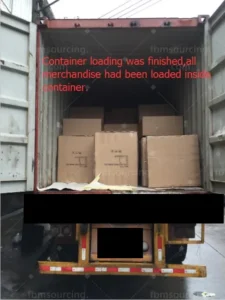
Sometimes, on a large project, the porcelain tiles alone fill full containers; sometimes the porcelain tiles share containers with the other product categories of the same project; and sometimes, in one batch, we combine a dozen or more product categories from several projects of the same client into a few containers — always full containers, and for us this is routine, well-practised work.
Two things follow. Loading order should follow the site’s tiling sequence, so the areas tiled first are reachable first rather than buried behind phase-three stock. And the conformity documentation has to be settled before the booking, because a tile container arriving without the registration in place is a container that sits.
Evidence to Request Before You Shortlist
These are documents about the product, requested for the specific tile references in the schedule rather than for the factory in general. A report covering a different model is about a different product.
- Test reports for the exact tile references specified, each naming the test method and issued by an accredited laboratory whose scope covers that method, not merely an accreditation number on the letterhead.
- Slip-resistance results for every wet area, external area and back-of-house area in the schedule, in the classification the specification calls for.
- Which conformity certificates exist for the destination market, the category they were registered under, and the validity dates. An expired or mismatched certificate is easily missed.
- Approved control samples for shade and calibre, signed and retained by both sides, with the batch reference recorded.
- Confirmation that trims, steps, coves and mosaics come in the same body and glaze as the field tile, with the producing plant identified for each.
- Packing specification and pallet configuration, since breakage in transit is overwhelmingly a packing and handling problem.
Where FBM Sourcing Fits
FBM Sourcing works on the project side. For a Gulf tile package that means splitting the schedule or BOQ across the plant types above, running sampling and the shade and calibre approvals against the specification, assembling the product evidence the destination market’s registration will require, inspection by our own team at the factory before shipment with photo and video records, and consolidating the tile with the project’s other categories into full containers.
Most of the difficulty in Gulf tile procurement is bookkeeping rather than manufacturing: matching references to reports, reports to registrations, registrations to shipments, and batches to phases.
Have a tile package for a Saudi or GCC project to price?
Send us the tile schedule or BOQ and we will split it across the right plant types, run the shade and calibre approvals, and assemble the product evidence your destination market’s registration will need.
Frequently Asked Questions
Which porcelain tile manufacturers in China can be independently verified?
Three can be checked against the Shenzhen Stock Exchange’s own company record: Guangdong Dongpeng Holdings, code 003012, admitted 19 October 2020, registered in Qingyuan; Monalisa Group, code 002918, admitted 19 December 2017, registered in Foshan; and MarcoPolo Holdings, code 001386, admitted 22 October 2025, registered in Dongguan — all in Guangdong. Most Chinese porcelain output comes from unlisted plants, which are not less capable but need verifying by other means.
Does a Chinese tile factory handle SABER registration for a Saudi project?
No, and a manufacturer claiming otherwise should be asked which certificate it means. SASO operates SABER as the platform where products and conformity certificates are registered and shipment certificates issued before goods enter the Saudi market, and a notice there warns that a shipment without the required conformity certificates and the shipment conformity certificate risks being re-exported. The factory supplies the test reports, technical file and product data; the registration sits with the importing party.
Is a conformity document accepted in the UAE also accepted in Saudi Arabia?
Not automatically. The GCC Standardization Organization, established by GCC Supreme Council resolution at its 22nd Session in Muscat on 30–31 December 2001 and operating since May 2004 from Riyadh, aligns what the standards say across the member states, but each country keeps its own standards body and scheme — SASO in Saudi Arabia, the Ministry of Industry and Advanced Technology in the UAE, and separate bodies in Qatar, Kuwait, Bahrain and Oman. Confirm the destination before fixing the documentation route.
How do you stop tile shade changing between phases of a Gulf development?
Fix shade and calibre against signed control samples before the first run, place the full multi-phase quantity against one production reservation wherever the programme permits, hold attic stock from the same batch for later repairs, keep batch and shade marking legible on the cartons, and allow a realistic wastage percentage at schedule stage so a small shortfall does not force a second batch into the building.
Should one factory supply the whole tile package for a project?
Usually not, because field tile, large-format slabs, technical anti-slip finishes and trims come off different production lines and frequently different plants, so a factory quoting all of them is often buying part of the package in. Split the schedule deliberately by capability, then manage shade, calibre and body-and-glaze matching across those plants as one coordination task rather than leaving each supplier to solve it alone.
About FBM Sourcing
FBM Sourcing manages the entire China procurement package for overseas construction projects. Since 2014 we have worked with developers, general contractors, builders, commercial project owners, interior design and construction companies and FF&E solution providers across more than 20 countries and over 1,000 containers, as their sourcing partner in China — from the schedule or BOQ through factory selection, sampling, inspection by our own team before shipment, consolidation and shipping. All quotations, invoices and shipping documents are issued by FBM Sourcing, and sea freight is quoted to you before shipment. If you have a porcelain tile package to price, start at China building materials and FF&E procurement.