Six Chinese manufacturers of built-in wardrobe and closet systems are currently listed on the Shanghai or Shenzhen stock exchanges and report custom wardrobe or whole-house custom cabinetry as a named product segment: Oppein Home Group (SSE: 603833), Suofeiya Home Collection (SZSE: 002572), Zbom Home Collection (SSE: 603801), GoldenHome Living (SSE: 603180), Nanjing OLO Home Furnishing (SSE: 603326) and Guangdong Piano Customized Furniture (SZSE: 002853). For a multifamily or build-to-rent scheme the useful question is not which is largest, but which already runs the kind of order being placed: the same wardrobe module repeated across hundreds of apartments, with the same board, edge banding and soft-close hardware in unit 4 as in unit 400, and replacement parts still available when a door is damaged.
This guide is for developers, general contractors, builders, commercial project owners, interior design and construction companies and FF&E solution providers pricing a wardrobe and closet package out of China. It covers built-in wardrobes, sliding and hinged wardrobe door systems and walk-in closet systems only. Kitchen cabinetry is a different production line with a different tolerance and hardware set, handled separately in our combined kitchen and wardrobe cabinet manufacturer list.
Why Is a Multifamily Wardrobe Package Different from a Single Custom Wardrobe?
A single custom wardrobe is a measuring problem. Several hundred across a multifamily or build-to-rent housing development is a repeatability problem, and almost every difficulty on site traces back to that distinction.
- Unit-by-unit repeatability. A scheme has few apartment types and many apartments, so the wardrobe scope is a short list of modules produced many times over, not hundreds of bespoke items. Module widths, carcase depth, shelf pitch and door leaf sizes should be fixed once, then repeated.
- Batch consistency in the decor. Melamine-faced board is printed decor paper pressed onto a substrate, and two runs of the same decor code can differ enough to be visible when two doors hang side by side. Tying the order to a single decor batch, or recording batch numbers per block, prevents a mismatch appearing between floors.
- Replacement parts years later. Rental stock takes damage, and an operator that cannot buy one matching door leaf in year three ends up replacing a whole wardrobe. Continuity of the decor code and hardware model matters more here than on a for-sale scheme.
- Hardware duty cycle. Doors and drawers in rented apartments are operated far more often, and less carefully, than in owner-occupied stock. Hinges, sliding door gear and drawer runners fail first.
- Installation tolerance. Built-in wardrobes are fixed to structure, so tolerance between shell and joinery has to be agreed before production, not discovered on site.
If the scope is still open between loose furniture and fixed joinery, the trade-offs are set out in our comparison of freestanding wardrobes and built-in wardrobe cabinets.
Which Listed Chinese Manufacturers Produce Built-In Wardrobe Systems?
Each company below was checked against the current listing records of the Shanghai and Shenzhen stock exchanges on 18 September 2026. All six are currently listed, none carries an ST or star-ST risk-warning prefix, and the positions described come from their own 2025 annual reports. No score or ranking is applied, because the right manufacturer depends on the scope, not on size.
| Manufacturer | Listing | Registered base | Reported position in wardrobe, FY2025 |
|---|---|---|---|
| Oppein Home Group Inc. | SSE 603833 | Guangdong | Largest line by unit volume |
| Suofeiya Home Collection Co. Ltd | SZSE 002572 | Guangzhou, Guangdong | Wardrobe and matching products 77.77% of revenue |
| Zbom Home Collection Co. Ltd | SSE 603801 | Anhui | Custom wardrobe 45.86% of revenue, ahead of kitchen |
| GoldenHome Living Co., Ltd. | SSE 603180 | Fujian | Whole-wardrobe revenue up 9.51% while kitchen fell |
| Nanjing OLO Home Furnishing Co., Ltd. | SSE 603326 | Nanjing, Jiangsu | Whole-house custom 81.27% of revenue; small project channel |
| Guangdong Piano Customized Furniture Co., Ltd. | SZSE 002853 | Zhongshan, Guangdong | Custom wardrobe 43.87% of revenue; project-channel led |
Suofeiya Home Collection Co. Ltd (SZSE: 002572)
Of the six, Suofeiya is the most wardrobe-weighted: its 2025 annual report puts wardrobe and matching products at 77.77% of revenue, against 12.90% for kitchen cabinets and accessories. It describes itself as the business that introduced the custom wardrobe concept to the Chinese market, built on sliding closet door technology, and it was the first A-share listed company in the custom home furnishings sector, listing in April 2011.
Evidence to request: the decor code and board specification for the modules quoted, plus confirmation the decor will be held for later replacement orders.
Oppein Home Group Inc. (SSE: 603833)
Oppein began in custom kitchen cabinets and extended into whole-house products, and wardrobes are now its highest-volume category by a large multiple: FY2025 sales of 2,576,724 sets of wardrobe and matching furniture against 616,025 sets of whole kitchen cabinets, the two together more than 80% of main business revenue. For a large mixed scheme, wardrobes, kitchens and doors can run through one production system on one decor programme rather than across separate factories.
Evidence to request: written confirmation of which of its production bases will make the carcases, and sample panels pressed on that base.
Zbom Home Collection Co. Ltd (SSE: 603801)
Zbom is the clearest case of a kitchen-first manufacturer in which wardrobe has overtaken the original category: its 2025 annual report gives custom wardrobe 45.86% of revenue against 35.4% for whole kitchen cabinets, on sales of 531,722 wardrobe sets. Two further figures matter for multifamily work: its domestic bulk project channel was 24.20% of revenue, so it is used to framework orders rather than single retail sales, and overseas business grew 77.73% to 8.38% of revenue.
Evidence to request: the hardware schedule by model, and packing specification for export of flat-packed carcases.
GoldenHome Living Co., Ltd. (SSE: 603180)
GoldenHome is registered with the Shanghai exchange as GoldenHome Living Co., Ltd., reflecting a move beyond its kitchen cabinet origins. It is the one manufacturer here whose wardrobe line grew against a falling kitchen line in FY2025: whole-wardrobe revenue rose 9.51% and unit sales rose 10.76% to 408,193 sets, while whole kitchen cabinet revenue fell 15.97%. Its 2025 annual report also describes a cross-border delivery network, with an all-category production base in Rayong, Thailand then under construction and expected to begin trial production in August 2026, and satellite plants in Dallas and Malaysia commissioned during 2025.
Evidence to request: confirmation of which country the quoted carcases will actually be produced in, since the group also operates production outside China.
Guangdong Piano Customized Furniture Co., Ltd. (SZSE: 002853)
Piano is the most project-oriented of the six. Its 2025 annual report describes a dual model of bulk project business alongside retail distribution, with the bulk side aimed at the pre-finished apartment market and run either directly or through project dealers under framework agreements with developers. Custom wardrobe and matching products were 43.87% of revenue in FY2025, and the report sets out a plan to widen the project range from kitchen cabinets alone into wardrobes, bathroom cabinets, balcony cabinets and door and wall products. One governance point belongs in any shortlist note: the report records that its controlling shareholder and actual controller changed in April 2026.
Evidence to request: the carcase board grade and edge banding specification used on its project orders, which can differ from the retail range.
Nanjing OLO Home Furnishing Co., Ltd. (SSE: 603326)
OLO Home reports its business as whole-house custom rather than wardrobe specifically, defining that segment as bedroom, living room and study cabinetry. In FY2025 whole-house custom was 81.27% of revenue and grew 11.99%, while kitchen fell to 18.73%. It positions itself on original design at the mid-to-high end. The honest qualification is that its bulk project channel is small, at 4.13% of channel revenue, though the report describes an intention to extend project work toward rental apartment and institutional schemes.
Evidence to request: reference module drawings showing a design-led range reduced to repeating modules at the unit counts required.
Pricing a built-in wardrobe package for a multifamily or BTR scheme?
FBM Sourcing works with developers, general contractors, builders, commercial project owners and FF&E solution providers on wardrobe and closet system packages from China. Send us your schedule, drawings or BOQ and our team will review it.
Where the Rest of the Supply Base Sits
Listed companies are a small part of the picture. Most capacity sits with unlisted manufacturers, which fall into recognisable types rather than brands worth naming without verification:
- Panel-furniture plants in the Guangdong cluster, around Foshan and Zhongshan — the usual base for repeating apartment modules in melamine-faced board.
- Whole-house custom plants in Jiangsu, Zhejiang and Anhui, often with stronger CNC and order-splitting software, having grown out of made-to-measure retail.
- Wardrobe door system specialists, producing sliding and hinged leaves, aluminium framing and track gear but not carcases — frequently a separate supplier to the carcase plant.
- Closet component manufacturers, producing internal systems, hanging rails, drawer boxes and pull-out accessories.
Our pages on wardrobe cabinet sourcing from China and walk-in closet systems from China set out how the carcase, door and internal component scopes divide.
What Board and Emission Class Should the Specification Name?
Formaldehyde emission from the board is the compliance point most likely to stop a wardrobe shipment, because it is regulated at the level of the finished article, not just the panel. What applies depends on where the apartments are.
- China. GB 18580-2025, the mandatory national standard on formaldehyde emission limits for wood-based panels and their products in interior decoration, was published on 30 May 2025 and took effect on 1 June 2026, replacing the now-withdrawn GB 18580-2017. A specification still citing the 2017 edition is citing a superseded standard.
- European Union. Entry 77 of Annex XVII to REACH, inserted by Commission Regulation (EU) 2023/1464, provides that articles shall not be placed on the market after 6 August 2026 if, under the test conditions in Appendix 14, formaldehyde released exceeds 0,062 mg/m3 for furniture and wood-based articles. That date has passed, so the limit applies to wardrobes placed on the EU market today.
- United States. Under 40 CFR 770.10, implementing TSCA Title VI, the standards are 0.05 ppm for hardwood plywood with a veneer or composite core, 0.09 ppm for particleboard, 0.11 ppm for medium-density fibreboard and 0.13 ppm for thin MDF, measured by ASTM E1333-14. They apply whether the product is a panel, a component part or incorporated into a finished good — so a completed wardrobe containing particleboard is covered, not only the raw board.
The consequence: the certificate has to match the board actually pressed for the order, and the batch has to be traceable. A generic mill letter covering a decor family is not evidence for the panels in the containers. Our page on formaldehyde standards for cabinets from China compares the classes.
Hardware, Doors and Moisture: The Parts That Fail First
On a rental scheme the wardrobe is judged years after handover, and by then the board decor is rarely the complaint. The failures are mechanical.
Hinges and runners. Soft-close hinges and drawer runners carry a manufacturer-stated cycle rating. The specification should name the hardware model and require cycle test evidence for that model, rather than accept a general claim that the hardware is soft-close. Where the specification names a durability standard for storage furniture or hardware, ask for the test report against that standard.
Sliding door gear. Sliding wardrobe doors fail through track deflection and roller wear rather than the leaf. Top-hung and bottom-rolling systems behave differently, and the choice interacts with how the head track is fixed to structure, so settle it at specification stage: it changes the carcase design.
Edge banding. On rented stock the edges take the abuse. Edge banding thickness and bonding method are worth specifying explicitly: a thin edge with a low-cost adhesive is the most common visible failure in the first few years.
Moisture. Wardrobes against external walls, or in humid climates, need a carcase board with a stated moisture-resistance grade, named in the specification and evidenced by test data for the board used.
Fire. Where the apartment type or building height brings interior finishes within scope of a fire requirement, the classification comes from the project’s own code references for that jurisdiction. The wardrobe package should state which classification is claimed and what test evidence supports it — a specification input for the project team to confirm, not something a catalogue can settle.
How Does FBM Sourcing Handle a Wardrobe Package?
FBM Sourcing acts as the sourcing partner in China for the project team, working from the schedule, drawings or BOQ through factory selection, sampling, inspection by our own team at the factory before shipment, with photo and video records, consolidation and shipping. On a wardrobe package the work concentrates on the points above: fixing the module list so repeating units are quoted as such, tying decor and hardware models to the order so replacement parts stay available, and collecting the emission and moisture evidence before production rather than after.
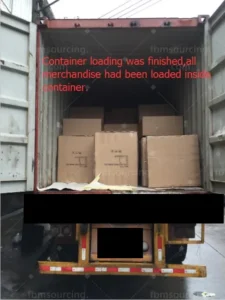
On loading, the pattern depends on the project. Sometimes, on a large project, the wardrobes alone fill full containers; sometimes the wardrobes share containers with the other product categories of the same project; and sometimes, in one batch, we combine a dozen or more product categories from several projects of the same client into a few containers — always full containers, and for us this is routine, well-practised work.
Pricing a built-in wardrobe package for a multifamily or BTR scheme?
FBM Sourcing works with developers, general contractors, builders, commercial project owners and FF&E solution providers on wardrobe and closet system packages from China. Send us your schedule, drawings or BOQ and our team will review it.
Frequently Asked Questions
Are these six companies the only wardrobe manufacturers in China worth considering?
No. They are the manufacturers whose listing status and wardrobe segment position can be verified against exchange records and published annual reports, which is why they can be named. Most wardrobe capacity in China sits with unlisted manufacturers, and for many multifamily packages one of those is the better fit.
Should a multifamily wardrobe package be ordered flat-packed or assembled?
Flat-packed is normal for built-in wardrobes on apartment schemes, because carcases assembled on site travel far more efficiently and built-in units are scribed to the shell anyway. The decision affects packing specification, the labelling scheme that gets the right modules to the right apartment, and the installation scope, so settle it before pricing.
What is the difference between this list and the combined kitchen and wardrobe list?
The combined list covers manufacturers supplying both kitchen and wardrobe cabinetry for commercial projects, and is the right starting point when both are in scope. This page is limited to built-in wardrobes and walk-in closet systems for multifamily and build-to-rent schemes, where the governing issue is repeating a few modules accurately across many apartments rather than breadth of range.
How far ahead should wardrobe modules be fixed on a build-to-rent scheme?
Before sampling, because a sample only means something if it is the module that will be repeated. Module widths, carcase depth, shelf pitch, door leaf sizes, decor code and hardware models should be frozen first; accessory layouts can vary later without disturbing production.
Does a wardrobe order need separate emission evidence for each apartment block?
It needs evidence tied to the board batches actually used, which on a large scheme usually means several batches and several certificates. What matters is traceability from certificate to the panels in the containers, so recording batch numbers against blocks or shipments beats one generic document covering the whole order.
About FBM Sourcing
FBM Sourcing manages the entire China procurement package for overseas construction projects. Since 2014 we have worked with developers, general contractors, builders, commercial project owners, interior design and construction companies and FF&E solution providers across more than 20 countries and over 1,000 containers, as their sourcing partner in China — from the schedule or BOQ through factory selection, sampling, inspection by our own team before shipment, consolidation and shipping. All quotations, invoices and shipping documents are issued by FBM Sourcing, and sea freight is quoted to you before shipment. If you have a built-in wardrobe and closet system package to price, start at China building materials and FF&E procurement.