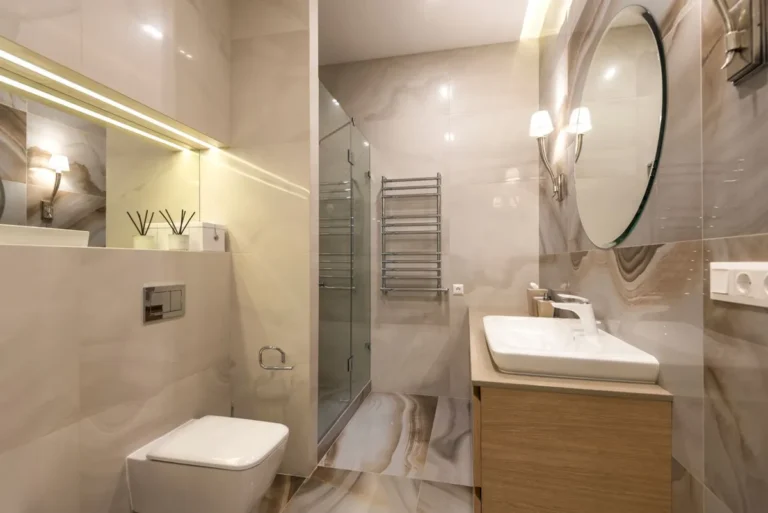
A chinese smart toilet — an integrated intelligent toilet or a smart bidet seat — is specified for hotel and apartment projects on four parameters that a standard toilet order never raises: electrical supply (110–120V/60Hz for North America versus 220–240V/50Hz for most other markets), water pressure compatibility across a 0.07–0.75 MPa operating range, a certification stack that covers both plumbing and electrical safety, and a spare-parts plan for seats, remotes and valves. China produces the large majority of the world’s smart toilets, and project-grade units are readily built to any destination standard — but only if the purchase order states the voltage, trap type, rough-in and certification requirements before production, because a smart toilet built for the Chinese domestic market cannot simply be rewired for a US or Australian bathroom after it arrives. This is the kind of scope a sourcing partner such as FBM Sourcing takes on.
This guide covers what commercial buyers should specify when ordering smart toilets from China at project volume. It is the intelligent-model companion to our standard toilets sourcing from China project guide — if your specification is conventional one-piece or wall-hung WCs without electronics, start there instead.
What Makes a Smart Toilet Order Different from a Standard Toilet Order?
A conventional toilet is a plumbing product; a smart toilet is a plumbing product and an electrical appliance in one box, and every added function adds a specification decision. Two product formats exist, and the choice shapes the whole order:
- Integrated smart toilets — one-piece units with tankless flushing, built-in bidet washing, seat heating and drying. Rated power runs 1000–1600W on instant-heating models. This is the format most new-build hotel and apartment projects specify, because the silhouette is clean and there is no retrofit joint to fail.
- Smart bidet seats — electronic seats fitted to a standard ceramic pan, typically 400–600W with a small heated tank. Useful when a project wants the function at a lower unit cost, or wants to keep a certified ceramic pan already specified elsewhere in the package.
The commercial consequence: a smart toilet order pulls the electrical contractor into a decision that is normally plumbing-only. Every fixture position needs a dedicated, earthed, GFCI/RCD-protected outlet roughed in beside the pan — and on a 200-key hotel that is 200 outlets that must be on the drawings before the walls close, not after the containers land.
What Electrical and Water Specifications Must You Confirm Before Production?
Voltage is the single most common smart toilet ordering error, because China’s domestic standard is 220V/50Hz while North America runs 110–120V/60Hz. The heating elements, pumps and control boards are different components, not a switchable setting — factories build the export version on the production line, so the destination voltage must be stated on the purchase order and confirmed on the pre-production sample. For Australia, the UK, the Gulf and most of Europe, 220–240V/50Hz aligns with the domestic Chinese build, but plug and cord standards still differ by market.
On the water side, confirm three numbers:
- Operating pressure range — most units are rated for roughly 0.07–0.75 MPa dynamic pressure. Tankless (pump-assisted) integrated toilets have a minimum-pressure floor; high-rise apartment projects with pressure-reduced upper floors should confirm the model flushes correctly at the worst-case floor, or specify units with a built-in booster pump.
- Flush volume — dual-flush at 3/4.5L is the common export spec; US projects should specify 1.28 gpf (4.8L) to meet WaterSense-level codes, and Australian projects should confirm the WELS star rating the development application assumed.
- Trap type and rough-in — a 305mm (12″) P-trap rough-in is standard for North America, while Australian and some UK stacks still call for S-trap outlets; our S-trap vs P-trap project guide explains how to read this off the plumbing drawings before ordering.
Sourcing this for a commercial project?
FBM Sourcing works with project owners, developers, main contractors and FF&E contractors on hotel, apartment, school, office and other commercial building projects. Send us your BOQ, drawings or product list — our team will review it and get back to you.
Which Certifications Do Chinese Smart Toilets Need for Your Market?
Because a smart toilet is both a plumbing fitting and an electrical appliance, it needs two certification tracks — and a unit certified for one market is not automatically compliant in another:
- United States and Canada: cUPC (or UPC/CSA) listing for the plumbing side, plus UL or ETL certification to UL 1431 for the electrical side, and FCC compliance if the unit ships with a wireless remote. WaterSense-level 1.28 gpf flush performance where local code requires it.
- Australia and New Zealand: WaterMark certification is mandatory for the plumbing connection, WELS registration covers water efficiency, and the electrical side needs RCM marking. Without WaterMark, a licensed plumber cannot legally install the unit — there is no workaround on site.
- UK and Europe: CE marking under the Low Voltage and EMC directives for the appliance, and WRAS approval (UK) for the water-side components; UKCA applies for Great Britain.
Established Chinese sanitary ware factories hold these certifications on their export lines, but certificates are model-specific: always ask for the certificate matching the exact model and voltage variant you are ordering, and have the numbers verified against the issuing registers before deposit. The full landscape is covered in our guide to CUPC, WaterMark, WRAS and CE sanitary ware certifications.
What Should the Specification Sheet Cover for Hotel and Apartment Use?
Consumer smart toilets are sold on feature count; project buyers should specify by function and serviceability. The specification decisions that matter at volume:
- Seat heating — adjustable across roughly 30–40°C in 3–5 steps, with an energy-save mode; confirm the seat ring is one-piece antibacterial PP or urea resin rated for commercial cycles.
- Washing and drying — self-cleaning stainless or antibacterial nozzle with adjustable position and pressure, warm-air dryer, and instant (tankless) water heating for continuous use in hotel duty.
- Hygiene functions — nozzle sterilisation (UV or electrolysed water), pre-wetting of the bowl, and rimless ceramic bodies that housekeeping can clean faster.
- Controls — for hotels, specify a wall-mounted or docked side control rather than a loose handheld remote; loose remotes are among the most-replaced items in guest rooms. For apartments, a handheld remote plus manual side buttons is the usual spec.
- Fail-safe flushing — a manual flush function that works during power outage. Tankless units without a mechanical backup strand guests when power drops; this single line on the spec sheet prevents it.
- Auto functions — lid auto open/close, foot-kick flush and night light are guest-visible differentiators that cost little at factory level; decide per brand standard rather than per supplier default.
Coordinate the smart toilet specification with the rest of the bathroom package — roll holders, robe hooks, grab rails and shelving are normally consolidated in the same containers, as covered in our bathroom accessories sourcing guide.
How Do You Plan Installation and Spare Parts for a Bulk Order?
The installation planning rule: the rough-in freezes the product decision, so select the smart toilet model before the slab and wall services close. Each fixture position needs the drainage outlet at the confirmed rough-in dimension, a cold-water stop valve within hose reach, and the protected power outlet placed to the side of the pan where the cord reaches without crossing wet zones — typically within 300–500mm. On projects using concealed cisterns and wall-hung smart pans, the carrier frame and flush plate must come from a matched system, which is one more reason to buy the bathroom as one coordinated package rather than fixture by fixture.
On after-sales, treat smart toilets like the electronic appliances they are. Our working recommendation for hotel and apartment orders: standardise one model across all room types, then ship an agreed allowance of spare stock of the wear-and-loss items — complete seats or seat rings, remotes and docking cradles, inlet and stop valves, nozzles and water filters — in the same containers as the main order. A spare seat that costs little as part of the production run costs a disproportionate amount, plus weeks of waiting, when air-freighted individually after handover. Confirm warranty terms in writing (2–5 years on ceramics, 1–3 years on electronics is typical from export factories) and confirm the spare-parts supply window for the model, since electronics generations turn over faster than ceramic ranges. All pre-shipment quality checks on FBM Sourcing orders — function-testing washing, heating, drying and flushing on sampled units, plus packing checks — are carried out by our own team in the factory with photo and video records delivered to the client.
Get a China Procurement Quote for Your Bathroom Package
If your hotel or apartment project is specifying smart toilets — alone or as part of a full sanitary ware and bathroom package — send us your fixture schedule, bathroom drawings, destination market and target dates. As a china sourcing agent for building materials and FF&E, we will confirm the correct voltage and certification build for your market, price the package on a 5% commission for suppliers you nominate (products we source for you are quoted at a direct price) model, and come back with a sourcing plan, sample schedule and container estimate.