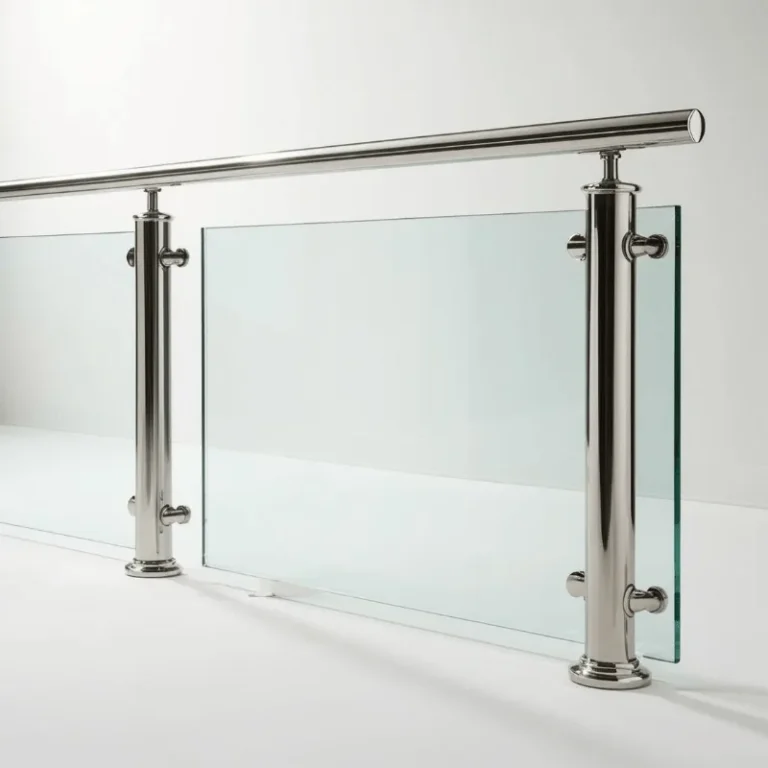
Specifying railing posts and hardware for a commercial balustrade order means locking down four things before any factory is approached: post type and base fixing (surface-mounted vs core-drilled), material grade (304 vs 316 stainless steel, matched to the project’s coastal or humidity exposure), hardware compatibility (clamp and spigot spacing matched to the post’s drilled hole pattern), and the load or building-code standard the finished system must meet. Getting these four right before quotation is what prevents an on-site fitment mismatch between posts, infill and hardware ordered from different production runs. This kind of coordination is what a sourcing partner like FBM Sourcing is for.
Why Posts and Hardware Get Specified Together
A railing system’s posts, infill (glass, cable or pickets) and hardware are functionally one assembly, but they are often quoted as if they were three separate purchases — which is how a project ends up with spigots that do not match the post’s hole spacing, or a hardware finish that does not match the post’s brushed grain. As a building material sourcing agent, FBM Sourcing orders posts and hardware from a coordinated production run rather than as three independent line items, so tolerance and finish are matched before anything ships.
Specification Checklist for Railing Posts and Hardware
- Post type and base fixing — glass balustrade post, cable railing post or baluster/picket post, and whether it is surface-mounted, core-drilled or side-mounted to a stringer
- Material grade — 304 stainless steel for standard interior and low-exposure exterior use; 316 stainless steel for coastal, high-humidity or high-corrosion environments
- Finish — brushed, polished, powder-coated or mill finish, specified consistently across posts, hardware and any handrail brackets
- Hardware compatibility — spigot and clamp hole spacing matched to the post’s drilled pattern, confirmed against the same factory drawing before production
- Load and code compliance — the applicable building-code load standard for the destination market (in Australia, AS/NZS 1170.1 for barrier loading actions; AS 1657 applies only to fixed industrial platforms, walkways, stairways and ladders), documented via factory test reports
Sourcing this for a commercial project?
FBM Sourcing works with project owners, developers, main contractors and FF&E contractors on hotel, apartment, school, office and other commercial building projects. Send us your BOQ, drawings or product list — our team will review it and get back to you.
304 vs 316 Stainless Steel: Which Do I Need?
304 stainless steel is suitable for most interior applications and low-exposure exterior use — it resists everyday corrosion at a lower material cost than 316. 316 stainless steel contains added molybdenum, which significantly improves resistance to chloride corrosion, and is the correct specification for coastal projects, pool decks, and any destination market with high humidity or salt exposure — the Caribbean, Southeast Asia, the Gulf and most Australian coastal developments. Specifying 304 to save cost on a coastal project is a common false economy: visible corrosion staining within one to two years is far more expensive to remediate than the material cost difference at order stage.
Ordering Posts, Infill and Hardware as One Package
The most reliable way to avoid a fitment mismatch is to order posts, infill (glass, cable or pickets) and hardware from the same factory production run, specified against one set of shop drawings. FBM Sourcing coordinates this across our railing posts and railing hardware sourcing programs, alongside infill options covered in our guides to glass railing, stainless steel railing and balcony railing systems.
Quality Control for Railing Hardware at Project Scale
A commercial railing order is inspected for material grade verification against the supplier’s mill certificate, thread and fitment tolerance on hardware, corrosion-resistance finish consistency, and — for tensioning hardware such as cable turnbuckles — function testing under load before the order ships.
On a seafront balustrade, the coating on aluminium parts needs the same care as the stainless grade of the posts. Our guide to AAMA 2605, QUALICOAT Seaside and 316 stainless hardware for coastal projects explains what to write into the order and which documents prove it.
Get a China Procurement Quote for Your Project
Send us your railing shop drawings, post and hardware schedule, destination port and timeline, and FBM Sourcing will come back with a sourcing plan and budget estimate for your project. Start through our China building materials and FF&E procurement page.