To source building materials from China for a construction project, run six steps in order: freeze specifications against your drawings, match each category to the right factory base, equalise and compare quotations line by line, approve physical samples with test reports, run a full inspection before shipment, and consolidate mixed-factory goods into containers sequenced for site installation. Most construction materials from China — doors, windows, tiles, flooring, sanitary ware, railings, cabinets — produce in 6–12 weeks after sample approval, ride an 18–35 day ocean leg, and are managed end to end by a sourcing agent and sourcing partner for a 5% commission for suppliers you nominate (products we source for you are quoted at a direct price).
This guide is written for real estate developers, building owners, general contractors and FF&E contractors buying project quantities — not retail amounts — and walks through each step with the numbers that drive the schedule. The delivery model behind it is FBM Sourcing’s China building materials and FF&E procurement service.
Watch How We Work: Factory QC to Container Loading
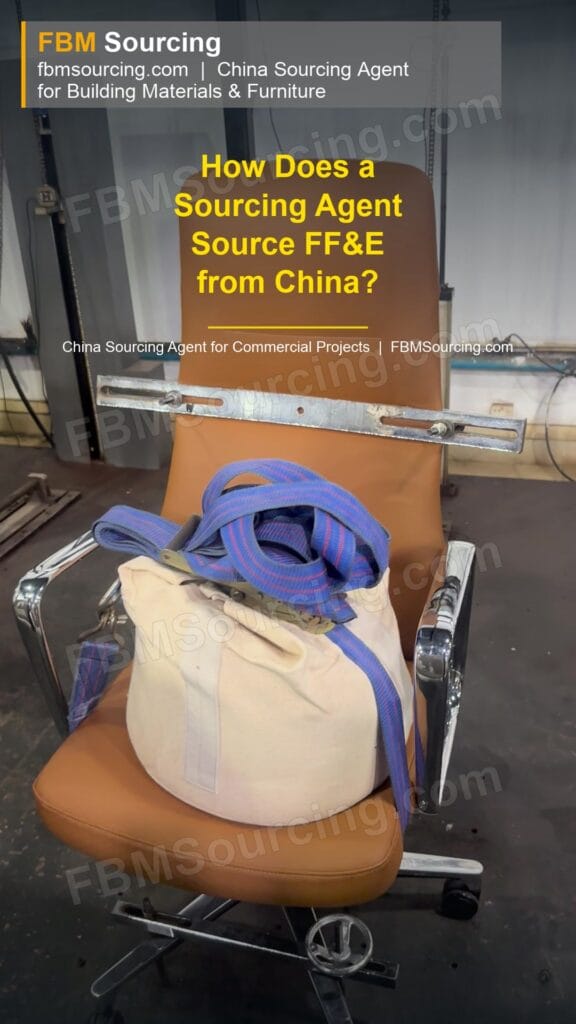
How Does a Sourcing Agent Source FF&E from China?
How does a China sourcing agent source FF&E from China for hotels, schools, offices, apartment buildings and student accommodation? FBM Sour…
Watch & read transcript →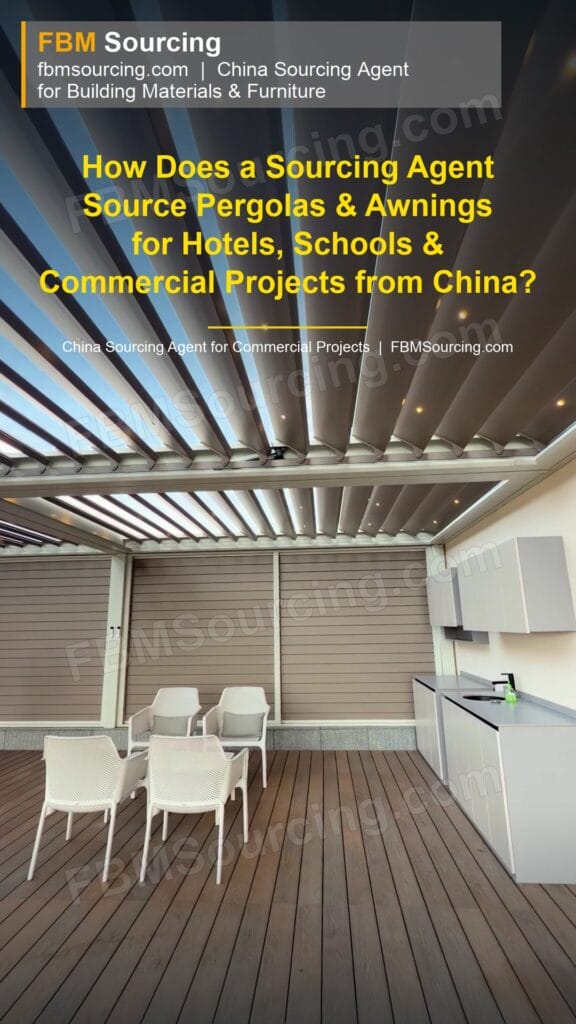
How Does a Sourcing Agent Source Pergolas & Awnings from China?
How does a China sourcing agent source pergolas and awnings from China for a hotel, resort or school project? FBM Sourcing is a building mat…
Watch & read transcript →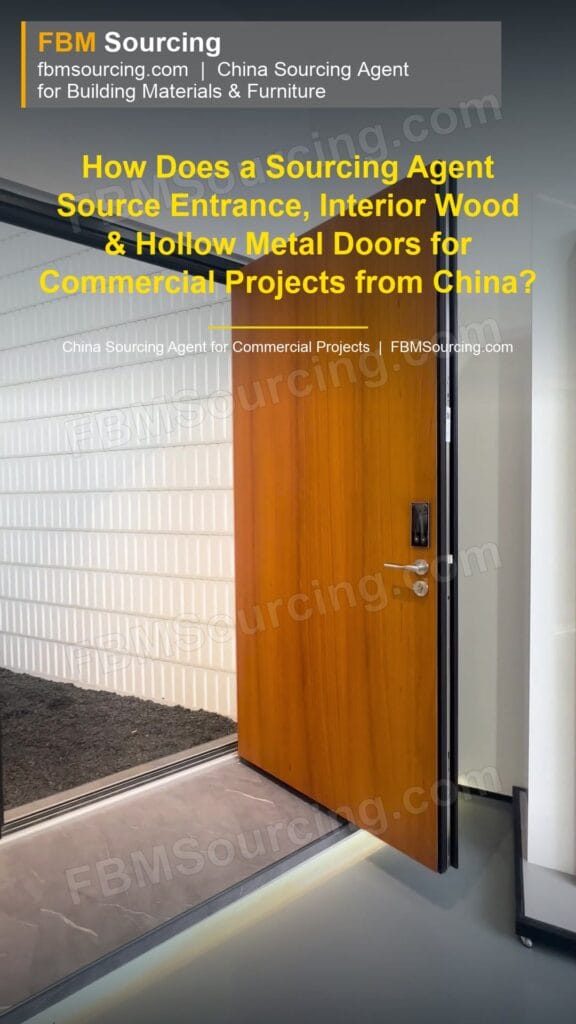
How Does a Sourcing Agent Source Doors for Hotel & Apartment Projects?
How does a China sourcing agent source entrance doors, interior wood doors, and hollow metal doors from China for hotels, apartment building…
Watch & read transcript →Which Construction Materials from China Make Sense to Import?
Project economics favour categories where the manufactured value is high relative to freight cost, and where custom sizes or finishes carry premium pricing at home:
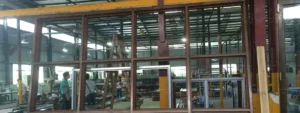
- Windows and doors — custom aluminium and uPVC window systems, interior door packages and fire-rated door sets; a full door set (leaf, frame, hardware) travels far better as a matched package than as parts bought separately. See our Chinese doors and windows sourcing guide.
- Tiles and stone — porcelain tile, slabs and stone cladding; tiles are weight-limited cargo, so a 20GP container typically maxes out on payload at roughly 25–27 tonnes before it runs out of volume, which changes the container plan versus furniture.
- Flooring — engineered timber, SPC and laminate, quoted by wear-layer and core spec, not photographs.
- Cabinets and joinery — kitchens, wardrobes and vanities, where board grade (E1, E0, CARB Phase 2 / TSCA Title VI) must be written into the order.
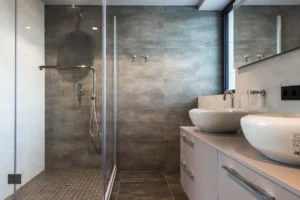
- Sanitary ware, railings, wall panels and lighting — usually consolidated with the categories above into mixed containers rather than shipped alone.
Curtain wall and facade systems are a separate discipline with engineering sign-off at destination — covered in our guide to curtain wall windows from China.
What Is the Step-by-Step Sourcing Process?
- Freeze the specification (week 1–2). Convert drawings and BOQ lines into factory-ready specs: exact dimensions, material grades, performance standards, finish references. Separate standard catalogue items from custom project products — they follow different workflows and different sampling depth.
- Match categories to factory bases (week 2–3). Each category has its own manufacturing geography and its own lead-time band; no single factory makes doors, tiles and lighting well.
- Equalise and compare quotations (week 3–4). Line-by-line, against the same specification — see the section below.
- Approve samples with documents (week 4–8). Physical samples arrive in 7–15 days per item; approval covers the sample plus its test reports, not the sample alone.
- Quality control before shipment (week 6–16). On FBM Sourcing projects the goods are inspected by our own team in the factory before they are loaded, with photo and video records.
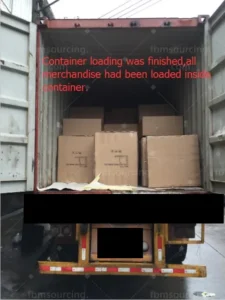
- Consolidate and ship (final 2 weeks + 18–35 days ocean). Mixed-factory goods grouped into containers sequenced against site installation order, heavy categories loaded and braced to survive the voyage.
Sourcing this for a commercial project?
FBM Sourcing works with project owners, developers, main contractors and FF&E contractors on hotel, apartment, school, office and other commercial building projects. Send us your BOQ, drawings or product list — our team will review it and get back to you.
How Do You Compare Factory Quotations Line by Line?
The cheapest quotation on paper is usually the one describing a different product. The recurring gaps that make quotes non-comparable are specification substitutions, and each has a number attached that must appear in writing:
- Aluminium finish — powder coating is typically specified at 60–80μm film thickness; a quote that is silent on coating thickness and profile wall thickness is not comparable with one that states them.
- Glass — tempered safety glass to EN 12150 (or destination equivalent), with unit build-up (e.g. double-glazed spacer width) written per line item.
- Board grade — E1 versus E0 versus CARB Phase 2 / TSCA Title VI compliant board changes both price and market legality for cabinets and joinery.
- Porcelain tile — water absorption ≤0.5% (ISO 10545-3) is what separates porcelain from ceramic pricing; slip ratings for commercial areas belong on the order, not the brochure.
- Scope lines — hardware, screens, spare parts, export packing and loading support are the items most often silently excluded from the low quote.
Whether the goods travel FOB, CIF or DDP changes who controls freight and risk from the loading port onward — compared in our guide to FOB vs CIF vs DDP for building materials from China. For US-bound projects, one framing rule keeps budget conversations honest: tariff rate ≠ landed cost — the duty line is only one component of a landed calculation that includes freight, destination charges and the factory-gate saving, so projects should run the full comparison rather than react to a headline rate.
Which Certifications and Test Reports Should the Order Include?
Certification is a purchase-order clause, not an after-thought at customs. The standards that matter depend on category and destination: CE or UKCA marking for doors and windows into Europe and the UK, fire classification to EN 13501 or ASTM E84 for finishes, EN 1634 / UL 10C fire-resistance test evidence for fire-rated door sets, CARB Phase 2 / TSCA Title VI for composite wood into the US, and cUPC or WaterMark for sanitary ware depending on market. Ask for the test reports at quotation stage and attach them to the order — our guide to certifications when importing building materials from China maps standards to categories, and fire-rated door sourcing covers the highest-stakes category in detail.
How Do Shipping and Consolidation Work for Mixed Material Orders?
A 40HQ container gives 76 m³ nominal volume, of which roughly 65–68 m³ is realistically usable once packing and bracing are in place — and heavy categories hit payload limits long before volume. The consolidation decision is whether each factory ships alone (FCL) or goods from several factories combine into shared containers, which is how most project orders below full-container volume per category actually move; the sequencing and loading logic is covered in full container consolidation for building material projects. Two rules protect the site programme: load containers in installation order (first-fix materials like windows and doors ahead of finish materials), and label every carton and crate with building, floor and zone so site receiving does not become an unpacking exercise.
What Are the Most Common Mistakes?
- Buying from product names instead of standards — “porcelain tile” or “fire door” without the test number behind it is a description, not a specification.
- Approving samples without performance documents — the sample proves appearance; only the report proves the rating.
- Under-specified packing on heavy or fragile goods — tiles, stone and glass need crating and bracing engineered for a 3–6 week sea voyage, and weak packing is the classic hidden saving inside a low quote.
- Containers sequenced by factory convenience — goods arriving in the wrong order stall installation crews even when everything is undamaged.
- Starting too late — 6–12 weeks of production plus 18–35 days of ocean freight cannot be negotiated away; the schedule is manufacturing reality.
How FBM Sourcing Supports Project Procurement
FBM Sourcing helps project teams source mid-to-high-end building materials, furniture and custom products from China: specification review, factory matching, quotation equalisation, sample coordination, quality control by our own team before shipment, with photo and video records, export preparation and delivery communication — for a 5% commission for suppliers you nominate (products we source for you are quoted at a direct price). Send your BOQ, drawings, quantities, destination port and required site dates, and we will return a category-by-category sourcing plan with a realistic delivery schedule.