What Does a Golf Clubhouse Fit-Out Actually Need from China?
A golf clubhouse is not a small hotel. It is seven different buildings sharing one roof — a retail shop, a wet locker room, a restaurant and bar, a banquet room, a bag and cart store, an administration floor and an outdoor terrace — and each of those has its own product standards, its own durability problem and its own procurement risk. The packages that travel well from China are the repeatable, specification-driven ones: locker room lockers and benching, banquet and terrace furniture, bag storage and cart barn racking, retail display joinery, flooring, lighting and washroom fit-out. The packages that usually should not travel are the ones tied to a local trade or a local approval — commercial kitchen equipment that needs destination gas and health approvals, and anything requiring local engineering sign-off.
This guide is written for club owners, developers, main contractors and the interior design and construction companies delivering clubhouse projects. It sets out the seven packages, what evidence to demand from each, and the sequencing that keeps the opening date intact.
The Seven Packages, and Which Ones Belong in a China Order
- Locker rooms — lockers, benching, vanity joinery, mirrors, washroom fittings. Sources well.
- Food and beverage — dining chairs and tables, bar stools, banquette seating, bar joinery. Sources well. Kitchen equipment generally does not, because it carries destination gas, electrical and food-safety approvals — see commercial kitchen equipment manufacturers in China.
- Banquet and events — stacking chairs, folding and round banquet tables, trolleys, dance floor, linen. Sources very well; this is the most commoditised, most repeatable package in the building.
- Pro shop — retail display joinery, gondolas, wall systems, fitting-room joinery, counters. Sources well when drawn properly.
- Bag storage and cart barn — bag racking, cart charging racks, staff lockers, workshop benching. Sources well.
- Outdoor terrace and halfway house — dining and lounge furniture, umbrellas, planters, shade structures. Sources well, with the highest durability risk in the building.
- Building materials and finishes — flooring, tile, doors, ironmongery, sanitaryware, lighting. Sources well where the destination certification route is settled first.
Why Does the Locker Room Cause More Problems Than the Restaurant?
Because it is the only permanently wet, permanently loaded room in the clubhouse, and because most locker specifications are written from an office or school reference rather than a golf reference.
A golf locker room takes wet shoes, wet waterproofs and wet towels several times a day, every day of the season. Powder-coated steel lockers, which are perfectly good in a school corridor, corrode at the base and around the fixings in that environment. The materials that survive are solid grade phenolic laminate and, to a lesser degree, high-pressure laminate on a moisture-resistant core; the difference shows up within two seasons, not ten years.
Four things to specify explicitly, because a factory will otherwise default to the cheapest interpretation:
- Material and core — solid grade phenolic through-colour, or HPL with a stated moisture-resistant core; not standard chipboard with a laminate face.
- Ventilation — through-ventilated doors or louvred panels, top and bottom, so that a locker with wet kit in it dries rather than composts.
- Hardware grade and finish — stainless hinges and fittings, 316 rather than 304 in coastal locations, with a salt-spray result to ASTM B117 where the course is on the coast.
- Lock type and keying schedule — mechanical, coin-return, digital or member-assigned, with the master keying schedule agreed before production; retro-fitting a keying system is an on-site rebuild.
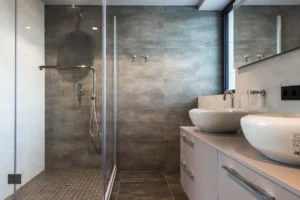
Benching and vanity joinery in the same room should be specified to the same wet-area logic. A solid surface vanity top with an integrated bowl is a better clubhouse decision than a stone top with an undermount bowl, because the silicone joint at an undermount bowl is the first thing to fail in a room that is cleaned with a hose.
The Banquet Package Is Where the Standards Actually Bite
Clubhouse event revenue depends on the banquet package, and it is the package most likely to be rejected on compliance rather than on quality.
Commercial seating has to be tested as commercial seating. For non-domestic seating, the European strength and durability references are EN 16139 for general non-domestic seating and EN 1335 where office task chairs are involved in the administration areas; in North America the reference family is ANSI/BIFMA, with the general-purpose chair standard the one most commonly cited on commercial projects. Ask which standard the chair was tested to, at what test level, and on which model — test reports are issued per model, not per range, so a report for the armless version does not cover the arm version.
Upholstery flammability is destination-specific and is where clubhouse orders most often get stopped:
- United States — upholstered furniture is commonly specified to California TB 117-2013, and many jurisdictions and insurers expect it as a minimum for assembly occupancies.
- United Kingdom — contract upholstery is normally specified against the BS 5852 ignition source tests, with the required source stated.
- Australia — upholstery fire requirements follow the building’s classification and use; NCC Volume One Specification 7 sets fire hazard property requirements for fixed seating in buildings such as theatres and public halls, so confirm the required test with the building certifier before the fabric is chosen.
Two practical banquet details worth writing into the enquiry: state the required stack height for stacking chairs and require matching stacking trolleys in the same order, because a banquet room with chairs that stack ten high and no trolley cannot be turned around between events; and require that folding banquet tables are supplied with the specific trolley for their size and shape, since round and rectangular tables need different trolleys.
Sourcing this for a commercial project?
FBM Sourcing works with project owners, developers, main contractors and FF&E contractors on hotel, apartment, school, office and other commercial building projects. Send us your BOQ, drawings or product list — our team will review it and get back to you.
The Terrace Is the Highest-Failure Package in the Building
Outdoor clubhouse furniture takes full sun, rain and — on links and coastal courses — salt. It is also the furniture members see first and photograph most.
Specify against exposure rather than against a look:
- Frames — marine-grade aluminium with an architectural powder coat, or 316 stainless in coastal positions. Ask for a salt-spray result to ASTM B117 on the finished, coated component, not on a test panel.
- Woven material — solution-dyed or UV-stabilised synthetic rattan with a stated UV performance, not an unspecified “PE rattan”.
- Fabrics — solution-dyed acrylic where budget allows; ask for the lightfastness rating and the water column figure rather than a marketing description.
- Timber — the same durability trade-off as WPC versus timber decking on resort projects; if teak or another hardwood is used, ask for the species, the grade and the legality documentation for the destination, which several markets now require at import.
- Umbrellas and shade — state the wind rating and the base weight required for it; an under-weighted base is the most common terrace failure and the most dangerous one.
Order a spare allowance on the terrace package. Outdoor furniture takes damage, and a set that cannot be matched in three years is a full replacement rather than a repair.
How Should the Order Be Sequenced Around an Opening Date?
Clubhouse projects almost always have a hard date — a season opening, a member event, a tournament — and the date is rarely negotiable. The sequencing discipline that protects it is straightforward and rarely followed.
- Fix the long-lead items first. Lockers, bespoke joinery and any item requiring a certified test report are long-lead because approval, not production, is the slow part.
- Approve samples once, formally. Sample rounds are the single largest consumer of programme on a fit-out. One properly prepared sample round with everything on the table beats three partial rounds.
- Decide the shipment split early. Building materials and finishes are needed on site before the FF&E; splitting them into separate shipments with separate arrival windows avoids a container of banquet chairs sitting in a car park while the floor is still being laid.
- Plan the container load around volume, not value. A 40 ft high-cube container gives roughly 68 m³ of usable packed volume, and a mid-sized clubhouse fit-out typically runs to several of them. Our minimum order commitment is a full container load rather than part-load consolidation.
- Build float for the approval chain, not for production. Where an item needs a destination certificate, the certificate is the critical path.
How the Quality Control Works
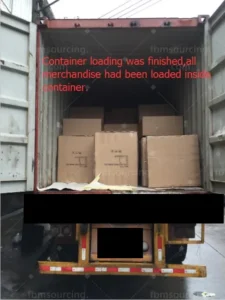
All inspection on FBM Sourcing packages is carried out by our own team at the factory before shipment, with photo and video records. On a clubhouse package the loading check is disproportionately important, because the order is multi-factory and the risk is not a defective chair but a missing carton of locker keys, trolleys or terrace fixings. Test reports and certificates from manufacturers’ laboratories or certification bodies are reviewed as documents in their own right, checked for the model covered, the test level and the expiry date.
Frequently Asked Questions
What should not be sourced from China for a golf clubhouse?
Commercial kitchen equipment is the main one — see commercial kitchen equipment manufacturers in China — because it carries destination gas, electrical and food-safety approvals and needs a local service route. Anything requiring local structural or fire engineering sign-off is the second. Everything else in the seven packages — lockers, banquet and terrace furniture, bag racking, retail joinery, flooring, lighting, sanitaryware — is routinely and successfully sourced from China when the specification is written properly.
What material should golf locker room lockers be?
Solid grade phenolic laminate is the durable answer for a wet golf locker room, with HPL on a moisture-resistant core as a mid-range option. Powder-coated steel is a false economy in a room that takes wet shoes and waterproofs daily. Specify through-ventilation, stainless hardware — 316 grade in coastal locations — and agree the keying schedule before production.
Which furniture test standards apply to a clubhouse?
For non-domestic seating, EN 16139 in Europe and the ANSI/BIFMA family in North America are the usual strength and durability references, with EN 1335 for office task chairs in the administration areas. Upholstery flammability is separate and destination-specific: California TB 117-2013 is commonly specified in the United States, BS 5852 in the United Kingdom, and in Australia the building certifier confirms the requirement under the NCC. Reports are issued per model, so check the model number on the certificate.
How many containers does a clubhouse fit-out take?
It depends entirely on scope, but a useful planning figure is that a 40 ft high-cube container gives roughly 68 m³ of usable packed volume, and a mid-sized clubhouse covering locker rooms, food and beverage, banqueting, pro shop and terrace typically runs to several containers rather than one. The more useful planning question is not how many containers but how many arrival windows the site can actually absorb.
How far ahead should a clubhouse order start?
Work backwards from the opening date through installation, shipping, production and — critically — sample approval and certification, which is usually the longest and least predictable stage. Items needing a destination-specific certificate should be identified and started first, because on a clubhouse the certificate, not the factory, is normally the critical path.
Sourcing this for a commercial project?
FBM Sourcing works with project owners, developers, main contractors and FF&E contractors on hotel, apartment, school, office and other commercial building projects. Send us your BOQ, drawings or product list — our team will review it and get back to you.
Get a China Procurement Quote for Your Project
FBM Sourcing has managed China procurement packages for commercial building projects since 2014, across more than 20 countries and over 1,000 containers. We manage the entire China procurement package on the buyer’s side: we take the clubhouse schedule package by package, run the technical exchange with manufacturers, check that certification actually covers the models specified, inspect with our own team and consolidate the shipment around the site’s arrival windows.
Send your clubhouse drawings, FF&E schedule or finishes list with the destination port and the opening date, and we will review them and come back to you. More on how a full package is put together: China building materials and FF&E procurement.