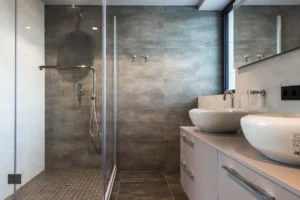
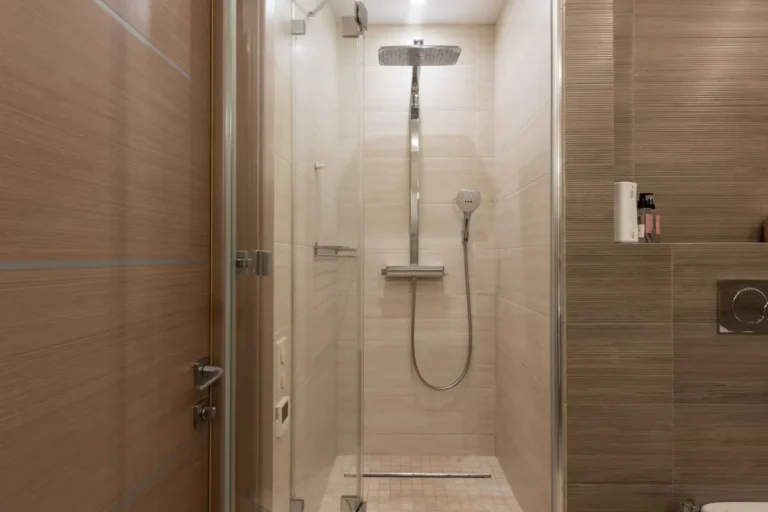
For hotel bathrooms, frameless shower enclosures are the right specification when the design brief calls for a clean glass line, the bathroom shell is built to tight tolerances (walls plumb within about 3 mm over the door height), and the operator accepts thicker glass, heavier hardware and more careful water management; framed and semi-frameless enclosures are the right specification when the project has hundreds of rooms on a fixed programme, wall and tray tolerances are looser, sliding doors are needed on tub-shower combinations, and the maintenance team wants a product that seals reliably with standard parts. Frameless uses 8–10 mm toughened glass with wall-mounted hinges and no perimeter frame; semi-frameless uses 6–8 mm glass with a slim frame on the fixed panels and a frameless door; fully framed uses 4–6 mm glass in an aluminium frame on all edges. On China-sourced hotel packages the decision usually comes down to three questions: how much tolerance is there in the finished bathroom, is the door hinged or sliding, and how many rooms have to be installed per day. That is the role FBM Sourcing plays as a sourcing agent and sourcing partner on projects like this.
What Is the Physical Difference Between Framed, Semi-Frameless and Frameless?
- Framed: aluminium extrusion on every edge of every panel; 4, 5 or 6 mm toughened glass; door usually sliding (bypass), bi-fold or hinged with a framed leaf; magnetic strip or PVC seals in the frame; adjustable wall jambs that absorb 10–20 mm of out-of-plumb per side. Weight per 1200×1900 sliding set roughly 25–35 kg.
- Semi-frameless: frame on the fixed panels and header (or a slim U-channel at wall and tray), frameless door leaf on pivot or hinges; 6–8 mm glass; polycarbonate sweeps and seals on the door edges. The most common hotel specification because it gives the frameless look on the door with framed adjustability on the panels.
- Frameless: no perimeter frame; 8 mm glass on fixed panels and sliding doors, 10 mm on hinged doors and large panels; solid brass or 304/316 stainless hinges, clamps and support bars mounted directly to the wall and glass; wall channels or point-fixed clamps for the fixed panels; clear polycarbonate seals only where water needs to be stopped. Weight of a single 2000×900 mm 10 mm door is about 45 kg; a wall-to-wall walk-in with a 1200 mm fixed panel and 800 mm door in 10 mm glass is 90–100 kg of glass on the wall.
The glass in all three should be thermally toughened safety glass certified to the destination’s standard — EN 12150 in Europe and the UK, ANSI Z97.1 and CPSC 16 CFR 1201 Category II in the United States, AS/NZS 2208 Grade A in Australia — and for frameless 10 mm doors we specify heat-soak testing to EN 14179 to reduce the risk of spontaneous nickel-sulphide breakage in service. The standards themselves are covered in glass safety standards EN 12150 and ANSI Z97.1.
Which Enclosure Type Suits Which Hotel Bathroom Layout?
The layout decides more than the design language does. On the room types that recur across hotel programmes:
| Bathroom layout | Usual specification | Reason |
|---|---|---|
| Tub-shower combination (economy and midscale) | Framed or semi-frameless sliding bypass, or a single frameless fixed bath screen | Sliding avoids door swing over the tub; a fixed screen is the cheapest frameless look |
| Walk-in shower with fixed panel (midscale and upscale) | Frameless fixed panel, 8–10 mm, with or without a return | No door, no seals, minimal hardware; water managed by tray size and shower head position |
| Corner or alcove shower with hinged door (upscale) | Frameless pivot or hinged door on 10 mm glass, semi-frameless where tolerances are unknown | Design-led; requires plumb walls and blocking for hinges |
| Accessible room (roll-in shower) | No threshold; frameless fixed panel or curtain per accessibility code | Clear turning space and no upstand; see accessibility guidance |
| Prefabricated bathroom pod | Whatever the pod maker installs and tests in the factory | Enclosure and tray are tested as a system before shipping |
For accessible rooms the enclosure is subordinate to the code: our note on ADA compliance for hotel FF&E and bathrooms covers the US requirements. Where the project is using pods, the enclosure choice moves upstream to the pod specification — see prefab bathroom pods vs site-built bathrooms.
How Much Tolerance Does Each Type Forgive on Site?
This is the question that decides most hotel packages, and it is the one factories are least likely to raise. A frameless enclosure is a piece of glass cut to a size; it does not adjust. If the wall is out of plumb by 8 mm over 2 m, a frameless door either binds or shows a tapering gap, and the fix is a site measure and a re-cut, which on a China order means a second shipment. A framed enclosure has wall jambs that slide 10–20 mm per side and a header that can be trimmed; a semi-frameless enclosure has that adjustment on the fixed panels and a small margin in the hinge on the door.
The rule we apply on hotel projects sourced from China:
- Frameless hinged doors: walls plumb within ±3 mm over the door height, tray level within 2 mm, and the enclosure ordered from site measurements per room or from a construction tolerance the contractor will sign for.
- Semi-frameless: walls within ±6 mm, tray within 3 mm; standard sizes can be ordered from drawings with a per-room check of the shell before shipping.
- Framed: walls within ±10 mm; ordered from drawings in standard sizes; the enclosure adjusts to the room.
Where the bathrooms are not built when the enclosures must be ordered — which is normal on a hotel programme — the choice is between specifying framed or semi-frameless in standard sizes with a tolerance the builder can meet, or ordering frameless in a small number of standard widths with 10–15 mm of design margin at the wall channel and accepting that some rooms will need site adjustment. On site measurement generally, see site measurement before custom production.
Sourcing this for a commercial project?
FBM Sourcing works with project owners, developers, main contractors and FF&E contractors on hotel, apartment, school, office and other commercial building projects. Send us your BOQ, drawings or product list — our team will review it and get back to you.
Water Management: Why Frameless Enclosures Leak More Often, and How to Prevent It
A frameless enclosure keeps water in by geometry, not by seals. Water that hits the door edge, the hinge gap or the base of the glass will find its way out unless the tray, the threshold and the shower head position have been designed for it. The failure pattern on hotel projects is predictable: a 10 mm frameless door on a small tray with the shower head opposite the door and a flat threshold, and housekeeping mopping the bathroom floor every morning. The preventive specification points are:
- Tray or wet-room former with an upstand or a recessed channel at the glass line, so the glass sits inside a lip rather than on a flat floor. Linear drains along the glass line are the cleanest solution on wet-room floors.
- Door swing and head position: the door should not be in the direct spray line; a fixed return panel of 200–300 mm next to a hinged door catches most of the splash.
- Seals in the right places only: a clear polycarbonate bottom sweep with a drip rail on the door, a bulb or fin seal on the hinge side, and a magnetic or fin seal where door meets fixed panel. Frameless does not mean sealless; it means no visible frame.
- Silicone at the wall channel and tray on the outside face only, so water inside drains back into the tray.
- Housekeeping instructions: squeegee and dry the glass; do not lean ladders or hoses on frameless doors; report a door that drops.
Framed enclosures manage water with the frame itself — the bottom rail collects and returns it and the jamb seals close the gaps — which is why they remain the default on tub-shower combinations and on economy programmes where nobody will be adjusting a door in room 314 at midnight.
Hardware, Finishes and Durability
On a frameless enclosure the hardware is the product. Specify solid brass or 304 stainless steel hinges and clamps (316 in coastal or high-chlorine environments), hinges rated for the actual door weight (a 10 mm 2000×900 door needs hinges rated at 45–50 kg per pair, and many standard hinges are rated at 35–40 kg), and a finish process the factory can document: PVD (physical vapour deposition) for brushed nickel, gunmetal, brushed brass and matte black gives markedly better wear and chemical resistance than electroplating or powder coating on hardware that is touched wet several times a day. Ask for the finish salt-spray result (ASTM B117 or ISO 9227, with the test hours set by the project specification) and for a cycle test on the door (the number of cycles matters less than that a test exists and the sample is the ordered configuration). Glass hardware sourcing generally is covered in glass hardware sourcing from China.
Framed and semi-frameless enclosures rely on the aluminium extrusion: 1.2–1.5 mm wall thickness, anodised (AA10–15 μm) or powder-coated to the destination’s exterior-grade standard, with rollers, seals and magnets available as spare parts for the life of the hotel — on a 300-room hotel, order a spares kit of rollers, sweeps and magnetic strips with the first shipment. Anti-lime (easy-clean) coating on the glass is worth specifying on all three types in hard-water areas; it is applied at the glass factory and adds days, not weeks, to the lead time.
Cost Structure, Lead Time and Container Planning
Buyers new to the category expect frameless to be an expensive door on the same tray; the reality is that the cost sits in three places — thicker glass (10 mm toughened, heat-soaked, with polished edges and drilled holes), hardware (a much larger share of a frameless enclosure’s ex-works value than of a framed one) and per-room customisation. Framed enclosures in standard sizes are the lowest ex-works cost and the fastest, and semi-frameless sits between the two. Lead times on hotel quantities from the Foshan and Zhongshan sanitary and glass clusters are confirmed by the factory in writing: framed and semi-frameless in standard sizes are usually quicker than frameless, which is made from confirmed sizes, plus the time to obtain site measurements or a signed tolerance. Where the enclosure ships as part of a full sanitary package, the sequencing and factory shortlist are in sanitary ware manufacturers in China for hotel and resort projects, and the product-level detail is on our shower enclosures sourcing page.
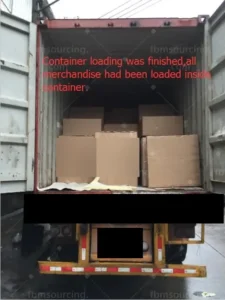
Enclosures ship in wooden crates or heavy honeycomb cartons with the glass edge-protected and the hardware boxed separately; a 40HQ carries roughly 200–260 complete sets depending on size and crating, and glass is dense enough that a mixed hotel container is often planned by weight rather than volume. We always ship by full container; where the enclosure quantity alone does not fill a box it is consolidated with the other bathroom and FF&E categories from the same project into one full container. Every set is labelled by room type and, for frameless, by room number where per-room sizes were used, so the installer receives them in sequence.
Framed vs Frameless: Decision Checklist for the Project Team
- Is the door hinged or sliding? Sliding tub-shower doors: framed or semi-frameless. Hinged walk-in: frameless or semi-frameless.
- Will the bathroom shell be finished and measurable before the order deadline? No: framed or semi-frameless in standard sizes, or frameless fixed panels with wall-channel margin. Yes: frameless from site measurements.
- What tolerance will the builder sign for? ±3 mm: any type. ±6 mm: semi-frameless. ±10 mm: framed.
- Coastal or high-chlorine site? Specify 316 stainless or PVD brass hardware whichever type is chosen.
- Housekeeping capability? Frameless needs squeegee discipline and periodic hinge checks; framed needs roller and seal replacement every few years.
- Accessible rooms? Follow the accessibility code first; the enclosure type is secondary.
How FBM Sourcing Handles Shower Enclosures on a Hotel Package
FBM Sourcing manages the entire China procurement package for overseas construction projects. On a hotel bathroom package the enclosure is specified together with the tray, the tiles, the drain and the shower fittings rather than as a stand-alone line, so the water management works as a system; the enclosure type is matched to the room layout and to the tolerance the builder will sign for, and the glass standard, heat-soak requirement, hardware material, finish process and test evidence are written into the purchase order. Our own team checks glass thickness and edge work, hardware material and finish, seals, packing and room-type labelling on the production units before shipment, with photo and video records delivered before shipment.
All quotations, invoices and shipping documents are issued by FBM Sourcing — you deal with us, and we carry the responsibility. For suppliers you nominate, we charge a 5% commission; for products we source for you, we quote a direct price. As a building material sourcing agent for the whole bathroom and FF&E package, we also carry the enclosure decision through to the sanitary ware, tiles, mirrors, vanities and accessories that share the same wall.
Related reading: which shower enclosure manufacturers in China a project buyer can actually verify.
Get a China Procurement Quote for Your Project
If you are specifying shower enclosures for a hotel, serviced apartment, student accommodation or resort project and want them sourced and inspected in China as part of the full bathroom package, send us the room-type drawings, the number of rooms per type, the tolerance the builder will work to, the destination port and the required-on-site dates. Our team will review the package and set out a quotation.
Use the quote button above or WhatsApp +86 135 6007 5057 to start the conversation.