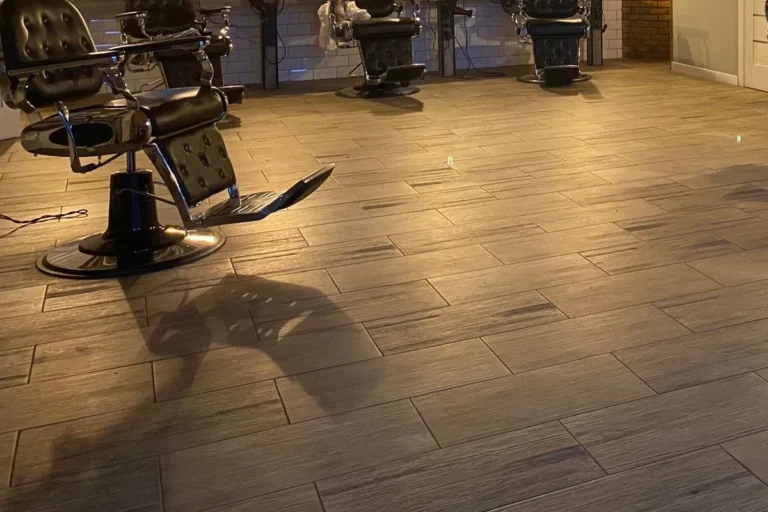
A salon or barbershop chain should standardise every product a client sits in, leans back into or looks into, and every surface that meets hair colour — the chair models with their pumps, bases and upholstery codes, the shampoo unit and its fittings, the styling station and lit mirror, the reception and retail joinery, and the finish codes for tops, floors and walls — while letting only the count and the layout change between store types. The items most worth settling once, centrally, are the ones that fail quietly after opening: upholstery that stains from colour and developer, shampoo fittings the local plumbing certifier will not accept, and lit mirrors with no electrical approval for the destination market.
This guide is for salon and barbershop chain operators and franchise systems opening new stores as commercial project owners, and for the interior design and construction companies and general contractors who build those store interiors.
What Goes into a Salon or Barbershop Store Kit?
Most formats break down into seven product groups made by different kinds of factories — which matters when all of them have to reach the same store in the same week.
| Product group | Typical contents | Usually made by |
|---|---|---|
| Styling chairs | Hydraulic chairs, bases, footrests, booster seats | Salon furniture factories |
| Barber chairs | Reclining chairs with headrests and footplates | Salon furniture factories |
| Shampoo units | Backwash basin and chair units, shampoo beds | Salon furniture factories, with basins and fittings from sanitary ware suppliers |
| Stations and mirrors | Wall and island stations, lit mirrors, tool holders | Joinery factories, mirror and lighting makers |
| Reception and retail | Counter, retail shelving, display units, waiting seating | Panel joinery and shopfitting factories |
| Colour bar and back of house | Mixing counter, trolleys, towel storage, lockers | Joinery and metal furniture factories |
| Finishes | Floor and wall tile or vinyl, wall panels, worktops | Tile, vinyl, laminate and stone factories |
Chairs and shampoo units carry the client experience, finishes carry the maintenance bill, and lit mirrors carry the compliance risk because they plug into the wall.
Which Items Should Be Identical Everywhere, and Which Can Change by Store Type?
Fix the product; let the configuration vary. Many chains run a full-service salon, a compact salon in a mall or transport hub, and sometimes a barber-only format, each drawing a different mix from one catalogue of approved products.
| Decision level | What it covers | Who can change it |
|---|---|---|
| Fixed at model level | Chair model, pump and base; upholstery material and colour code; shampoo basin and fitting set; mirror size, light colour temperature and driver; laminate, tile and worktop codes; hardware | Head office, by formal change to the kit |
| Configured per store type | Number of chairs and shampoo units; wall or island stations; retail wall length in modules; counter length | The store-type definition |
| Adapted per site | Floor plan, shampoo row against the drainage run, socket and data positions | Local design and construction team |
| Kept local | Water heaters, drainage and interceptors, electrical installation, air conditioning | Local contractor under local permits |
Franchise systems gain most from strictness at the first level, because that is where brand consistency and common spare parts are won or lost.
What Should a Styling or Barber Chair Specification Fix?
Many chair models look alike in a catalogue photograph, so the specification should name what a photograph does not show.
- Hydraulic pump. Lift range, rated user load and the cycle testing run on that pump. Fix the pump model at approval; a pump change is the most common silent substitution on a reorder.
- Base. Shape, diameter, weight and finish. Chrome plating can mark where water and chemical residue sit, while powder coat and stainless steel age differently.
- Recline, lock and headrest. Barber chairs need a positive rotation lock, a recline that holds under a client’s weight and an adjustable headrest; styling chairs usually need rotation and height only.
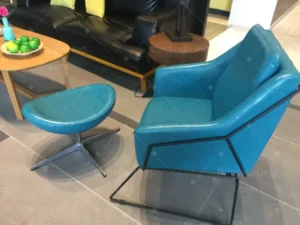
- Upholstery. PVC or PU coated fabric, colour code, backing, foam and seam construction. Seams and piping are where colour and water get in first.
- Powered models. An electric barber chair or shampoo bed is electrical equipment and needs the same destination approval as a lit mirror.
Colour, developer, bleach and sanitiser reach chair arms and backs every day, and PVC and PU react differently to them — see our note on fabric or vinyl upholstery for commercial seating. Apply the chain’s own products to swatches cut from the production roll, leave them for set contact times, clean them with the salon’s routine and photograph the result. Approve the upholstery on that evidence, not on the swatch card.
Shampoo Units: Why Does the Plumbing Side Drive the Specification?
A shampoo unit looks like furniture but connects to the supply and the drain, so the basin, mixer, hand spray, hoses and waste outlet can each sit under a different local rule. The furniture side covers basin material (vitreous china is hard-wearing but can chip; acrylic and composite basins are lighter but can scratch), the neck cut-out and tilt, the recline and leg rest, and hose length. The plumbing side is about acceptance.
Australia
On the Australian Building Codes Board’s WaterMark Schedule of Excluded Products (version 2026-1), a basin is excluded from WaterMark certification with AS/NZS 1172.4 listed as evidence of suitability, but waste outlets require certification, and where an excluded product includes integral components listed on the Schedule of Products, each component must be individually certified. The Schedule of Products lists tapware to AS 3718, with hand sprays among its tap types, and flexible hose assemblies to AS 3499. Tapware carries the lead free requirement, subject to listed exceptions: from 1 May 2026 manufacturers may only produce lead free WaterMark certified plumbing products, and existing products with a current WaterMark licence may be installed until 30 April 2028. Settle how a complete backwash unit will be treated with the certifying plumber before sampling.
United States, England and Wales
Where the Uniform Plumbing Code applies, pipe, fittings, traps, fixtures and devices in a plumbing system must be listed or labeled (third-party certified) by a listing agency, and ASME A112.18.1/CSA B125.1 is the North American standard for plumbing supply fittings. New Jersey’s plumbing subcode, for example, requires shampoo sinks in barbershops, beauty parlors and other grooming facilities to have hair interceptors installed in lieu of regular traps, so the basin waste has to suit the interceptor. In England and Wales, the Water Supply (Water Fittings) Regulations 1999 require water fittings to be of an appropriate quality and standard and suitable for the circumstances in which they are used. Approval routes are compared in our guide to sanitary ware certifications by destination market.
Most chains either import complete units with destination-certified fittings, or import basin and chair and fit locally certified tapware, hoses and waste on site. What fails is finding out at the first opening that the hand spray is not acceptable.
Standardising a salon or barbershop store kit for several new openings?
Send us the store kit schedule or drawings for one store type. We will review the chairs, shampoo units, mirrors and finishes and match each product group to the right factories.
Styling Stations and Lit Mirrors: Does the Approval Cover the Model That Ships?
A lit mirror, or a station with built-in sockets, is electrical equipment, and the approval has to belong to the finished product in the model and size being shipped, for the destination voltage and plug. A certificate for an LED strip or driver alone does not approve the mirror.
- United States. OSHA’s workplace electrical rules make equipment acceptable only if approved, and the first route the definition names is listing or labeling by a Nationally Recognized Testing Laboratory. A salon with staff is a workplace.
- European Union. The Low Voltage Directive 2014/35/EU covers electrical equipment rated between 50 and 1,000 V AC.
- Australia and New Zealand. Scope under the Electrical Equipment Safety System turns on voltage and on equipment being designed or marketed as suitable for household, personal or similar use, and it is immaterial whether it is also marketed for commercial purposes. In-scope equipment must not be sold unless marked with the RCM.
Mirror lighting is also a colour tool, because stylists judge tone under it. Fix colour temperature and colour rendering in the kit, and take each opening wave’s mirrors from one production batch so neighbouring stations show a client the same shade. Voltage and plug questions are covered in our guide to voltage and electrical standards for lighting and appliances from China.
Which Finishes and Worktops Stand Up to Hair Colour?
Most salon finish failures are staining, not wear. EN 12720 sets out a method for assessing the resistance of rigid furniture surfaces to cold liquids (it does not apply to leather or textile surfaces), and for ceramic tiles ISO 10545-14 covers resistance to stains and ISO 10545-13 chemical resistance. Those reports are a starting point; approval should rest on a test with the chain’s own products.
| Surface | Common options | Test with the chain’s own products |
|---|---|---|
| Colour bar and station worktops | HPL, compact laminate, solid surface, engineered stone | Colour, developer and bleach for set contact times, then the normal clean |
| Floors around chairs and colour bar | Porcelain tile, homogeneous vinyl, resin flooring | Staining on the production batch; grout colour and type; how cut hair sweeps off the texture |
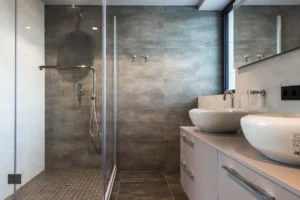
| Walls behind shampoo units | Porcelain tile, HPL panels | Splash staining; water at joints and edges |
| Reception counter and retail shelving | HPL, engineered stone, laminated panels | Scratching, hot drinks and daily cleaning; shelf adjustment for new bottle heights |
| Chair bases and metalwork | Chrome plating, powder coat, stainless steel | Marking after repeated cleaning with the chain’s disinfectant |
Light grout beside the colour bar stains quickly, so grout colour belongs in the kit, not in the installer’s choice. For counters, the engineered stone or solid surface decision is compared in our note on quartz and solid surface countertops.
How Does the First Salon Lock the Kit?
Treat the first opening, or a full-size mock-up of one chair, one shampoo position and one retail bay, as the reference salon. A week of real appointments shows what drawings miss:
- Chair spacing against the swing of a cape and the path of a trolley.
- Neck comfort at the basin for tall and short clients, and hand spray hose reach.
- Whether colour looks the same under the mirror lighting as it does at the door.
- Socket and holster positions against where stylists actually put a dryer down.
- Floors, grout and worktops after a week of colour services, and whether shampoo drains stay clear.
Then record each product by model, code and approved sample, and keep one approved sample set at the factory and one at head office for checking reorders. The route to an approved sample is described in our guide to the sample approval process.
How Should Supply Work When Several Salons Open Close Together?
- Buy batch-sensitive materials per wave. Upholstery, laminate and tile vary between production batches, so buy each wave’s quantity in one batch.
- Plan by lead time. Chairs, mirrors and joinery run on different production calendars, and the slowest group sets the wave’s ship date.
- Pack for weight and glass. Mirrors and china basins need crating or reinforced cartons, chair bases must not move against upholstery, and cartons marked by store let each contractor receive a complete set.
- Ship spares with the first wave. Pumps, upholstery covers, headrests, mirror drivers, and worktop and tile from the same batch.
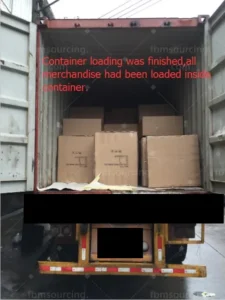
Sometimes, on a large project, the salon fixtures alone fill full containers; sometimes the salon fixtures share containers with the other product categories of the same project; and sometimes, in one batch, we combine a dozen or more product categories from several projects of the same client into a few containers — always full containers, and for us this is routine, well-practised work. Our note on how to consolidate goods from multiple factories into one container explains how the goods come together before loading.
What FBM Sourcing Does on a Salon Store Kit
As a sourcing partner in China, FBM Sourcing matches each product group in a chain’s store kit to factories that make it as their core product, tests samples against the chain’s own colour and chemical routine, and checks each electrical and plumbing certificate against the model being ordered. Inspection by our own team at the factory before shipment, with photo and video records, covers pump operation, upholstery colour against the approved sample, basin surfaces, a light-up test on each mirror model and the match between product labels and certificates.
Standardising a salon or barbershop store kit for several new openings?
Send us the store kit schedule or drawings for one store type. We will review the chairs, shampoo units, mirrors and finishes and match each product group to the right factories.
Frequently Asked Questions
What should a salon chain standardise when sourcing salon furniture from China?
The product models and finish codes: the chair model with its pump, base and upholstery code; the shampoo unit with its fitting set; the station and lit mirror, including light colour temperature; the reception and retail joinery; and worktop, floor and wall finish codes. Store types should differ only in counts and configuration.
Do salon shampoo basins imported into Australia need WaterMark certification?
Under the WaterMark Schedule of Excluded Products (2026-1), a basin is excluded from certification with AS/NZS 1172.4 listed as evidence of suitability, but waste outlets require certification, and integral components on the Schedule of Products, such as tapware including hand sprays and flexible hose assemblies, must be individually certified. Confirm how a complete backwash unit will be treated with the certifying plumber before sampling.
Does an LED salon mirror need electrical certification?
Yes, for the destination market and the specific model. In the United States, OSHA requires workplace electrical equipment to be approved, for example through listing or labeling by a Nationally Recognized Testing Laboratory; in the European Union it falls under the Low Voltage Directive; in Australia and New Zealand in-scope equipment must be marked with the RCM.
How do you test salon upholstery and worktops against hair colour staining?
Apply the chain’s own colour, developer, bleach and disinfectant to samples cut from production materials, leave them for set contact times, clean them with the salon’s routine and photograph the result. Reports to EN 12720 or ISO 10545-14 are useful starting evidence, but only the salon test shows how a material behaves with the chain’s own products.
Should a franchise system let franchisees choose their own chairs and mirrors?
Only within two or three pre-approved options inside the store kit. Open choice leads to mixed pump types, upholstery that does not match under salon lighting and no common spare parts, while a short approved list lets each option be sampled, tested and certified once.
About FBM Sourcing
FBM Sourcing manages the entire China procurement package for overseas construction projects. Since 2014 we have worked with developers, general contractors, builders, commercial project owners, interior design and construction companies and FF&E solution providers across more than 20 countries and over 1,000 containers, as their sourcing partner in China — from the schedule or BOQ through factory selection, sampling, inspection by our own team before shipment, consolidation and shipping. All quotations, invoices and shipping documents are issued by FBM Sourcing, and sea freight is quoted to you before shipment. If you have a salon and barbershop store kit package to price, start at China building materials and FF&E procurement.