Extended-stay hotel FF&E procurement is the process of specifying, manufacturing and shipping a complete room package in which every key includes a kitchenette — so the scope spans furniture, fixtures and equipment plus building materials such as kitchen cabinets, countertops, sinks, tapware and backsplash tile, consolidated from multiple specialist Chinese factories into shared containers. A 120-key extended-stay property commonly ships in 10–14 containers with kitchen packages included, and production plus transit typically runs 90–120 days door-to-door. The workflow runs from brand-standard spec review through room-type mock-up approval, mass production, pre-shipment inspection and phased delivery to site. This is the kind of scope a sourcing partner such as FBM Sourcing takes on.
For developers and general contractors, the practical sequence looks like this:
- Spec extraction and brand-standard review — the FF&E schedule, kitchenette drawings and finish schedule are checked against the applicable extended-stay brand standards before anything is quoted.
- RFQ to specialist factories — casegoods, upholstery, kitchen cabinets, stone countertops, sanitary ware and appliance coordination are quoted separately by the factories that actually make each category.
- Room-type mock-up approval — one complete sample room per room type, including the kitchenette, is built and approved before mass production starts.
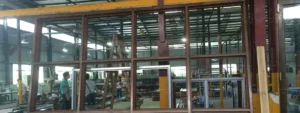
- Production and quality control — FBM Sourcing’s own team inspects on the factory floor, with a full pre-shipment inspection and photo/video records delivered before shipment.
- Container consolidation and phased shipping — kitchenette packages and furniture are loaded into shared containers, sequenced floor by floor where the site cannot receive everything at once.
What Makes Extended-Stay FF&E Different from a Standard Hotel Package?
A select-service hotel room package is essentially furniture plus soft goods. An extended-stay room is closer to a small apartment built to hotel brand standards: guests stay 7 to 30-plus nights, cook their own meals, and receive weekly rather than daily housekeeping. That changes both what you buy and how it has to be built.
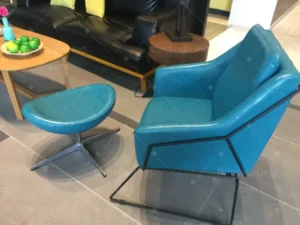
The casegoods count per key is materially higher. A typical extended-stay studio carries a full-size wardrobe, a dining table with seating, a dedicated work desk, a larger sofa or sleeper, bed and headboard, nightstands and media unit — commonly 12–15 casegood and seating pieces per key against 8–10 in a comparable select-service room. On top of that sits the kitchenette: cabinets, countertop, sink, tapware, backsplash and coordinated appliances.
Durability requirements also shift. With weekly housekeeping, spills sit longer and surfaces take more sustained use, so extended-stay specs lean harder on wipeable vinyl and performance fabrics, sealed or high-pressure-laminate work surfaces, and foam that meets CAL 117-2013 flammability requirements. This is a different specification problem from a design-led independent property — if that is your project type, our guide to boutique hotel FF&E procurement from China covers the custom-design route in detail.
The Kitchenette Package: Where Hotel FF&E Meets Building Materials
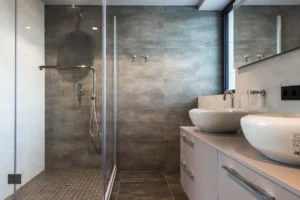
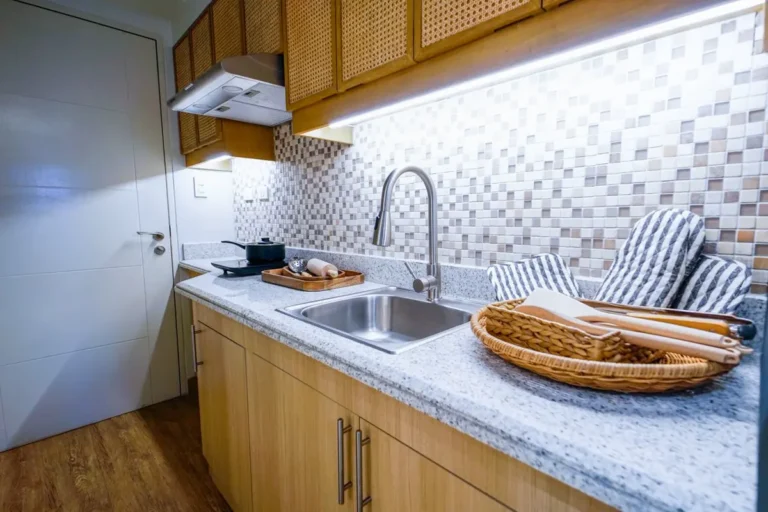
The kitchenette is what makes extended-stay procurement genuinely different in mechanics, not just in quantity. No single factory produces it. In China, kitchen cabinets come from a cabinet factory, quartz or stone countertops from a stone factory, sinks and tapware from sanitary ware factories, backsplash tile from a tile factory, and appliances from appliance vendors — four or five specialist suppliers behind one line item on your FF&E budget.
A competent china sourcing agent turns that into one kitchenette package: one spec set, one production schedule, one consolidated quality check, and shared containers instead of five part-loaded shipments. Typical construction for a hotel-grade kitchenette is an 18 mm plywood or E1 melamine-faced board carcass with a 20 mm engineered quartz countertop — and the cabinet construction decision itself (face-frame versus European frameless) affects both cost and installation, which we break down in our comparison of framed vs frameless kitchen cabinets for projects.
Appliance coordination matters more than most owners expect. Cutout dimensions for the under-counter fridge, microwave or cooktop must be frozen before cabinet production starts, and voltage, plug type and certification (UL for the US, SAA for Australia, CE/UKCA for the UK and Europe, SASO for Saudi Arabia) must match the destination market. Getting an appliance cutout wrong across 120 keys is a rework problem measured in weeks, not days — which is exactly why the kitchenette package is engineered as one unit rather than five purchase orders.
Durability Specs Built Around 7–30 Night Stays
Extended-stay wear patterns are harsher than the nightly-turnover model. The same guest uses the same sofa, desk chair and dining chairs every day for weeks, and housekeeping intervenes far less often. Specifications should reflect that reality rather than defaulting to standard hospitality grades.
On upholstery, extended-stay programs typically specify performance fabric or contract vinyl rated at 50,000–100,000 double rubs on the Wyzenbeek test, well above the 30,000 double-rub threshold generally used for heavy-duty contract upholstery. Seating foam should meet CAL 117-2013; task and dining seating for US projects is commonly specified to ANSI/BIFMA X5.1 durability and stability testing. Worktops and dining surfaces favour high-pressure laminate or quartz over veneer, and drawer runners and hinges should be specified by cycle rating, since a wardrobe in an extended-stay room is opened daily for a month, not twice per stay.
Casegoods construction deserves the same scrutiny. Extended-stay wardrobes, desks and media units take daily use for weeks at a time, so specify 2 mm PVC edgebanding on high-wear edges rather than the 0.4–0.8 mm tape common on residential product, moisture-resistant board for any carcass panel adjacent to the kitchenette sink run, and mechanical fixings that survive repeated knock-down and reassembly if the property plans future refresh cycles. Finishes should be specified by test, not by adjective: scratch and stain resistance on worktops, and a wear-rated lacquer or laminate on horizontal surfaces.
These are exactly the points a factory will quietly value-engineer if nobody is checking. Locking the durability spec into the mock-up approval and purchase contract — and then verifying it on the factory floor — is where a sourcing agent earns its fee on this asset class.
Sourcing this for a commercial project?
FBM Sourcing works with project owners, developers, main contractors and FF&E contractors on hotel, apartment, school, office and other commercial building projects. Send us your BOQ, drawings or product list — our team will review it and get back to you.
How Do Mock-Up Rooms and Brand-Standard Compliance Work?
Every serious extended-stay program should run a room-type mock-up before mass production. The factories build one complete room set per room type — studio, one-bedroom, accessible room — including the assembled kitchenette with countertop and appliances installed. The owner, operator and designer review it against the drawings and the brand’s design and construction standards, corrections are logged, and only the approved version is released to mass production.
Mock-up production commonly takes 30–45 days from approved shop drawings, and it is the cheapest quality control you will ever buy: correcting a drawer dimension or a countertop overhang on one sample room costs almost nothing, while correcting it across 10–14 containers of finished goods is a project-schedule event. Where a franchise brand is involved, the spec compliance review happens here too — finishes, fire ratings, appliance schedules and accessibility details are checked line by line against the applicable extended-stay brand standards. How Chinese factories handle that documentation burden is covered in our article on Chinese factories and hotel brand standards for FF&E.
For the wider picture of how a full FF&E procurement China package is structured — who holds the specification, how categories are grouped across factories, and where the sequencing risk sits — our main guide covers the whole process end to end.
During mass production, inspections are carried out by FBM Sourcing’s own team on the factory floor, with a full pre-shipment inspection and photo/video records delivered before shipment — across every factory contributing to the package, not just the headline furniture plant. How the same stages fall on a calendar, from design sign-off to container arrival, is set out in the hotel project procurement timeline for China sourcing.
Containers, Timelines and Phased Floor-by-Floor Delivery
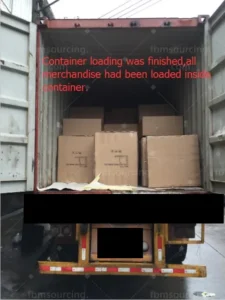
Because the kitchenette package adds cabinets, stone and appliances to an already furniture-heavy room, extended-stay properties ship more volume per key than any other select-service product. A 120-key extended-stay property commonly ships in 10–14 forty-foot high-cube containers — each holding roughly 68 usable CBM — with kitchen packages consolidated alongside casegoods and seating rather than shipped separately.
Plan on roughly 6–8 CBM per key once the kitchenette is included, against 4–5 CBM for a comparable select-service room. Load planning matters as much as the total: casegoods ship assembled or semi-assembled for hotel programs, cabinets ship as flat-packed carcasses with doors and stone crated separately, and appliances travel boxed on the floor of the container with furniture stacked above. A well-planned load sheet sequences each container to a floor or a block of rooms, so the site team opens doors to complete room sets instead of sorting twelve containers of mixed categories on a live construction site. Extended-stay room counts make the case for treating the whole scope as a single ff&e procurement china package rather than a series of category orders placed months apart.
On timing, production plus ocean transit commonly runs 90–120 days door-to-door as a typical planning range, not a promise: roughly 45–60 days of coordinated production across the specialist factories after mock-up approval, followed by consolidation and sailing — around 15–20 days to the US West Coast, 28–35 days to the US East Coast or the Caribbean, and 20–28 days to the Middle East. Projects targeting a Q1 opening should also plan around the Chinese New Year factory shutdown, which removes most of a production month.
Few extended-stay sites can receive 14 containers in one week. The standard solution is phased delivery: production completes, and containers are released floor by floor as the site becomes ready, with the balance held at origin. How to structure that — and what factories will and will not agree to — is detailed in our guide to factory hold-stock and staggered delivery from China.
Extended-Stay Hotels vs Serviced Apartments: Not the Same Procurement
The two segments look similar — both have kitchens, both host long stays — but they are different procurement problems. An extended-stay hotel is a franchise-brand hotel product: standardized room types, brand-standard compliance, hotel-grade contract durability, and typically 100–140 keys per property. A serviced apartment or aparthotel is usually operator-leased residential-style stock, specified more like a furnished apartment building; we cover that model separately in our guide to serviced apartment and aparthotel FF&E procurement.
| Factor | Extended-stay hotel | Serviced apartment / aparthotel |
|---|---|---|
| Product type | Franchise-brand hotel; brand standards govern the spec | Operator-leased residential-style units |
| Room mix | Standardized studios and one-bedrooms, typically 28–40 m² | Full apartment layouts, often 40–80 m² with separate kitchens |
| Kitchen scope | Compact kitchenette package per key | Full residential kitchen, often part of the base build |
| Durability basis | Contract hospitality grades (CAL 117, ANSI/BIFMA, high double-rub upholstery) | Residential-plus grades chosen by the operator |
| Approval route | Brand-standard compliance review + mock-up sign-off | Operator and designer sign-off only |
The practical consequence: an extended-stay package must survive a brand inspection, while a serviced-apartment package must survive a lease term. Specify accordingly, and do not let a factory quote residential-grade product against a hotel-brand spec.
Get a China Procurement Quote for Your Project
FBM Sourcing manages the entire China procurement package for overseas construction projects. For an extended-stay program, that means one accountable team across the casegoods, upholstery, kitchenette package, stone, sanitary ware and appliance coordination — working as your building material and FF&E sourcing agent in China on an a 5% commission for suppliers you nominate (products we source for you are quoted at a direct price), from spec review through mock-up, production, consolidation and phased delivery.
To get a quotation started, send your room-type drawings, FF&E schedule or BOQ, kitchenette elevations if you have them, key count and room mix, destination port and target opening date. Our team will review the package against your brand standards and come back with a consolidated, like-for-like proposal for the full scope.