
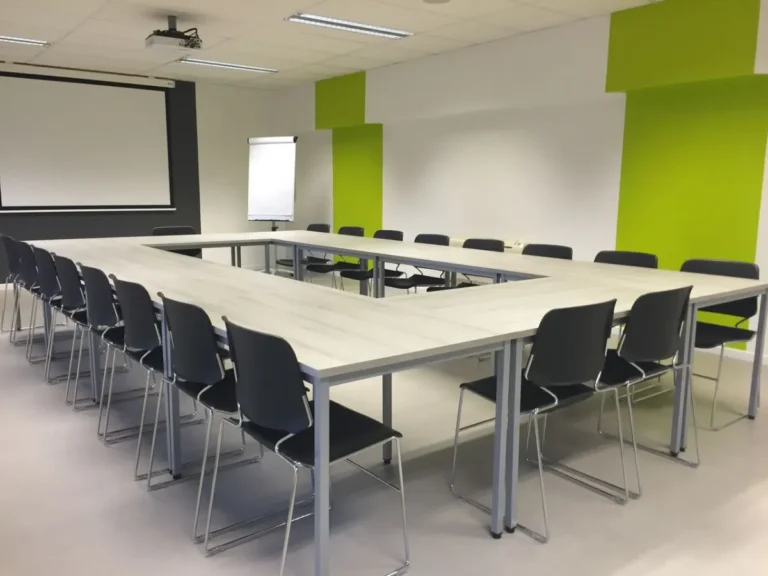
EN 15372:2023 non-domestic tables requirements should be read against the standard’s stated scope and the project specification. Buyers need to identify the exact table configuration and ask the responsible reviewer which evidence is required.
This guide summarises the published scope, not the full test clauses. It does not claim that EN 15372 applies to every table, is legally mandatory in every market, or proves suitability for a particular project. The designer, specifier or compliance professional should determine applicability and the required evidence.
How does EN 15372:2023 apply to non-domestic tables?
BSI’s BS EN 15372:2023 product page describes requirements for safety, strength and durability for non-domestic tables, including tables with glass in their construction. The distinction “non-domestic” matters: buyers should describe where and how the table will be used, not rely only on a product label such as restaurant table or contract table.
The product page is a scope description. It is not the full standard text, and it does not by itself identify which test, load, user category or acceptance criterion applies to a project. Do not invent a test level or attribute a particular pass result to an unverified table. Where a project requires a report, request the complete evidence relevant to the actual model and construction.
BSI lists BS EN 15372:2023 as current. Because standards and project specifications may be revised, confirm the requested edition and any destination-specific use before placing an order. An edition name in an old quotation is not enough to prove that it is the edition required by the current project documents.
How should the project team describe the table?
Identify the table by item code, setting, dimensions, shape, top construction, base, edge, finish and intended use. Distinguish dining tables from meeting tables, occasional tables and fixed counters when their use or construction differs. If one family appears in multiple rooms, record any variation in size, top material, base or fixing.
For a glass-top design, identify the proposed glass construction and how it is supported, retained and edged. The standard’s published scope includes tables with glass, but this statement does not establish a particular glass thickness, safety treatment or approved configuration. The supplier should identify the offered construction; the project professional should set and review the required specification.
For a table with an unusual base, pedestal, extension mechanism or integrated component, ask for a drawing of the assembled product. A brochure image may not show the connection, stability arrangement or moving parts relevant to the project’s review. Keep the quotation, drawing, material references and any test documents tied to the same revision.
Sourcing this for a commercial project?
FBM Sourcing manages the entire China procurement package for overseas construction projects. We work with Developers · General Contractors · Builders · Commercial Project Owners · Interior Design & Construction Companies · FF&E Solution Providers. Send your BOQ, drawings or product schedule for review.
What evidence should accompany a quotation?
Ask for a product drawing, bill of materials or construction description, finish references and any test report or declaration specifically requested by the project team. A report should identify the tested model or representative construction and its test scope. If a proposed model differs in materials, dimensions or assembly from the documented one, ask the responsible reviewer whether the existing evidence remains relevant.
Separate product evidence from installation design. The table supplier may describe the furniture, while the project team decides the final layout, circulation and interfaces with floors, walls and adjacent equipment. A standard addressing table requirements does not replace local review of a room layout or determine every building-code question.
For furniture procurement planning, see our FF&E schedule guide and BOQ guide. Use the shop drawing resource to keep product revisions connected. For broader contract furniture support, see FBM Furniture.
Use EN 15372:2023 non-domestic tables as a defined scope reference
For an RFQ, cite the exact edition and make clear whether the project is asking for a declaration, test report, technical schedule or another form of evidence. Ask the supplier to identify the table model and variant covered, along with construction details that matter to the project. The project reviewer can then compare the document scope with the actual quotation rather than relying on a general catalogue statement.
Build a table-by-table evidence matrix
Where a package contains different table families, assign each a product code and record size, top material, support, fixing and intended location. Map each item to the requested criterion and document received. A single report may cover one configuration but not every size or finish. Keep the applicability decision with the reviewer and flag unverified variants rather than assuming family-level coverage.
Keep material substitutions under review
If the quoted top, understructure, fixing detail or model changes after the evidence is reviewed, treat it as a revision. Ask whether the submitted report still covers the changed configuration and request updated documents if necessary. Link the decision to the revised schedule and drawing so the approval history remains clear through ordering.
Coordinate procurement records with the project specification
Use the same identifier across the specification, schedule, quotation, sample register and evidence folder. Record the edition of the standard, the reviewer, review date and any limitation stated in the report. This does not make the procurement record a certification; it makes the basis of review visible to the project team and easier to revisit if the design changes.
What the standard scope does not establish
A standards reference should be read alongside the actual project requirement. A scope statement tells the reader the general subject covered by a document, while the full text contains the detailed requirements and methods. It does not establish that a particular design, dimension, finish or installation is appropriate for every user or environment. The project’s specification should state which criteria matter and identify the party responsible for reviewing the evidence.
BSI’s scope summary says EN 15372:2023 does not include electrical safety or resistance to ageing and degradation. It also identifies categories outside scope. If a table includes power components, is intended for an excluded setting or has a special use requirement, list that need separately. Ask the appropriate project specialist to define the additional review rather than extending the standard’s title to cover requirements it does not state.
Check test evidence against the quoted construction
When a supplier submits a report, compare its product identity with the quotation line. Check the model, top, support, fixing, relevant dimensions and any stated variant coverage. If the report covers a different configuration, ask the supplier to explain the relationship and provide supporting documentation for review. Do not infer equivalence from a similar appearance or shared product-family name.
Record document title, issuing organization, edition or method, date, product code and stated scope. Keep any exclusions and conditions visible. A buyer’s evidence register can track receipt and review status, but it is not itself proof of compliance. The responsible specifier or compliance reviewer must decide whether the submitted information is adequate for the project requirement.
Sourcing this for a commercial project?
FBM Sourcing manages the entire China procurement package for overseas construction projects. We work with Developers · General Contractors · Builders · Commercial Project Owners · Interior Design & Construction Companies · FF&E Solution Providers. Send your BOQ, drawings or product schedule for review.
Ask focused questions about glass and storage features
The BSI scope includes non-domestic tables with glass in their construction, but that wording does not identify every glass type or table design as approved. Ask which glass construction is offered, how the top is supported or fixed, and which evidence applies to that assembly. Route material and safety questions to the project’s qualified reviewer and preserve the exact product reference being reviewed.
If a table includes shelves or other storage, note that the BSI scope summary says the document does not assess the suitability of storage features except in relation to stability tests. State any storage requirement separately, including the intended configuration and project criteria. Request product information for the actual feature and avoid treating the table standard as a complete assessment of every accessory.
Manage editions and revisions through procurement
Put the cited edition in the specification, RFQ and evidence matrix. If the project specification names a different edition or another document, ask the specifier to resolve the reference before quotations are compared. Keep a record of who confirmed the applicable version and when. This prevents a bidder from answering against a different edition without making the deviation visible.
When the furniture model or construction changes after review, reopen the affected evidence line. The project should decide whether the existing report remains relevant. Record the revised product code, changed detail, reviewer and decision. This is especially useful when one table family is offered in multiple dimensions or top materials, because the procurement team can see exactly which variant has been accepted.
Use a clear approval gate before purchase
Before order release, reconcile the latest table schedule, approved drawing, finish selection, quotation and evidence status. Separate technical acceptance from commercial confirmation. Mark each outstanding deviation with an owner and decision date rather than burying it in email. If the project requires a sample, connect it to the approved product code and specify whether the sample confirms only appearance or another defined aspect.
For a multi-location project, list the table configurations by site and keep location-specific differences explicit. Do not assume that a report or approval for one location automatically covers every other table in the package. A consistent identifier and revision history make the project team’s review traceable from the first quotation through delivery.
Questions project teams ask about EN 15372
Does EN 15372:2023 cover domestic tables?
BSI describes the scope as non-domestic tables. The project team should use the applicable standard for the table’s actual intended use.
Does it include glass tables?
BSI’s scope description says it includes non-domestic tables with glass in their construction. The exact glass assembly and evidence still need to be identified.
Does an EN 15372 report prove that a table is suitable for every project?
No. Confirm the tested model, report scope, project specification and destination requirements with the responsible reviewer.
Is the standard automatically mandatory in every country?
This article makes no such claim. Applicability depends on the destination, project specification and the requirements determined by the responsible project professionals.
What should a buyer send when requesting a quote?
Send the table schedule, drawings, quantities, finishes, intended use, project location and any applicable evidence requirement identified by the designer.
FBM Sourcing manages the entire China procurement package for overseas construction projects. For suppliers you nominate, we charge a 5% commission; for products we source for you, we quote a direct price. Our own team performs one inspection after bulk production is complete and before shipment, and your project team is welcome to attend.





